Thrill me. Terrorise me. I am all in. Witty, propulsive, and layered with deadpan elder wisdom—that’s how Oburu Oginga rolls these days. Nothing moves him even with the tension ratcheting up within the Orange Democratic Movement (ODM), the party he now leads. He looks at storms and laughs them off, as if he wishes only to learn in what new shape disaster will unfold itself. And laugh it off again.
Before he found his mojo, he looked lost, throwing a lonely line here and there, and an occasional sad one, too. And then something changed. Today, he can say one sentence, and it goes viral. A few weeks ago, he spoke some words casually, in Swahili textured with a faint hint of a Luo drawl that lengthens vowels and softens consonants with age: “Hatuwezi kuwa bila pawaaaa (we cannot stay without power).” The sentence went viral. And he seems to enjoy it as campaign rallies that never seem to end, bleed into each other into one long colourful cascade.
Of late, he has become a hilariously ungovernable character—richly comic, theatrical, delivering punchline after punchline. He has his own unique style: the wide‑brimmed hat tilted with the easy authority of a grandfather, and the orange jacket worn the way only elders do.
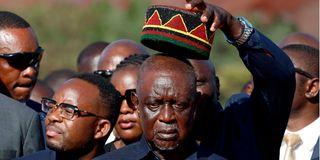
Senator Oburu Oginga during the ceremony to install Raila Odinga Junior as the head on of Raila Odinga'sd family at Opoda Farm in Bondo, Siaya County.
Photo credit: Alex Odhiambo | Nation Media Group
His smile is easy—and mischievous—building the way a storm builds over Lake Victoria, slow and inevitable and impossible to ignore once it is fully there. It is the smile of Chinua Achebe’s Ogbuefi Ezeugo (in Things Fall Apart )—the orator, the spiritual spine of the clan who could silence a thousand people simply by opening his mouth, and who, in old age, has discovered he can silence them just as completely by saying nothing at all.
But for Oburu, whenever he opens his mouth, the whole room roars with laughter. He has improvised his own style as he has charted his own way forward. Where his brother Raila burnt with the fierce forward momentum of a Dostoevsky protagonist, Oburu is a low, patient flame of a Tolstoy one.
There is a moment in ancient Greek drama—a tragic turn of events—when the great hero dies or departs, and lesser mortals must pick up the shattered pieces of what once was the epitome of greatness. The ancient Greek playwrights Sophocles and Aeschylus knew this well. And now, so does the post-Raila ODM party.
In the play Antigone , Sophocles writes that the character Creon takes over leadership in Thebes after King Oedipus. Creon becomes the unfortunate, tormented administrator who inherits power in the wake of the legendary Oedipus. Creon is an earnest man. He believes in order, in legitimacy, in the proper management of what the hero built. But he is not Oedipus. He never will be. And Thebes knows it.
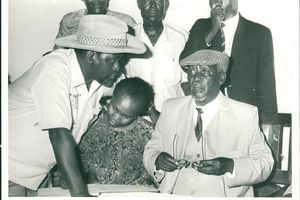
ODM leader Raila Odinga (left) and his brother, EALA Legislator Oburu Oginga during a Christmas service at St Peter Nyamira ACK church in Bondo on December 25, 2018.
Photo credit: File | Nation Media Group
The Romans had a phrase for it—capax imperii nisi imperasset—“capable of rule, had he never ruled.” It applies to Oburu. The gap between looking adequate from the outside and actually commanding loyalty from the inside proved fatal for those who couldn’t exert supreme authority. A ruler who is respected but not feared—and who cannot generate either fear or awe in Greek (or Luo political) culture—faces a profound limitation.
This is Oburu’s predicament: he is the custodian of a legend, not a legend himself. Raila had something that cannot be taught or transferred: an almost mystical connection with the masses. When Raila was detained, the people felt detained with him. When he was teargassed, they felt the sting too. That connection between leader and people is rare and cannot be inherited. As one of the hashtags put it well: “you cannot copy paste Baba.”
Oburu carries the Odinga name—that extraordinary brand, made first by his father Jaramogi Oginga Odinga, the great founding nationalist, and then re‑made white‑hot by Raila. Bearing the name means having heavy political capital, but it also carries the burden of outsize expectations.
The character Creon, in Antigone , struggles against the expectations set in the very city he governs. ODM is caught in the same fix.
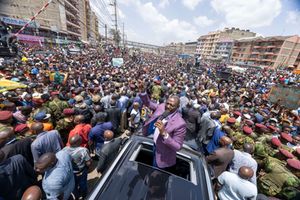
Siaya Senator Oburu Oginga eulogises his brother Raila Odinga during the funeral service at Jaramogi Oginga Odinga University grounds in Bondo, Siaya County on October 19, 2025.
Photo credit: Sila Kiplagat | Nation Media Group
Every proclamation Creon makes is measured against what Oedipus—or even the gods themselves—might have done. Oburu faces an identical crisis. Everything he says is second‑guessed, and people may wonder whether Raila would have done the same.
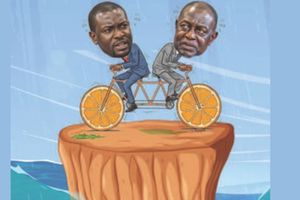
And myths, as the Greeks knew better than anyone, are far harder to inherit than kingdoms. This is the challenge of Oburu, the elder brother of the man they called Agwambo—the Enigmatic One. Oburu now finds himself in the role the Greeks would have recognised immediately: the surviving noble, tasked with the administration of greatness and accommodating the younger figures in ODM circling the edges of the stage. The most implacable of these younger politicians are Babu Owino and Edwin Sifuna. These Young Turks are barrelling down the other side of Oburu’s lane, getting closer to a head‑on collision.
However, if Oburu were to hold ODM together long enough for a legitimate succession process—he might yet earn a dignified place in the party’s history.