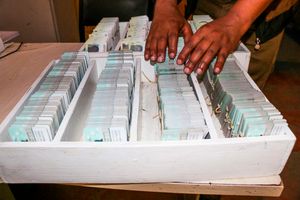
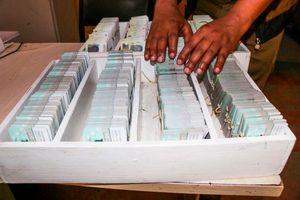
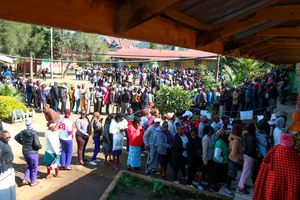
The value of a national identity cards (IDs) project has increased to Sh31 billion from Sh10 billion, as the government ramps up production of the documents required to register new voters ahead of next year’s General Election.
President William Ruto’s administration has revised the project’s expected completion date to June 30, 2028 and also increased the budget, first to Sh12 billion and then Sh31 billion, according to official documents.
Started by the previous government in 2014, the project – supplies for ID cards materials – was estimated to cost Sh10 billion over eight years, but its funding has only increased considerably under the Kenya Kwanza administration, according to the Controller of Budget.
The project’s estimated value was reviewed upwards to Sh12 billion around November 2023 and then scaled up to Sh31 billion from January 2025, five months after the Gen Z protests.
This year, the State Department for Immigration and Citizen Services has included Sh6.8 billion under supplies for production of ID material and Sh4.9 billion for contracted technical services.
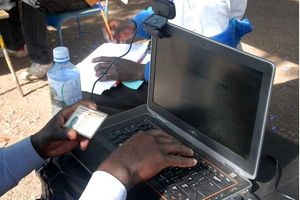
An additional Sh3.5 billion is allocated to facilitate the ongoing mobile registration outreach programme, states the national government budget implementation review report for the 2025/2026 financial year.
More than 1.7 million Kenyans have been registered since the beginning of the current financial year in July.
Photo credit: File | Nation Media Group
The allocation is “towards efficient registration for national identity cards and birth certificates,” according to the report dated August 2026.
As a pointer to the seriousness with which authorities are taking the programme, the State Department for Immigration and Citizen Services recorded the highest absorption of the development budget at 116 per cent – an impressive achievement considering the average absorption rate for the development budget is 60 percent.
The Controller of Budget notes this efficiency is “driven by additional funding under Article 223 of the Constitution to facilitate the joint mobile registration outreach programme for national identity cards and birth certificates.” The article allows emergency spending by government without parliamentary approval.
“Notably, the National Registration Services sub-programme recorded an absorption rate of 131 per cent, surpassing the reporting period’s threshold of 75 per cent. This was due to additional funding under Article 223 of the Constitution to facilitate the joint mobile registration outreach programme for national identity cards and birth certificates,” according to the national government budget implementation review report for the first nine months of the 2025/26 financial year issued in May.
The cumulative expenditure for the ID project as of December 31, 2025 is Sh11.7 billion.
This is an increase from Sh9.6 billion as of December 31, 2024, which translates to an expenditure of Sh2.1 billion over one year.
The government has implemented reforms to speed up issuance of IDs to new applicants and also those replacing lost or defaced ones, including the removal of application fees and rollout of enhanced digital registration systems.
More than 1.7 million Kenyans have been registered since the beginning of the current financial year in July, according to officials. The government also plans to register eligible one million secondary students who are sitting the Kenya Certificate of Secondary Education (KCSE).
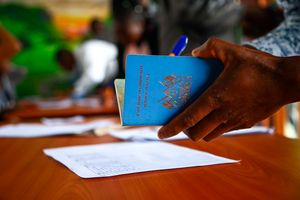
A national identity card is mandatory to register as a voter. The Independent Electoral and Boundaries Commission (IEBC) is targeting to register an additional six million new voters to increase the number of registered voters to approximately 28.5 million for 2027 General Election, up from 22.1 million in 2022. As at August 20, this year, 2.9 million new voters had been listed and registration is continuing at the commission’s constituency offices nationwide.
President Ruto removed rigorous vetting that applicants from northern Kenya were subjected to for decades by previous governments that cited national security concerns due to terrorism.
The president described the restrictions as discriminatory to residents of border counties but cautioned removal of the hurdles is not to facilitate abuse.
“It’s not an invitation for foreigners to acquire Kenyan documents illegally. Kenyan identity cards will only be issued to legitimate citizens of this republic. Our commitment to justice and inclusion goes hand-in-hand with our duty to protect the integrity of our national identity and the security of our country. We did not abolish verification of citizenship, we abolished discrimination. We abolished the targeting of entire communities simply because of their ethnicity or place of birth,” Dr Ruto said in an address during this year’s Madaraka Day celebrations in Wajir County.
Uncollected IDs lying at Huduma Center in Kibera.
Photo credit: File | Nation Media Group
“What the president has done is to do away with the excessive vetting, unfair vetting of fellow Kenyans from the northern part of Kenya who were being taken through a very painful exercise of vetting to ensure that they enjoy the same rights as any other citizen in the republic of Kenya,” National Assembly Majority Leader Kimani Ichungwah said amid growing concerns by critics that the decision was politically motivated.
Opposition leaders have claimed foreigners are being issued with IDs and registered as voters to shore up voters’ numbers as part of a vote rigging plot by government.
They have alleged government-friendly regions are being favoured during issuance of IDs and registration of new voters.
Democracy for the Citizens Party (DCP) leader Rigathi Gachagua has repeatedly claimed opposition leaning zones are being discriminated against.
“In areas considered to be anti-government, new applicants are waiting for three and four months to get IDs. We are asking for issuance of ID cards to all Kenyans without discriminating them because of their perceived political leaning. We don’t want selective issuance of voters’ cards,” Mr Gachagua said recently.
“In next year’s elections, IEBC have no dog in that fight. We want them to be fair arbiters. We will ask IEBC how many more voters have been registered since the last mass voter registration was stopped and in what regions. We will also ask the registrar of persons how many people have got ID cards and from what regions,” Nyandarua Senator John Methu, who is also DCP’s secretary-general, has said.