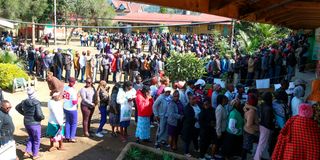
Voters queue to cast their votes at AC Ol Kalou Primary School polling station during the Ol Kalou by-election on July 16, 2026.
A State House meeting held on July 13, 2026, has revealed how the 2027 presidential race has shifted towards voter distribution in the 47 counties, and how numbers could be increased in perceived strongholds ahead of the polls.
With political shifts and realignments already taking shape, strategists for various presidential aspirants, including President William Ruto, have retreated to boardrooms to crunch numbers and come up with new tactics.
At the heart of the 2027 game plan is the 24.7 million already registered voters and the numerical strength of traditional voting blocs like Mt Kenya, Nyanza, Western, Gusii, Coast, Ukambani, among others.
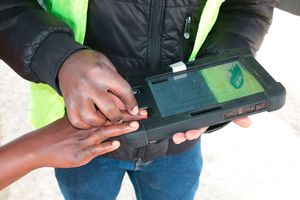
Also of interest is the projected 28.4 million voter register as key players seek to have their regions record the highest turnout. The Independent Electoral and Boundaries Commission (IEBC) seek to enlist an additional 3.78 million new voters ahead of the 2027 General Election.
President Ruto is among 2027 contenders, who are keenly studying the numbers and the country’s shifting electoral maps. The President and his allies have in the past publicly expressed their frustrations with low voter registration turnout in some of the perceived strongholds of the broad-based government.
He recently held a meeting with North Eastern leaders to discuss numbers in the region. A recent survey by Infotrak showed that UDA’s largest support comes from North Eastern at 45 per cent, Rift Valley (39) and the Coast (29).
“We are here because it has emerged that the five counties in northern Kenya are doing extremely badly in terms of application for Identification cards (IDs) and voter registration,” Garissa Governor Nathif Jama told both national and county government administrators days after the State House meeting.
“This message came from the highest office in the country. We were told that despite the removal of the discriminatory ID vetting process, we could still not get our people to register to get ID cards. It came out clearly that we were not letting our people get ID cards and even those with ID cards were not registering as voters,” Governor Jama said.
According to IEBC, Garissa county registered 22,981 new voters out of its 57,453 target for 2027 during the first phase of mass voter registration, while Wajir registered 23,699 out of 59, 242. Mandera recorded 24,755 new voters out of 61,885, with Marsabit enlisting 19,040 out of the possible 47,596, while Isiolo registered 10, 210 out of 25, 523.
The newly registered voters plus the 2022 register bring the cumulative numbers for the five counties to 983,362 votes.
Speaking during the burial of Mzee Edwin Koech, father of Roads Cabinet Secretary Davis Chirchir, in Sotik, Bomet County, on April 30, the President also expressed concern over the low uptake in his Rift Valley bastion.
“There are 1.8 million eligible voters who have not registered with the IEBC and another 500,000 young people in Rift Valley who are yet to obtain national identity cards after turning 18.”
“It is unfortunate that I have to go out there begging other communities for support while there are huge numbers at home who have not registered as voters. This is a serious matter that we need to address,” said the President.
Chief of Staff and Head of Public Service Felix Koskei.
Head of Public Service Felix Koskei has also expressed similar frustrations over low voter registration. In a recent event in Nandi, Mr Koskei described the 2027 election as a battle that would be won on high voter registration.
“The 2027 General Election will not be a laughing matter. It will be a titanic battle to retain the presidency, one unlike any we have seen before. We have discussed what needs to be done urgently to ensure the President retains the people's support,” he said.
During the recent mass voter registration, Bomet enlisted 43,000 new voters out of the possible 107,497, Kericho registered 48,825 new voters out of 122,067 target for 2027, while Uasin Gishu enlisted 57,730 out of 144,326. Elgeyo Marakwet, on the other hand, registered 24,395 new voters out of 60,989; Nandi recorded 46,340 out of 115,854; Baringo enlisted 32,061 out of 80,143, while West Pokot registered 25,098 out of 62,741target for 2027.
The seven counties cumulatively have 2.43 million registered voters, with a potential of pushing the numbers to 3.13 million if it meets its 2027 target by IEBC.
No region illustrates Kenya's changing electoral arithmetic more than Western.
Independent Electoral and Boundaries Commission (IEBC) chairperson Erastus Edung Ethekon.
The five counties of Kakamega, Bungoma, Busia, Trans Nzoia and Vihiga now account for 2.92 million registered voters, making the Mulembe nation the country's second-largest voting bloc after Mt Kenya.
For years, Western voted in different political directions. While parts of Bungoma and Trans Nzoia leaned towards Ford Kenya and later Kenya Kwanza, Kakamega, Busia and Vihiga largely backed Odinga.
Today, however, the region has become the centre of an intense political contest. President Ruto has invested heavily in the region through development tours, Cabinet appointments and frequent visits.
National Assembly Speaker Moses Wetang'ula continues to consolidate Ford Kenya's influence, while Prime Cabinet Secretary Musalia Mudavadi remains one of the President's key political allies.
Yet the Opposition is equally determined not to surrender the region. Senator Edwin Sifuna's planned rallies in Bungoma and Trans Nzoia, backed by leaders from Linda Mwananchi and the United Opposition, underline the growing belief that Western could become the kingmaker in 2027.
Kisii Senator Richard Onyonka argues that if the opposition locks down Western while combining it with Eastern support, President Ruto's re-election prospects become significantly weaker.
"We have done our arithmetic, and there is no way Ruto can win if we are united," he says.
Whether that arithmetic holds will depend on one factor that has historically eluded opposition coalitions—unity.
In Luo Nyanza, the four counties of Kisumu, Migori, Siaya and Homa Bay cumulatively had 2.2 million votes. A projection by IEBC shows that the four counties would in the 2027 polls have 2.78 million votes. In the recent mass enlisting, Kisumu recorded 69,208 new voters out of its target of 173,018, while Homa Bay registered 62,857 out of 157,142. Migori, on the other hand, registered 53,598 out of 133,744, with Siaya registering 60,865 out of 152,156.
The four counties currently have 2.41 million votes. The region has, for successive elections, joined hands with Western, Gusii and Coast, making a crucial voting bloc. With the absence of Raila Odinga and the emergence of ODM’s Linda Mwananchi, the voting pattern by the traditional bloc may shift significantly.
In the 2022 polls, the 10 Mt Kenya counties of Laikipia, Tharaka-Nithi, Murang’a, Kiambu, Nyeri, Kirinyaga, Nyandarua, Embu, Meru and Nakuru had a cumulative vote power of 5.8 million. IEBC’s 2017 projection shows that the 10 counties would have 7.4 million votes.
In the recent mass enlisting, Meru recorded 88,072 out of 220,178, Tharaka Nithi registered 26,456 out of 66, 138, Embu recorded 38,130 out of 95,327, while Nyandarua registered 41,195 out of 102,218. Nyeri, on the other hand, registered 54,935 out of 137,337; Kirinyaga enlisted 42,888 out of 107,218; Murang’a registered 70,824 out of 177,061; and Kiambu enlisting 145,428 votes out of 363,572. Laikipia registered 29,999 out of 74,997, while Nakuru registered 120,317 out of 300,796.
The 10 counties currently boast of 6.3 million votes. On Monday, former Deputy President Rigathi Gachagua urged residents of the Mount Kenya region to mobilise every eligible voter, including the youth, the elderly and the sick, to register ahead of what he described as an "epic political battle" against President Ruto.
“We need to ensure we have 10 million votes in Mount Kenya, Nairobi, the Maasai and the Kipsigis regions so that we are able to decisively beat President Ruto in the 2027 General Election,” he said at his Wamunyoro home in Nyeri County.
Referring to the recent Ol Kalou parliamentary by-election, Mr Gachagua claimed the outcome had demonstrated that President Ruto could be defeated.
“With the outcome of the Ol Kalou by-election, it is crystal clear that it is possible to beat President Ruto and send his allies in Mount Kenya into political oblivion,” he said.
The latest IEBC registration figures have elevated some regions into kingmakers while increasing the strategic value of urban counties, forcing presidential hopefuls to rethink alliances, campaign routes and voting targets long before the first ballot is cast.
Unlike previous elections where ethnic voting blocs largely dictated the outcome, the next presidential contest, analysts say, will be fought on a bigger, younger and more urbanised voter register, compelling political formations to rethink alliances, messaging and campaign strategy.
At the centre of the contest are three emerging formations.
President Ruto heads into the election with the advantage of incumbency and the Broad-Based Alliance bringing together his United Democratic Alliance (UDA) and the Dr Oburu Oginga-led ODM faction.
Facing him is the United Opposition—a coalition bringing together Mr Gachagua, former Interior Cabinet Secretary Dr Fred Matiang'i, Wiper leader Kalonzo Musyoka, People's Liberation Party leader Martha Karua, Democratic Party leader Justin Muturi and DAP-Kenya leader Eugene Wamalwa, all projecting an image of unity ahead of the election.
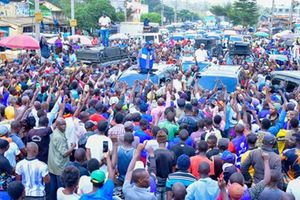
Nairobi Senator Edwin Sifuna addresses supporters of Linda Mwananchi during a political rally in Trans Nzoia County on July 25, 2026.
The third force is Mr Sifuna's Linda Mwananchi movement, which has steadily gained traction, particularly in Western Kenya and parts of Nyanza, even as it publicly pushes for opposition unity.
A candidate must secure more than half of all valid votes cast and obtain at least 25 per cent of votes in no fewer than 24 counties.
That requirement has fundamentally altered presidential politics.
It means numerical dominance in one region is insufficient. Winning the presidency now requires building geographically diverse coalitions capable of attracting support across the country.
Nairobi remains the undisputed electoral giant, with approximately 2.69 million registered voters, making it by far the country's largest county electorate.
Kiambu follows with 1.4 million voters, while Nakuru now stands at more than 1.15 million and Kakamega approaches one million.
Together, these four counties alone command more than six million registered voters.
The IEBC notes that Nairobi, Kiambu, Nakuru and Kakamega are among the fastest-growing counties, a reflection of rapid urbanisation and population movement.
If there is one region every presidential hopeful must court relentlessly, it is Mt Kenya.
Analysts say that the alliance with the Dr Oburu Oginga-led ODM faction potentially opens new political space in parts of Nyanza, Coast and Western while helping soften traditional hostility towards UDA in regions that previously voted overwhelmingly for the late ODM leader Raila Odinga.
“It also gives the President access to experienced political structures that remain influential across several counties,” says Mr John Anditi, a political pundit.
Some analysts argue that the growing register presents a double-edged sword for the President. On one hand, it rewards development-focused politics, particularly in rapidly growing counties.
On the other, younger first-time voters are proving less attached to traditional political loyalties and more concerned about unemployment, taxation, governance and the cost of living.
“That uncertainty could erode the advantages normally enjoyed by an incumbent administration,” says Prof Gitile Naituli.
Follow our WhatsApp channel for breaking news updates and more stories like this.