The battle for 2027 has shifted to the voter register, as a contentious directive by the electoral agency on Friday sparked fears of exclusion, confusion and a potential crisis.
Already, a storm has erupted over the roll after the Independent Electoral and Boundaries Commission (IEBC) directed that Kenyans registered before 2012 may be required to register afresh, triggering fears that millions could be locked out of the 2027 vote.
On Saturday, the IEBC moved to calm fears over reports that voters registered before 2012 would need to register afresh.
In a statement, the commission clarified that the directive only applies to a small group of citizens who did not provide their details in 2012 when the new register of voters was established under the 2010 Constitution and the boundaries delimitation of 2012.
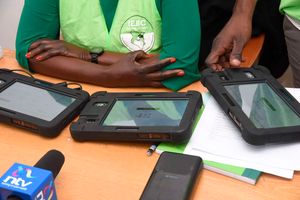
Independent Electoral and Boundaries Commission clerks register voters at Shimoni Fish Port during the launch of Enhanced Continuous Voter Registration exercise in Kwale County March 30, 2026.
Photo credit: Kevin Odit | Nation Media Group
“The overwhelming majority of Kenyans who registered before 2012 and subsequently enrolled under the biometric system in 2012 are already part of the register. There is no need for them to register again,” the commission said.
On Friday, the IEBC asked voters who registered before 2012 to have their biometric details captured again to ensure their names are in the system.
“The events of 2007/08 led to reforms in many sectors, including the electoral system. Those who registered as voters before 2012 may have to register afresh,” IEBC chairman Erastus Ethekon said.
“The current biometric register of voters came into operation in 2012. Individuals who had enrolled as voters before 2012 are not part of the current register unless they subsequently presented themselves for fresh registration.”
Mr Ethekon explained that the shift followed electoral reforms after the 2007/08 post-election crisis, which led to the adoption of biometric systems aimed at enhancing credibility and transparency.
According to the agency, the register currently in use was built after the 2012 boundaries delimitation, which saw about 14.5 million voters registered.
The number rose to 19.6 million in 2017 and 22.1 million in 2022, with a target of 28.8 million voters ahead of the General Election next year.
The clarification from IEBC came after confusion arose from public messaging suggesting that every pre-2012 voter must re-register.
The commission stressed that before 2012, the register was manual. In 2012, Kenya transitioned to a biometric voter registration, requiring eligible citizens to have their data captured digitally.
The new system has been the foundation of the register used in the 2013, 2017 and 2022 General Elections.
Independent Electoral and Boundaries Commission clerks register voters at Shimoni Fish Port in Kwale County on March 30, 2026
Photo credit: Kevin Odit | Nation Media Group
“As of the 2022 General Election, the commission maintained a verified and audited register comprising 22,120,458 voters,” IEBC said.
“Eligible voters should ensure their details are correct, but the vast majority are already captured in the system,” the commission said.
The Friday statement sparked confusion, with a section of leaders interpreting it to mean that many Kenyans risk being excluded from voting unless they undergo a process similar to fresh registration.
The directive has particularly alarmed older voters and those in remote regions who may face logistical challenges in accessing registration centres.
People’s Liberation Party leader Martha Karua, a principal in the United Opposition, yesterday framed the issue as constitutional.
“The right to vote is not conditional; it is guaranteed under Article 38 of our Constitution,” she said.
Ms Karua added that requiring Kenyans who registered before 2012 to re-register within a limited time-frame raises constitutional concerns, arguing that the burden of administrative transitions should not be shifted to citizens.
“Under Articles 81 and 86 of the Constitution, the IEBC is obligated to ensure a voting system that is inclusive, transparent and does not disenfranchise anyone,” the former cabinet minister said.
She challenged the commission to address concerns on the integrity of its systems, including claims about missing Kenya Integrated Elections Management System (Kiems) gadgets.
“The IEBC should confirm or deny that it cannot account for more than 20,000 Kiems kits or the tampering with voters’ data on its public portal. The IEBC must convince Kenyans that its decision is in good faith and not in any way intended to disenfranchise voters,” she said.
Independent Electoral and Boundaries Commission clerks register voters at Shimoni Fish Port in Kwale County on March 30, 2026.
Photo credit: Kevin Odit | Nation Media Group
“It should clarify how it will guarantee that no eligible Kenyans, especially the elderly and those in remote areas, are locked out of the 2027 elections.”
Ms Karua said IEBC has a duty to build, not destroy, confidence with the electorate.
“We will not stand by as bureaucratic processes threaten the sovereignty of the people. We will defend that right,” she said.
Mr Justin Muturi , another opposition figure, also gave an opinion on the issue, saying the integrity of the register is non-negotiable.
While encouraging Kenyans to register as voters, the former attorney-general pointed to findings from a KPMG audit conducted ahead of the 2022 elections, which uncovered anomalies in the register.
They included hundreds of thousands of duplicate records, deceased voters and registrations linked to invalid identification documents.
The audit also flagged “mysterious” system users with elevated privileges capable of altering voter data.
“A credible register is the foundation of free and fair elections,” Mr Muturi said, calling for a fresh comprehensive audit and closer collaboration between the IEBC and government agencies responsible for civil registration.
He demanded that the National Registration Bureau disclose the number of death certificates issued in recent years to help reconcile population data with the voter roll.
“Failure to do so could prompt legal action,” Mr Muturi said.
Safina Party leader Jimi Wanjigi took a more confrontational stance, accusing the commission of acting in bad faith.
“On behalf of President Ruto, the IEBC is clearly attempting to disenfranchise legitimate registered voters from the register. It is clear some numbers are not adding up for some people,” Mr Wanjigi said.
He added that attempts to lock out eligible voters would be fiercely resisted, terming it a direct assault on democracy and the sovereign will of the people.
“Any attempts to disenfranchise an eligible voter in the upcoming election will amount to a war on the will of Kenyans. It will not be tolerated,” Mr Wanjigi said.
Lawmakers from across the political divide also raised concerns over the register. Vihiga Senator Godfrey Osotsi cautioned the commission against introducing new processes midstream, saying such actions risk eroding public trust in the electoral agency.
“The IEBC has to be careful not to lose credibility. The afterthought has the potential to create misconceptions,” the senator said.
Kiharu MP Ndindi Nyoro called for clearer communication and the use of technology to enable voters to verify their registration status remotely.
“The commission needs to be clear-minded and communicate properly on what exactly it wants Kenyans to do,” he said, adding that digital platforms could ease pressure on physical registration centres.
With less than two years to the next General Election, the stakes could not be higher.
A flawed or contested voter register has the potential to undermine public confidence and trigger disputes similar to those witnessed in previous electoral cycles.
For the opposition, the directive has become a rallying point, reinforcing long-standing concerns about the independence of the electoral commission.