One year from today, more than 28 million Kenyans — going by the electoral commission's own registration target — will queue to choose the next crop of leaders.
They will do so on a communications network that did not exist when this republic last learned how to hold a competitive election.
In 1992, when Kenyans voted under multiparty rules for the first time in a generation, there was no mobile telephony in the country worth the name. Observation was work for accredited strangers: foreign missions, church groups, and a thin line of domestic monitors. Where they were not standing, nothing was recorded.
The Communications Authority's sector statistics for January to March 2026 record 84.1 million active mobile subscriptions and penetration of 157.7 per cent. Smartphones account for 63.7 per cent of the 78.7 million devices connected to Kenyan networks — something over fifty million cameras. Mobile broadband subscriptions stood at 62.6 million at the end of March.
That is the observer Kenya did not have in 1992. It is now the most numerous in the country, and it has already been tested.
A screengrab of a video of armed men arriving at a polling station in Ol Kalou.
Photo credit: NMG
Under the rules that governed every Kenyan election from 1992 onward, that was the end of the record. However, in Ol Kalou, it was not. Some unknown fraction of the 41,656 people who voted that day were carrying the only evidence that mattered, and much of it had already left the constituency by the time the men in masks drove away. Within days, NTV was reconstructing their movements from that material.
Confiscating the press no longer confiscates the record. That is a structural shift in Kenyan power, and 2027 is the first general election to be held under it.
It arrives at an awkward moment. Parliament is at present doing two things at once. It has approved the most expensive election technology programme in the country's history. And it is considering a Bill that deletes the public's statutory right to watch results as they are declared.
Every five years Kenyans are told the election was stolen inside a machine. That servers were infiltrated. The system was compromised. Numbers changed in transit.
The claim arrives with total confidence, usually within hours, usually before evidence exists.
Kenyans already hold the intuition needed to test it, because they exercise it thousands of times a second.
When you send money to your mother, relative, friend or family, the network does not decide the amount. You decide. M-Pesa, Airtel Money or Telkom's T-Kash carries the instruction you give.
If it fails, you know in seconds, and you send again. Nobody has ever accused Safaricom, Airtel or Telkom of choosing how much rent you owe.
The scale of that trust bears stating. Safaricom says in its public statements that the company's OneApp platform handles roughly 500 million transactions and about Sh100 billion a day, on infrastructure capable of 10,000 transactions a second.
The M-Pesa core, migrated to a cloud-native system last September, runs at 6,000 transactions a second with headroom to double.
Kenyans entrust those networks with dowry, funeral contributions, wages, stock, rent and the private conversation of a nation. They have never once confused the carriage with the decision.
Form 34A works the same way, and the law is unusually clear – and the Supreme Court has tested it again and again during presidential election petitions in 2017, and found it sound.
The presiding officer completes the form at the polling station, in the room, before party agents who have watched the count and who sign it.
The KIEMS kit photographs the completed form. The network transmits that photograph to constituency and national tallying centres and to the public portal.
The Court of Appeal held in 2016, in the case brought by Maina Kiai, that results declared at constituency level in those forms are final and cannot be altered afterwards by the commission.
That is the load-bearing principle of the entire system. The paper in the room outranks everything downstream of it.
When the Supreme Court examined the 2022 presidential petition, it ordered scrutiny of the transmission system. The court found no credible evidence that the forms on the public portal had been accessed, intercepted or altered, and no significant difference between the copies on the portal, those delivered to the national tallying centre and those handed to agents.
It found that transmission logs offered as proof of interference carried no probative value, and that some material submitted had been drawn from 2017 or was forged.
The technology did not decide the last election. Nor did it steal it. It carried a decision made on paper, in a room, in front of witnesses — and when that carriage was tested at the highest level, it held.
In May, the commission went before the National Assembly's Justice and Legal Affairs Committee, chaired by Tharaka MP George Murugara, seeking Sh74.8 billion for the 2027 cycle against the Sh41.3 billion the Treasury had allocated. The committee approved the additional Sh33.5 billion in full.
Sh9.3 billion of it goes to KIEMS kits, taking the election technology budget past Sh10 billion. The commission intends to replace all 45,353 kits bought in 2017, reusing about 14,000 acquired from Smartmatic in 2022 for Sh4.2 billion. It requires 59,352 devices in total: 55,393 for polling stations and 3,959 for training. Polling stations themselves rise from 46,229 in 2022 to a projected 55,393.
Kibwezi West MP Mutuse Mwengi.
Photo credit: Dennis Onsongo | Nation Media Group
Not every MP was persuaded. Kibwezi West's Mwengi Mutuse asked why kits that work are being replaced. Rarieda's Otiende Amollo, one of the country's more careful election lawyers, said he was concerned about the replacement and considered the existing devices current.
Others questioned why the projection had climbed from Sh61 billion to Sh74.8 billion in a matter of weeks, and why the unit cost of a handheld device ran as high as it did.
Running alongside that spending is the Election Laws (Amendment) Bill, 2026. Its Section 19 deletes section 39(1G) of the Elections Act — the provision requiring the commission to establish a mechanism for livestreaming results as announced at polling stations, expressly, in the statute's own words, "for purposes of public information only."
The feed carries no legal weight. It is what lets agents, journalists and citizens watch numbers arrive and compare them against what is announced later.
The Bill's provenance is the part that has gone unremarked. It is a product of the National Dialogue Committee — the process convened after the deadly protests that followed the 2022 declaration, drawing members from both Kenya Kwanza and Raila Odinga's Azimio. It was read a first time in the National Assembly on 13 February 2025, then shelved. It is jointly sponsored by Senate Majority Leader Aaron Cheruiyot and Minority Leader Stewart Madzayo. Government and opposition, together.
Independent Electoral and Boundaries Commission (IEBC) chairperson Erastus Edung Ethekon.
Photo credit: Wilfred Nyangaresi | Nation Media Group
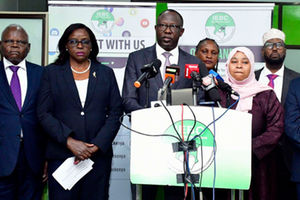
The commission has distanced itself firmly. The chairperson, Erastus Ethekon, said the commission had made no such decision and no proposals to Parliament, that it neither drafted nor sponsored the Bill, and that Section 44 — which mandates the integrated system for registration, identification and transmission — is untouched. What the Bill introduces, the commission says, is a complementary mechanism for stations where transmission is impossible for want of a 3G network, the minimum standard for sending result forms.
Both accounts can be true. The commission is right that voter identification is not being rolled back. It has not explained why the express guarantee that citizens may watch declarations in real time needs deleting. Kakamega Senator Boni Khalwale has called the proposal dead on arrival. Former Kabete MP Paul Muite called it rigging in plain sight.
The livestream requirement was not an ornament. It was installed as a transparency safeguard after the 2007 chaos.
Scepticism is warranted in one direction. A network that transmits faithfully can still be pointed at the wrong thing, and real-time verification only works where citizens are safe enough to attempt it. At Ol Kalou, journalists were assaulted while police stood by. A camera in the pocket of a frightened person records nothing.
Nor is volume the same as scrutiny. Fifty million devices are not fifty million observers. They become observers only when their owners know what to photograph, and when.
A voter who photographs the Form 34A at their own polling station, at the moment of declaration, before the result travels anywhere, holds a copy of the document the Court of Appeal ruled final and the Supreme Court checked the portal against. Not a screenshot of a website. The form, in the room, with the signatures on it.
There will be 55,393 such rooms next August. The commission has been given Sh10 billion to carry what happens inside them, and Parliament is deciding this session whether the country still has a legal right to watch.
In 1992, the record of a Kenyan election was held by whoever was standing in the room, and there were very few of them. One year from today, the room will be full.