For decades, Kenya’s youth have been described as the country’s greatest untapped political force.
The demographic has always been viewed as a generation large enough to shape elections, yet too disillusioned to consistently turn its numbers into votes.
That narrative was challenged in 2024 when Gen Z transformed online frustration over the Finance Bill into the country’s biggest youth-led protest movement in decades, forcing the government into an unprecedented retreat and redefining what political participation looks like in the digital age.
The movement was born online. Young Kenyans took to social media platforms such as TikTok, X and Instagram to break down the Finance Bill into simple, accessible language, exposing provisions they believed would worsen the cost-of-living crisis.
As the content spread, so did calls to action. Within days, social media had evolved from a space for debate into the command centre of a nationwide movement with no single known leader, political party or ethnic identity.
By mid-June 2024, thousands had poured into the streets, mobilised under hashtags such as #Re-jectFinanceBill2024 and #OccupyParliament, demonstrating the power of digital organising in an era when smartphones had become the movement’s loudest megaphone.
The protests were driven by growing frustration over the rising cost of living, unemployment, heavy public debt and a widening sense of economic hardship. The proposed Finance Bill became the focal point because many believed its tax measures would place even greater pressure on households already struggling to make ends meet.
As demonstrations intensified, police responded with tear gas, water cannons and mass arrests. More than 200 protesters were detained during one of the early marches, while allegations of excessive force and enforced disappearances or abductions fuelled even greater public outrage.
Photo credit: Nation Media Group
The defining moment came on June 25, 2024, when protesters breached Parliament during debate on the Finance Bill. The dramatic scenes captured international attention and fuelled public anger, as cameras captured dozens of young protesters felled by bullets in the streets and outside the Parliament buildings.
Within days, President William Ruto withdrew the Bill and declined to sign it into law, marking one of the most significant policy reversals by a Kenyan government in recent history. What had begun as opposition to new taxes evolved into a broader demand for accountability, transparency and responsive leadership.
Analysts observed that the movement succeeded in cutting across ethnic, regional and party divisions that have traditionally defined Kenyan politics, uniting participants around shared economic concerns and demands for better governance.
Charles Mutisya, a Gen Z from Mombasa, maintains that all young people in the country should be part of the movement because they have a major role to play in shaping the outcome of future elections. He said the current target was to rally voters from other demographics, such as boda boda riders and mama mboga, to join the youth movement.
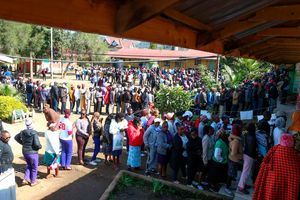
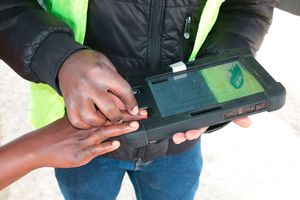
The movement, which reflected Kenya’s changing political landscape, turned into a mobilisation vehicle for voter registration ahead of the 2027 General Election. Through the #NikoKadi hashtag and other youthful calls to action, thousands turned up to register during the Enhanced Mass Voter Registration (ECVR) drive by the Independent Electoral and Boundaries Commission (IEBC).
“We need to remain united. We started the #TukoKadi movement, and if Gen Zs stay ignorant, then we will not achieve the intended goal, which is to elect good leaders,” Mr Mutisya said.
Mr Mutisya appealed to young people to go back to the drawing board and strategise afresh ahead of the 2027 General Election, noting that divisions had emerged among them since 2024. This, he said, had given politicians a chance to entrench traditional ethnic political strategies among the youth.
Members of the youth-led ‘Niko Kadi’ initiative march through the streets of Kisumu City on March 26.
Photo credit: Alex Odhiambo| Nation Media Group
“We need to make independent decisions in 2027 because now you can see they (politicians) are using tribal rhetoric to divide us. I don’t expect a Gen Z to think like a village person. We need to act differently and stand against the kind of politics we have in Kenya,” added Mr Mutisya.
The ECVR Phase I constituted a structured, time-bound national exercise designed to accelerate voter enrolment ahead of the 2027 General Election. The programme integrated continuous registration with targeted outreach to enhance participation, inclusivity and accessibility for all eligible Kenyans.
In its implementation, the commission operationalised 30,615 registration centres and recruited, trained and deployed 12,520 registration officials supported by 5,390 Kenya Integrated Election Management System (KIEMS) kits. By the end of the drive in April 2026, a total of 2,612,725 new voters had been enlisted.
This comprised 267,249 registered under Continuous Voter Registration (CVR) conducted at IEBC offices and 2,345,476 under the ECVR. Although the IEBC did not provide an official breakdown of new voters by age or gender, it repeatedly stated that many of them were young because registration centres were also set up in higher learning institutions.
Political observers note that the remaining challenge is for voters to turn up on election day, as questions still remain over whether they will vote as a bloc. Should this happen, Gen Z would be able to use its numbers as a decisive swing vote to shape the outcome of the elections.
“When masses come together and push for a common course, then those in power will listen. It’s unfortunate that some of the youth have been bought, but you cannot buy everyone because we will continue to encourage more and more to register as voters,” said Walid Sketty, an activist based in Mombasa.
In 2022, voters within the youth age bracket of 18-34 were 8,811,693, accounting for about 39.8 per cent of registered voters. Of these, the largest single age group was 30-34 years, with 3.41 million voters, closely followed by 25-29 years, with 3.36 million voters.
Using the IEBC’s 2022 register and updating it with the current ages of voters shows that millennials, currently aged 30-45, may remain the largest single voting bloc, with about 10.7 million registered voters.
Gen Z, aged 18-29, is expected to grow substantially from the 5.4 million registered in 2022 because millions who were below voting age then have since turned 18 and will be eligible to register before the 2027 General Election. This is partly due to measures by the government, through the Ministry of Interior, to enhance the issuance of national identity cards, including mobile registration drives in high schools and marginalised regions.
Youths in a peaceful procession on the streets of Mombasa during the 'Niko Kadi' voter registration campaign on March 24, 2026.
Photo credit: Kevin Odit | Nation Media Group
At a meeting in Mombasa with National Government Administrative Officers last month, Principal Secretary for Internal Security and National Administration Raymond Omollo reiterated the need for officers to mobilise all eligible Kenyans to acquire national identity cards.
“The document enables Government to plan effectively while empowering wananchi to access opportunities and participate fully in national development,” he said.
Today, the meaning of civic engagement has broadened among the youth, showing that participation in national development and politics extends beyond casting a ballot to include organising, educating, mobilising and holding leaders accountable between elections.
Digital platforms have enabled a generation that consumes politics differently to sustain national conversations that are not driven by political elites but by ordinary young citizens. Through short-form videos, livestreams and constant social media updates, young people are gearing up in an attempt to turn the tide in 2027.
Content creators have joined the conversation, producing humorous skits that underscore the qualities of good leadership and the importance of accountability. At the same time, thousands of young people tune in daily to livestreams across social media platforms, where civic issues, governance and public policy are debated, reflecting a growing appetite for political engagement beyond the ballot box.
Youths in a peaceful procession on the streets of Mombasa during the 'Niko Kadi' voter registration campaign on March 24, 2026.
Photo credit: Kevin Odit | Nation Media Group
IEBC chairperson Erastus Ethekon took note of the new trends after the conclusion of the mass voter registration exercise, urging the youth to stay on course.
“You are the energy that powered this engine. Through your songs, your hashtags, your dance, and your peer-to-peer mobilisation, you have proven that you are not merely leaders of tomorrow, but the decisive stakeholders of today, and in fact, you can lead today,” he said.
The IEBC explained that Continuous Voter Registration is ongoing at its constituency offices and Huduma Centres across the country. The voter register will later undergo verification to remove duplicate registrations, conflicting records and any other anomalies.
The validated records will then be compiled, and voters invited to verify their details and report any discrepancies for correction. The final register, certified by an independent auditor and the IEBC, will then be published in the Kenya Gazette.