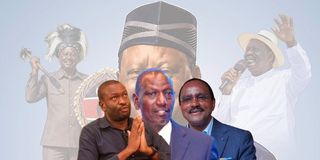
The battle to inherit Raila Odinga’s political name, networks and legacy has moved into the heart of the 2027 contest, with President William Ruto and a growing field of opposition politicians invoking the late former Prime Minister as they court the bastions that sustained his political career for decades.
From President Ruto to Nairobi Senator Edwin Sifuna, former Deputy President Rigathi Gachagua , Jubilee Presidential candidate Fred Matiang’i, People’s Liberation Party leader Martha Karua, DAP-K leader Eugene Wamalwa, Wiper Patriotic Front leader Kalonzo Musyoka , and even ex-president Uhuru Kenyatta , Raila’s name has remained a recurring feature of political rallies and speeches since his death on October 15, 2025.
In Nyanza, where Raila built an exceptionally loyal political base, his memory has become particularly valuable political currency.
President Ruto has repeatedly reached back to his relationship with Raila in his efforts to deepen his presence in the region, reminding voters of their days together in the ODM Pentagon and the political alliance that eventually culminated in the National Accord and the creation of the Grand Coalition Government.
President William Ruto addresses members of the public after inspecting the Dhogoye Bridge and the ongoing road works in the area, Bondo, Siaya County.
Photo credit: PCS
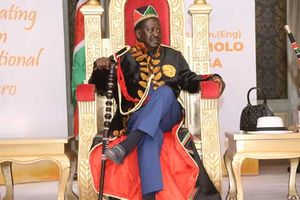
At the unveiling of Raila’s mausoleum at Kang’o ka Jaramogi in Bondo on October 7, President Ruto devoted a substantial portion of his speech to the former Prime Minister’s political journey, portraying himself as someone who had sat with and worked alongside him.
“This mausoleum speaks Baba’s language. It is shaped as a pentagon, with five sides. Among the Luo, five is Abich , the number of unity, togetherness and completion,” Dr Ruto said.
He recalled the ODM Pentagon of 2007, when he sat alongside Raila and other leaders who backed his presidential bid.
“Five recalls the ODM Pentagon of 2007. Leaders from every corner of Kenya came together behind a common national vision. I was privileged to sit at that table with him. I saw and learnt first-hand how Jakom built bridges between communities and between people,” he said.
President Ruto went further, presenting his administration’s development programmes as part of the legacy Raila left behind.
“Every road we open in a forgotten region advances the usawa transformation of our country. And every such road is a tribute to the legacy of Raila Amolo Odinga,” he said.
He also invoked the former Prime Minister’s political philosophy, saying Raila’s lifelong cause could be captured in two words — “equitable transformation”.
The President's appeal to Raila's legacy comes as he seeks to consolidate support in a region that had overwhelmingly backed his political nemesis in successive presidential elections.
The Head of State has also repeatedly reminded Nyanza voters that he backed Raila’s presidential bid in 2007, when he was part of the ODM Pentagon, and that he subsequently worked with him in the Grand Coalition Government.
At Bondo, he portrayed the 2024 broad-based arrangement with Raila as a continuation of the former Prime Minister’s willingness to put national unity ahead of political differences.
“Raila was a fighter. He pushed hard. He pushed hard to extend the boundaries of our democracy. But unlike many politicians, he knew when to step back. Whenever insisting on his way would block the path to national unity, he chose the nation,” Dr Ruto said.
“Whenever some sought to exploit our nation's crisis in 2024 for political expediency, Baba chose to hold the nation together. That same spirit brought us together in the Broad-Based Government.”
Wiper Patriotic Front Party Leader Kalonzo Musyoka addresses residents of Chwele in Kabuchai Constituency, Bungoma County, during a tour of Western Kenya by opposition leaders in July, 2026.
Photo credit: Pool
Mr Sifuna, who served as secretary-general in Raila’s ODM Party for eight years, has made his personal relationship with the former Prime Minister central to his political messaging.
At Linda Mwananchi rallies, Mr Sifuna has repeatedly presented himself as a political student of Raila, often wearing Raila-branded T-shirts and invoking his former boss when explaining the new movement’s political direction.
“I loved Baba,” is a sentiment that runs through Sifuna’s post-Raila political messaging, even as he seeks to establish an independent political vehicle.
At Raila’s burial on October 19, 2025, Mr Sifuna described serving him as the privilege of his political life.
“It was the privilege of my life to have met Baba and to have studied under his feet, to have learned all that I have learned from him and finally to serve him as his Secretary General for the last eight years,” he said.
Months later, the references became part of the Linda Mwananchi campaign.
At a meeting on March 27, Mr Sifuna said: “We have decided we will hold on to the ethics that Raila left us with. The task ahead of us is enormous, but none of us is weak, and we are ready to liberate this country.”
During the chaotic Linda Mwananchi rallies in Homa Bay on August 16, Mr Sifuna again invoked Raila while challenging the argument that development should take precedence over constitutional rights.
“Baba told us to place democracy, freedom and respect for the rule of law above everything else,” Mr Sifuna told supporters in Nyandiwa, Sindo and Homa Bay town.
He added: “As Sifuna, building roads and stadiums cannot be difficult for me, but what I promise you is I will uphold the rule of law, protect your rights and will never kill your children.”
Linda Mwananchi supporters at K'Owuor Grounds, Kisumu, on Sunday, April 26, 2026.
Photo credit: Alex Odhiambo | Nation
The Homa Bay rallies were particularly significant because they represented a direct contest for Raila’s political backyard. The movement’s leaders were seeking to demonstrate that his political support could be transferred to a new generation of leaders.
Mr Sifuna has also invoked Raila’s political friendships to explain the alliances around Linda Mwananchi.
In Machakos on May 31, he said: “I have a register of Baba's friends,” before telling supporters that many ODM members were now in Linda Mwananchi and had not forgotten those who stood with Raila.
Mr Musyoka, another long-time Raila ally, has taken a similar approach.
During a recent Ukombozi Alliance tour of Busia County on September 26, the Wiper leader reminded voters of his long association with Raila.
“The over 15 years I was behind Raila cannot be forgotten. Our victory was stolen, and we faced challenges in the court, but I stood by him,” Mr Musyoka said.
He urged voters who had supported Raila to join his political camp, while also presenting himself as part of the political network that had remained loyal to the former Prime Minister.
Eugene Wamalwa, another member of the opposition alliance, has similarly sought to anchor his politics in Raila’s legacy.
Speaking in Busia, Mr Wamalwa told residents: “We lost Baba, but we haven't lost his vision and what he stood for.”
Former Defence Cabinet Secretary Eugene Wamalwa.
Photo credit: Alex Odhiambo | Nation Media Group
His comments echo a tribute he made days after Raila’s death, when he argued that the best way to honour the former Prime Minister was to protect the democratic principles for which he had fought.
“The best way to honour Baba is to jealously guard the now endangered freedom, civil liberties and democratic principles that he fought for and fiercely defend his favourite child—Devolution,” said Mr Wamalwa.
Dr Matiang’i, who is also positioning himself in the opposition field, has concentrated on another aspect of Raila’s legacy — his ability to keep political communities together.
Jubilee Presidential hopeful Dr Fred Matiang'i in Borabu, Nyamira County on April 24, 2026.
Photo credit: Ruth Mbula | Nation Media Group
Speaking days after Raila’s burial, Dr Matiang’i said Raila had treated politicians across the region as his children.
“All of us, whether you were from Kisii, Nyamira, Homa Bay, Kisumu or any of the larger Nyanza region counties, he took all of us as his children,” Dr Matiang’i said.
Ms Karua, meanwhile, has presented Raila as a comrade in Kenya’s democratic struggle.
On the day of his death, she described him as “a fearless defender of the people, a voice for the voiceless, and a steadfast comrade in the fight for the second liberation.” She recalled working with him for more than three decades, sometimes as an ally and sometimes as an opponent.
For Mr Gachagua, despite having spent much of his political career on the opposite side from Raila, he has also spoken admiringly of his political organisation.
In his October 15, 2025 condolence message, he described Raila as “the father of our democracy” and “a formidable hero of Kenya’s 2nd liberation”.
Mr Gachagua acknowledged that the two had not always been on the same political side, but said he admired Raila’s ability to build ODM into a durable political machine.
“Much as we have never been on the same political side, I have had strong admiration for Raila Odinga's art of forming and sustaining a strong political party that survived four general elections,” he said.
Perhaps the most personal invocation of Raila has come from Babu Owino, one of the leading figures in Mr Sifuna’s Linda Mwananchi camp.
“Raila Amolo Odinga was more than my political mentor; he was like a father to me,” Mr Owino said.
The Embakasi East MP explained that he had lost his biological father while still in primary school and that Raila subsequently assumed a fatherly role in his life.
Babu has since continued to use Raila’s political legacy in his own positioning within the opposition.
Embakasi East Constituency MP Babu Owino speaks at Sarova Stanley during the Linda Mwananchi forum reviewing the broad-based government’s 10-point agenda report on March 11, 2026.
Photo credit: Wilfred Nyangaresi | Nation Media Group
He has urged Raila’s daughter Winnie Odinga to join Linda Mwananchi, using an analogy that underscored his view of the movement as a larger political platform.
“Winnie is like a turtle that is bigger than the pond that she is going to. She should join the ocean, and this is where it is at, Linda Mwananchi,” he said.
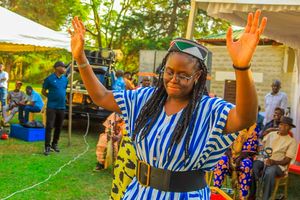
Winnie Odinga during a ceremony in Bondo, Siaya County, on October 3, 2026.
Photo credit: Alex Odhiambo | Nation Media Group
Mr Owino’s argument was that Raila’s political children should look beyond the immediate confines of the factional battle within ODM.
The symbolism has become even more pronounced as the first anniversary of Raila’s death approaches. At the unveiling of his political vehicle on October 4, Mr Sifuna described October as a deeply symbolic month.
“October will forever remain etched in our memories as the month in which we lost our icon and liberation hero, Raila Odinga,” Mr Sifuna said. “We are here because of him, and he has enabled us to scale the mountain and see the Promised Land.”
Mr Kenyatta, although not seeking any political seat in 2027 after his retirement, has renewed the defence of his decision to support Raila in the 2022 presidential election , insisting that he did everything within his power to help his former political partner win the presidency.
Speaking on September 22 during Jubilee Party NEC, Mr Kenyatta recalled the 2018 handshake that brought him and Raila together after the disputed 2017 election and said their subsequent cooperation was intended to pave the way for Raila’s presidential bid.
“We fostered the handshake and even agreed to support Raila Odinga. I did all I could to help Baba to become the president of the Republic of Kenya,” Mr Kenyatta said.
He maintained that Raila received enough votes to win the election, despite the official declaration of President Ruto as the winner. The Supreme Court subsequently upheld Dr Ruto’s victory.
Political analysts say that the result is an increasingly crowded contest over a political inheritance that cannot be reduced to a party name or a single constituency.
“Raila's death ended his personal political journey, but it did not end the political value of his name. As the 2027 contest gathers pace, politicians across the divide are seeking to attach themselves to different parts of his legacy — his democratic struggle, his political alliances, his appeal to marginalised communities, his advocacy for devolution and, above all, the loyalty he commanded in Nyanza,” says Mr Geoffrey Mboya.