Campaign financing in Kenya is regulated by the Independent Electoral and Boundaries Commission (IEBC) under the Election Campaign Financing Act and specific periodic regulations, such as the Election Campaign Financing Regulations, 2026, for the 2027 General Election.
Article 88(4)(i) of the Constitution of Kenya mandates the IEBC to regulate the amounts of money spent by or on behalf of any candidate or political party.
The law allows the IEBC to gazette spending limits for all elective positions, including presidential, gubernatorial, senatorial, Woman Representative, Member of Parliament (MP) and Member of County Assembly (MCA) seats.
The limits factor in geographic size, population density and the economic status of respective constituencies or counties.
"The IEBC shall provide the regulation of campaign financing and the amount of money that may be spent by or on behalf of candidates and political parties in an election," states Article 88(4) of the Constitution.
For instance, the IEBC on August 7, 2026, gazetted new financing regulations ahead of the 2027 General Election.
Under the regulations, presidential election spending has been capped at Sh6.11 billion for the 2027 General Election and that of political parties at Sh24.45 billion.
At the county level, the commission issued varying limits for those eyeing Governor, Senatorial and Woman Representative seats, depending on the devolved unit of origin.
Nairobi County was, for instance, granted the highest spending limit of Sh181.31 million, followed by Turkana and Marsabit at Sh142.07 million and Sh127.02 million, respectively.
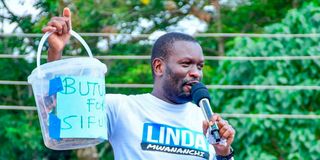
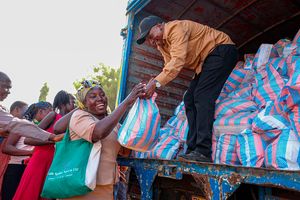
Nairobi Senator Edwin Sifuna receives donations from his supporters during a Linda Mwananchi rally in Butula, Busia County, on August 7, 2026.
Photo credit: Alex Odhiambo | Nation Media Group
Members of Parliament candidates will be allowed to spend between Sh15 million and Sh100 million, depending on the size of the constituency. The IEBC has only allowed MCA candidates to spend between Sh3.48 million and Sh22.09 million.
The IEBC said it used a formula that takes into account population and geographical area, with population carrying a 70 per cent weight and land area 30 per cent.
Candidates or political parties that exceed the prescribed limits and fail to report the breach commit an offence, with convictions attracting a fine of up to Sh2 million or imprisonment for up to five years, or both.
Under the gazetted Election Campaign Financing Act, the IEBC imposed restrictions on campaign contributions, providing that a single source cannot contribute more than 20 per cent of the total contributions allowed under the respective schedules.
The Election Campaign Financing Regulations, 2026, set the expenditure period for campaign funds to a period beginning at least six months before the date of the General Election and ending on the 14th day following the end of the General Election.
Here, each candidate or political party is required to appoint an authorised person, who shall receive campaign contributions, discharge expenditure, and file campaign contributions and expenditures.
However, a candidate may act as their own authorised person. The party or candidate is required to notify the IEBC of their authorised person, who shall be in charge of election financing.
Political parties or candidates are also required to submit the names of any supporting person or organisation that intends to campaign in support of or contribute to the campaign.
The candidate or political party is also expected to open a bank account for the purpose of campaign financing. Such an account should be under the name of the party, the candidate, or the candidate and authorised person. It can also be under the name of a supporting person or organisation.
The account should be opened at a financial institution domiciled in Kenya. The said account shall be closed by the authorised person within three months after the declaration of the election or upon the withdrawal or death of a candidate.
Then, a copy of the bank statement shall be submitted to the IEBC once unpaid claims and surplus election funds have been processed.
According to the financing regulations set by the IEBC, details of harambees held to raise campaign funds shall be recorded. This includes the names of donors and contributors, and the funds shall not be directly from a foreign government.
Energy Principal Secretary Alex Wachira presents a six-kilogram gas cylinder to a resident of Ol Kalou on July 7, 2026 as campaigns for the by-elections intensify.
Photo credit: Boniface Mwangi | Nation Media Group
The details of contributors to a harambee shall also be recorded, and those who contribute above Sh20,000 shall be issued with a receipt. The candidates or political parties may also appoint a campaign expenditure committee.
"Where a candidate, political party or referendum committee incurs campaign expenses exceeding one million shillings during an expenditure period, the candidate, political party or referendum committee shall cause an audited report of the expenses to be prepared by an Auditor with a valid practising certificate and submitted to the Commission,” the IEBC regulations further state.
It is also the mandate of the authorised person or committee to prepare and submit to the IEBC a preliminary expenditure report and final expenditure report.
The campaign financing shall be scrutinised by the Commission, which will review the reports. If the IEBC discovers errors or technical omissions, it may require the authorised person to submit an amended report.
The IEBC can go further to undertake an investigation of a person where it considers that there has been a breach of the Act.