As political parties quietly assemble campaign teams, enrol candidates and negotiate alliances ahead of the 2027 General Election, another battle is already underway behind closed doors — one that could ultimately determine who gets the best shot at State House.
It is not about manifestos or coalition agreements. It is about money.
From chartering helicopters and hiring digital strategists to financing opinion polls, grassroots mobilisation and nationwide tours, Kenya's elections have become billion-shilling enterprises, prompting fears that democracy is increasingly becoming a preserve of those with the deepest pockets.
The growing influence of money in elections has forced the Independent Electoral and Boundaries Commission (IEBC) to move, once again, to regulate campaign financing after previous attempts collapsed under political pressure.
Under the proposed Election Campaign Financing Regulations, 2026, every presidential candidate, political party and aspirant will be required to operate a designated bank account through which all campaign income and expenditure must pass.
Candidates will also be required to appoint campaign finance managers, disclose donors and account for campaign spending in what the commission says is an effort to enhance transparency and create a level playing field ahead of the polls.
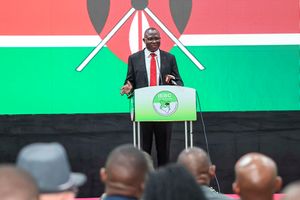
"Our objective is to set contribution and spending limits in order to create a level playing field for everybody who is contesting," IEBC Chairman Erastus Ethekon said during the launch of public consultations on the draft regulations.
"If we let money distort the will of the people, then we will be running against the constitutional principles of free, fair and accountable elections."
The proposed rules also prescribe spending ceilings, with presidential candidates allowed to spend up to Sh4.44 billion, while political parties fielding candidates from the presidency to the MCA level will have a combined ceiling of Sh17.7 billion.
Parliamentary, gubernatorial and county candidates will equally face expenditure limits depending on the size of their electoral areas.
Yet, even before the regulations become law, political players are openly acknowledging that the battle for 2027 will require unprecedented financial mobilisation.
Within the emerging opposition coalition, discussions are also focusing on the daunting question of how to finance a national campaign against an incumbent government.
Nation has established that the opposition technical committee is quietly developing a resource mobilisation framework aimed at sustaining campaigns from the presidency to the grassroots.
Coalition insiders admit that matching President William Ruto's logistical capacity and nationwide political machinery remains one of their greatest challenges.
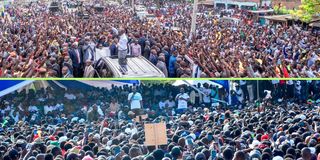
Wiper Patriotic Front Party Leader Kalonzo Musyoka addresses residents of Chwele in Kabuchai Constituency, Bungoma County, during a tour of Western Kenya by opposition leaders in July, 2026.
Photo credit: Pool
For Wiper Patriotic Front leader Kalonzo Musyoka and his allies, however, the answer does not lie in billionaires or secret financiers.
Makueni Senator Dan Maanzo says the opposition intends to rely on public fundraising rather than State resources, stating that elections become unnecessarily expensive only when politicians resort to bribery.
"Elections become expensive when candidates use money to bribe voters. They can actually be much cheaper when they are people-driven," Mr Maanzo told Nation.
He accused President Ruto’s government of using public resources to bankroll campaigns, saying the opposition would instead mobilise supporters and well-wishers.
"We shall fundraise for our coalition. You don't have to steal from government to run an election. The 2002 election proved that a people-driven campaign can overcome financial disadvantages."
The senator said the coalition's greatest asset is not wealthy financiers, but ordinary Kenyans yearning for political change.
"Our biggest resource is the people," he said.
His argument reflects a growing belief within sections of the opposition that crowdfunding and grassroots fundraising can reduce dependence on wealthy financiers who often expect political favours after elections.
Vihiga Senator Godfrey Osotsi, and a principal in the Linda Mwananchi movement, believes small contributions from ordinary Kenyans provide a healthier democratic model.
"The model of fundraising from ordinary people is the way to go to avoid post-election corruption due to vested interests by local and international funders," he said.
That philosophy has also been embraced by Linda Mwananchi’s de facto leader and Nairobi Senator Edwin Sifuna, who recently rejected Central Organisation of Trade Unions (Cotu) Secretary-General Francis Atwoli's public pledge to contribute Sh1 billion towards his presidential campaign.
Linda Mwananchi rally: Nairobi Senator Edwin Sifuna, who is in the Linda Mwananchi team, during a rally at Moi’s Bridge in Uasin Gishu County on July 25, 2026.
Photo credit: Jared Nyataya | Nation
Instead, Mr Sifuna has said that he would rather rely on crowdfunding than become indebted to powerful benefactors, reinforcing a narrative that elections should be financed by citizens rather than political financiers who would orchestrate “State capture” once he wins.
Yet, while the opposition talks about transparent fundraising, remarks by former Deputy President Rigathi Gachagua have highlighted the complex reality surrounding campaign financing in Kenya.
Mr Gachagua has publicly revealed that he deliberately avoided formal banking channels while mobilising campaign resources abroad.
"When I was abroad, I mobilised a lot of campaign funds," he said.
"I was cautious that if the money passed through the bank, the government would intercept it, so I brought it through some business friends in Eastleigh."
His comments have generated fresh debate because they stand in sharp contrast to the IEBC's latest proposals. If the draft regulations are adopted, candidates will be required to channel all campaign funds through designated bank accounts, making it significantly more difficult to move campaign money outside formal financial systems.
The proposed regulations also seek to track private donations, monitor campaign expenditure, audit campaign accounts and establish mechanisms for resolving disputes arising from campaign financing. The commission said the reforms are intended to operationalise the Election Campaign Financing Act, 2013, whose implementation has repeatedly stalled after Parliament rejected earlier regulations before the 2017 and 2022 general elections.
The debate has, therefore, moved beyond how much candidates should spend, and is increasingly becoming about where campaign money comes from, how it is spent and whether Kenyans will finally know who finances those seeking public office. Beyond the debate over campaign bank accounts and fundraising models lies an even bigger concern—whether Kenya's elections are gradually becoming contests of financial muscle rather than ideas.
The warning signs have become increasingly visible during recent by-elections, where opposition leaders accuse the government of deploying enormous financial resources to influence voters. The Ol Kalou parliamentary by-election has become the latest reference point.
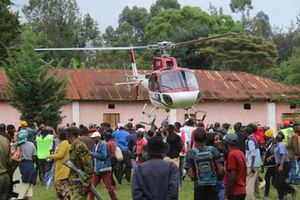
Mr Gachagua claimed government officials outnumbered voters in the constituency, describing the skies as crowded with helicopters ferrying senior officials and campaign teams.
Democracy for the Citizens Party leader Rigathi Gachagua salutes during a political rally at Mwingi Town in Kitui County on April 22, 2026.
Photo credit: Pius Maundu | Nation
In a rare joint statement, opposition leaders: Mr Gachagua, Mr Musyoka, former Chief Justice David Maraga, Jubilee presidential candidate Dr Fred Matiang'i, People's Liberation Party leader Martha Karua and Mr Sifuna alleged that the campaigns amounted to outright voter bribery and abuse of public resources.
"If this is a precursor to the 2027 General Election, then Kenyans have reason to worry because public money is not a campaign tool," the leaders said, accusing the government of violating election laws governing the use of state resources during campaigns.
Those concerns have been echoed by several opposition figures. Dr Matiang'i recently questioned the excessive deployment of government machinery during by-elections. He said that choppers, public officers and huge sums of money had become commonplace.
Nyamira Senator Okong'o Omogeni lamented that money capable of improving healthcare was allegedly being spent buying votes, while former Agriculture Cabinet Secretary Mithika Linturi claimed hundreds of millions of shillings were deployed during last year's Mbeere North parliamentary by-election.
Such claims reflect a growing perception that campaign spending is spiralling beyond the reach of ordinary politicians.
The era when political campaigns relied largely on party branches and volunteers has steadily given way to sophisticated, professionally managed operations requiring enormous financial investment.
Today's presidential campaigns involve fleets of helicopters, digital advertising agencies, public relations firms, pollsters, data analysts, social media influencers, branded merchandise, logistics teams, security personnel and elaborate voter mobilisation networks stretching across all 47 counties.
Behind many of those operations are wealthy financiers whose identities often remain unknown to the public despite legal provisions requiring disclosure.
Former President Uhuru Kenyatta enjoyed the backing of influential business leaders, including members of the Mt Kenya Foundation, which organised high-profile fundraising dinners to mobilise campaign resources.
The late Raila Odinga also relied on elaborate fundraising drives involving business leaders and supporters, while President Ruto built an extensive nationwide fundraising network long before ascending to State House.
Such fundraising models have become central to Kenya's presidential politics, with campaign dinners attracting millions of shillings from individual contributors while wealthy businessmen quietly bankroll candidates behind the scenes.
Political strategists involved in previous presidential campaigns estimate that a competitive bid can cost between Sh10 billion and Sh20 billion.
University of Nairobi political economist Prof Karuti Kanyinga has previously estimated that mounting a serious presidential campaign costs about Sh14 billion, largely because candidates must maintain visibility across all 47 counties and nearly every constituency during the campaign period.
Yet some opposition leaders insist elections should never become auctions won by the highest bidder.
People’s Liberation Party (PLP) leader Martha Karua argues that leadership should be determined by integrity rather than campaign generosity.
"It is not a money contest," she said.
"If we really want change, it is not enough to say 'Kasongo must go'. People should judge leaders by their character, competence and track record."
She has also accused President Ruto's administration of using public resources to gain political advantage, insisting that her party would spend only what it legitimately raises from supporters.
Civil society organisations believe the answer lies in enforcing existing laws rather than enacting new ones.
The Centre for Multiparty Democracy (CMD) argues that Kenya already possesses sufficient legal safeguards but has consistently failed to implement them.
Executive Director Frankline Mukwanja wants mandatory disclosure of campaign donations, stronger auditing by the IEBC and severe penalties for candidates who breach campaign finance rules.
"Transparency is essential to safeguard electoral integrity and public trust," he said, warning that opaque financing allows wealthy interests to shape political outcomes behind the scenes.
Its national coordinator, Mulle Musau, notes that the Campaign Financing Act of 2013 already outlines legal and illegal sources of campaign funds and gives the IEBC authority to regulate campaign financing.
According to Mr Musau, Parliament's repeated failure to approve implementing regulations has delayed full enforcement of the law.
He says the commission's latest proposals should finally compel candidates to disclose both the source and use of campaign funds while enabling investigators to determine whether electoral offences have been committed.
He also appealed to voters to reject vote buying, arguing that citizens remain the ultimate custodians of Kenya's democracy.
Political analysts, meanwhile, caution that the opposition faces a difficult balancing act.
Governance expert Mark Bichachi argues that attempting to compete with President Ruto on financial strength alone would be futile.
Instead, he says, opposition leaders should embrace technology-driven campaigns and harness the energy of Gen Z voters, many of whom have demonstrated an ability to organise without traditional political structures.
Professor Gitile Naituli agrees that campaign resources matter but says history shows they are never sufficient on their own to secure victory.
Dismas Mokua believes the opposition must first convince Kenyans that it offers a compelling alternative government before asking citizens to contribute financially.
"The 'Kasongo Must Go' slogan alone is not enough to make people part with their hard-earned money," he argues.
Governance expert Javas Bigambo reaches a similar conclusion, describing the opposition's limited financial resources as its greatest structural weakness heading into 2027.