Former Deputy President Rigathi Gachagua is waging a political comeback that now includes presidential ambitions analysts describe as either a brilliant gambit or a fatal misstep that could cast his career into the doldrums.
For some, the very idea of a Gachagua presidency is unthinkable given the impeachment tag hanging overhead like the Sword of Damocles. For others, it is too early to dismiss it.
His allies like to describe his maneuvering as four-dimensional chess. But chess, for all its grandeur, is still a game where pieces move predictably. In politics, the pieces are people, and they can walk away--or stick around.
Former Deputy President Rigathi Gachagua arrives at Jomo Kenyatta International Airport from the US on August 21, 2025.
Photo credit: Francis Nderitu | Nation Media Group
Initially thought to be largely a kingmaker in the united opposition, Mr Gachagua says he is best suited to take on President William Ruto head-on and deny him a second term in the 2027 polls, a position already rattling his co-principals in the coalition.
“I plead with you to support my presidential bid so that I can send Ruto home. He tricked us into going to the wedding (elections) on a borrowed horse (without our political party), but we know better now,” said the former deputy president on Sunday in Nyandarua.
He has previously expressed similar sentiments, which now appear to have been calculated.
“I believe that I am the best and should be the flag-bearer of our team. If that doesn’t happen and someone else is chosen, I have promised to support that candidate,” he first declared three months ago at the launch of his party, The Democratic Change Party (DCP).
Analysts say Mr Gachagua is trying to think 10 steps ahead while others are wrestling over the very next move. Whether that marks him as a visionary or a man out of sync with Kenya’s political reality is exactly the question that dominates political talk today.
Last October, Mr Gachagua became the first deputy president removed under Kenya’s 2010 Constitution after a bruising Senate impeachment on charges that included ethnic incitement, intimidation of judges, and abuse of office.
His lawyers insist the accusations were politically engineered, but the scars are indelible.
President Ruto wasted no time nominating Interior Minister Kithure Kindiki as his replacement, signalling closure, consolidation, and perhaps a warning to his former ally never to return.
Mr Gachagua’s lawyers argue that since he has challenged his impeachment before courts, its effect- disqualification from holding a State office- is suspended until the final judicial determination.
They cite the Supreme Court finding in the petition filed by impeached Nairobi Governor Mike Sonko that the disqualification only takes effect with the exhaustion of judicial review avenues.
Under the circumstances, they believe the former DP has three options to secure his clearance by the electoral commission to vie if he so wished.
The first is to overturn the Senate impeachment in courts on the basis he had been hounded out on mere political allegations and not a violation of provisions of Chapter Six on Leadership and Integrity of the Constitution.
Alternatively, Mr Gachagua could obtain temporary court orders suspending the impeachment pending a final verdict on the premise the case would not have been concluded by the time of the elections.
Finally, he could persuade the courts to declare that since his impeachment was ‘a political witch hunt’, Article 75(3) on improper conduct of a State officer that would lead to disqualification from holding State office does not apply.
While some in his camp genuinely want Mr Gachagua to run for the highest office in the land, others see it as the best strategy to force the other leaders in the United Opposition to submit, giving the ex-DP the longer end of the stick in the event of victory. They argue that this would give him more influential positions in the subsequent coalition government.
Those who want him to run- especially politicians seeking to ride on his coattails to secure their seats- argue that being on the ballot would guarantee the vote of the entire Mount Kenya region, and that DCP would win all the elective seats in the area, riding on the euphoria that his candidacy would generate. Mr Gachagua says he is targeting over 100 MPs in the next parliament to earn him a place at the negotiating table should he not become president.
Former Agriculture Cabinet Secretary Mithika Linturi echoes the opinion held by Mr Gachagua’s legal team.
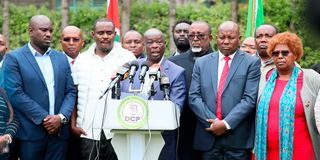
Opposition leaders Eugene Wamalwa, Rigathi Gachagua, Martha Karua, Kalonzo Musyoka, Fred Matiang'i, Mukhisa Kituyi, Justin Muturi and Mithika Linturi in Nairobi on April 29, 2025.
Photo credit: Pool
“There’s no hurdle on Riggy G’s path to contesting for presidency. The impeachment you refer to is already contested in court. And until such a matter is settled with the courts affirming it is when that argument can obtain, and if anything, we expect the courts to do justice to him. Also, he has not exhausted all legal avenues on this matter,” said Mr Linturi who was dropped from the Cabinet after the Gen Z revolt.
But Jubilee Party Secretary General Jeremiah Kioni disagrees. “Some civic education will help our people understand what being impeached under the 2010 Constitution actually means. When that happens, you’ll not see some people running around saying they can run for elective seats. Once impeached, you are being told you cannot start galvanising people behind you.”
In his Mt Kenya backyard, the paradox is more glaring. Mr Gachagua is admired as a combative opposition voice, yet somewhat doubted as a national leader.
“They want him to keep Ruto in check but not to take the reins,” one operative said ruefully.
“Given the choice between Gachagua and William, the mountain would prefer Tutam [two terms], not Wantam [one term],” another one retorted.
To students of Kenyan political history, the echoes of 1966 are difficult to ignore, when Jaramogi Odinga’s dramatic break with Jomo Kenyatta left him lionised as a dissenter but permanently exiled from power. Many wonder if Mr Gachagua is walking down the same lonely road.
The risks extend beyond his former stronghold. Should he insist on running, he would step into a crowded field where Prof Kindiki embodies establishment continuity, Ms Martha Karua offers reformist credibility, and restless disruptors like Mr Moses Kuria thrive on division and bare-knuckled approaches.
With retired president Uhuru Kenyatta’s Jubilee machinery also flickering back into play, Mr Gachagua could be nursing leverage, not a manifesto.
For a man already impaired by impeachment, the climb is steep, and every misstep could become defining.
Nowhere are these challenges more visible today than in Mbeere North, where a looming by-election has taken on the weight of an acid test.
DCP, which Mr Gachagua leads, sparked uproar after it abruptly withdrew its candidate Duncan Mbui in favor of a deal brokered with former minister Justin Muturi’s Democratic Party, handing the ticket to Mr Newton Karish.
Embu County DCP Chairman Joshua Kane rejected the deal outright, insisting Mr Mbui remains the grassroots choice and warning that forcing him out could lead to a “mass exodus” of supporters.
The fallout has exposed fractures that threaten to undermine Gachagua’s authority before his presidential ambitions have even been tested. If he cannot hold together his own party in Embu, critics ask, how does he expect to anchor a national coalition?
The stakes are heightened further by the shadow of Dr Ruto, described by rivals as Kenya’s ultimate political shark. The president, who built his career mastering raw electoral arithmetic, has shown a capacity to shed allies at will while recalibrating repeatedly.
With this calculation, Dr Ruto projects confidence that he can win a second term even without complete loyalty from the mountain.
Not everyone, however, believes Mr Gachagua’s presidential talk signals a genuine State House bid. Many in his ranks whisper that it is a bargaining chip, meant to keep him from negotiating out of weakness as coalitions shift.
Still, the gambit could go either way. His appetite for media exposure, constant fiery soundbites, and rolling allegations carry the danger of fatigue.
Political communicators warn he may “dance himself lame before the main dance,” losing attention before the contest truly begins.
Yet for all the skepticism, his story commands attention precisely because it forces Kenya to confront uncomfortable questions.
Is Mr Gachagua’s career finished, or is he only just beginning a long march back? Is his impeachment a permanent blot, or can he turn it into a badge of defiance? The by election in Mbeere, more than any court ruling or speech, may provide the first real answers.
Victory could establish him as the centre of opposition politics; defeat could consign him to the political wilderness.