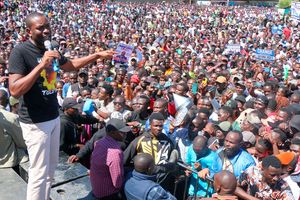
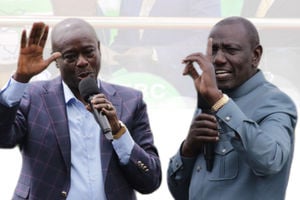
The battle for Kenya's 2027 presidency is steadily taking shape, as opposition leaders begin a three-day tour of Western Kenya tomorrow (Friday), a region they consider pivotal to the 2027 presidential contest.
The blitz comes ahead of Democracy for the Citizen’s Party (DCP) Rigathi Gachagua’s proposed 45-day retreat expected to shape the coalition's future.
This, he noted, would culminate in the delicate task of selecting a joint presidential flag bearer and running mate in a bid to avoid splitting the anti-President William Ruto vote.
On Friday, Mr Gachagua’s team – The United Alternative Government – will begin a three-day tour of Western Kenya to promote the anti-Ruto ‘Wantam’ campaign.
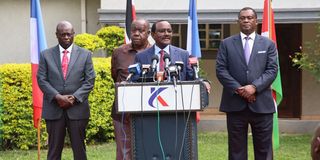
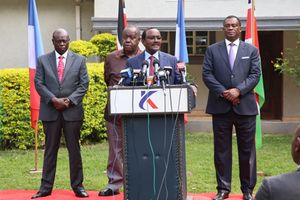
DCP party leader Rigathi Gachagua, Jubilee deputy party leader Fred Matiang’i, Wiper Party leader Kalonzo Musyoka and DAP-Kenya’s Eugene Wamalwa during a press briefing at the SKM Centre, Nairobi, on the opposition’s alternative budget proposals and key economic priorities.
Photo credit: File | Nation Media Group
The team brings together the former Deputy President, Wiper Patriotic Front Leader Kalonzo Musyoka, Eugene Wamalwa of the Democratic Action Party – Kenya, Martha Karua of People’s Liberation Party, Jubilee presidential candidate Fred Matiang’i and Justin Muturi of Democratic Party.
The region, according to Mr Wamalwa who will play host to the team, represents an equally critical battleground.
The leaders will embark on a three-day political blitz across Western Kenya counties of Vihiga, Kakamega, Busia, Bungoma and Trans Nzoia, a region they believe could become one of the decisive battlegrounds in the next General Election.
Speaking ahead of the tour, Mr Wamalwa said the opposition was entering a critical phase of coalition building after spending nearly two years traversing different regions of the country under the "Wantam Movement" (one term) banner.
According to Mr Wamalwa, Western Kenya has emerged as a strategic political theatre following the fallout between President Ruto and Mr Gachagua, which significantly altered political calculations in the vote-rich Mt Kenya region.
"The Western region will be one of the main battlegrounds between the One Term Movement and the Two Term Movement," he said, arguing that the ruling coalition is now focusing heavily on the region after losing substantial support in Mt Kenya.
The opposition believes the region's large voting population and its central role in national politics make it indispensable in determining the outcome of the next election.
Western Kenya has historically been a major political force, producing influential leaders and commanding a significant voting bloc across its five counties.
The region is also home to Prime Cabinet Secretary Musalia Mudavadi and National Assembly Speaker Moses Wetang'ula, two key allies of President Ruto.
For the opposition, winning over voters in the region is viewed as essential if it is to mount a credible challenge against the Kenya Kwanza administration.
Mr Wamalwa said the coalition intends to use the tour to popularise its message on economic hardships, taxation, governance, healthcare, education and youth issues.
He linked the birth of the ‘Wantam’ Movement to the 2024 Gen Z protests, saying that the demonstrations exposed deep divisions within the Kenya Kwanza administration and highlighted growing public dissatisfaction with government policies.
The opposition maintains that rising taxes, the housing levy, healthcare reforms under SHA, and the higher education funding model have increased the burden on ordinary Kenyans.
It also intends to continue pushing for accountability over the deaths and injuries recorded during anti-government protests, an issue likely to feature prominently during the Western Kenya engagements.
Beyond the regional tour, attention is increasingly shifting to the opposition's planned retreat, which Gachagua has described as a 45-day consultation process aimed at charting the coalition's future.
The consultative retreat is expected to bring together key opposition leaders, including Mr Wamalwa, Mr Gachagua, Mr Musyoka, Dr Matiang'i, Ms Karua and Mr Muturi.
Although several leaders have publicly expressed presidential ambitions, Mr Wamalwa insisted that unity would ultimately take precedence over individual aspirations.
"We all know that only one of us can become the sixth President of Kenya," he told the Nation at his DAP-Kenya party offices in Karen, Nairobi on Wednesday. He added that coalition principals understand that a divided opposition would struggle to defeat Dr Ruto.
The DAP-Kenya leader repeatedly invoked the 2002 political model that united opposition forces behind the National Alliance Rainbow Coalition (NARC), arguing that the same spirit of sacrifice and consensus would be necessary in 2027.
Political observers view the retreat as one of the most consequential opposition gatherings since the formation of the anti-Ruto alliance.
One of the biggest questions facing the opposition is how it will identify its presidential flag bearer.
Several options have been floated publicly, including opinion polls, delegate voting, and negotiated consensus.
Mr Wamalwa declined to reveal the preferred formula, describing it as a "strategic matter" that would be discussed internally.
However, he emphasised that the eventual candidate must satisfy several key criteria. Foremost among them, he said, is integrity.
According to Mr Wamalwa, Kenyans are demanding a leader with a clean public record, respect for constitutionalism and a commitment to fighting corruption.
He argued that any candidate seeking to lead the opposition should be prepared to undergo intense public scrutiny regarding their past conduct in public office.
The coalition is also expected to consider electability, regional balance, coalition stability and the ability to unite diverse political interests across the country.
Another critical element in opposition calculations is the possibility of a future alliance with the Linda Mwananchi movement associated with dissenting voices within ODM, led by the embattled ODM Secretary-General Edwin Sifuna.
Mr Wamalwa confirmed that discussions between the United Opposition and Linda Mwananchi leaders remain ongoing.
He likened the potential arrangement to the 2002 alliance between the National Alliance Party of Kenya (NAK) and the Liberal Democratic Party (LDP), which eventually formed NARC and defeated the KANU regime.
Should the two formations agree to work together, negotiations would involve power-sharing arrangements and representation in the coalition's leadership structure. "We are expecting them to come as partners, not followers," said Mr Wamalwa.
The opposition believes that a merger with Linda Mwananchi would significantly broaden its national reach and increase pressure on the ruling coalition.
The opposition enters the Western Kenya tour convinced that economic concerns remain its strongest campaign weapon.
Its leaders have consistently criticised government taxation policies, the housing levy, healthcare reforms and the management of strategic state assets.
They also intend to highlight unresolved grievances among sugar farmers in Western Kenya, where the future of major sugar factories remains a politically sensitive issue.
Mr Wamalwa accused the government of failing to honour promises made to sugarcane farmers and workers following reforms in the sector.
The opposition hopes these issues will resonate with voters across the sugar belt stretching through Kakamega, Bungoma, Busia and parts of Nyanza.
While the opposition insists that no final decisions have been made regarding a presidential ticket, the Western Kenya tour marks the beginning of a new phase in its campaign.
Having conducted political engagements in Mt Kenya, Eastern, Nairobi, Coast and Nyanza, the coalition is now focusing on Western Kenya before proceeding to the North Eastern region.
The planned retreat is expected to provide a platform for evaluating the coalition's strengths, reviewing regional feedback and determining the best path towards presenting a united front.
The opposition leaders are emphasising unity and patience, insisting that coalition building is a process rather than an event.
Whether they ultimately settle on a consensus candidate, a scientifically selected flag bearer or another formula altogether may determine not only the future of the coalition but also the shape of Kenya's 2027 presidential contest.
With the campaign season gathering momentum, Western Kenya is set to offer an early indication of how receptive voters are to the opposition's message and whether the coalition can transform its promise of making Dr Ruto a ‘wantam’ president into a viable national alternative.