The political rapprochement between Kanu Chairman Gideon Moi and President William Ruto was expected to open a new chapter in their long-running rivalry.
But with questions lingering over the terms of their understanding, fresh tensions surrounding the Moi family over the Eldoret land dispute, and new realignments ahead of the 2027 General Election, the Kanu chairman’s return to the political arena on Friday could test a new battle for influence taking shape.
Mr Moi is expected to address a range of issues, in a meeting with party officials and opinion leaders, surrounding his political dealings with the President at his Kabarak home in Nakuru, including the apparent failure of their handshake and the circumstances that have complicated efforts to build a working relationship between the two leaders.
His remarks, insiders confided in Nation, could offer fresh insight into a political arrangement that had raised expectations of reconciliation between two influential figures whose rivalry has shaped the contest for power, particularly in their Rift Valley backyard.
Kanu first vice-chairperson Ibrahim Sheikh confirmed the Friday meeting but did not divulge details.
“I understand the Chairman is already en route to Kabarak by air,” Mr Sheikh told Nation on Thursday evening.
He said the meeting was scheduled to begin at 9 am at Kabarak and directed those seeking further details to the party’s National Executive Council Secretary for Communications.
“The meeting is scheduled to commence at 9am at Kabarak,” Mr Sheikh said, saying he was invited but will not attend as he was out of the country.
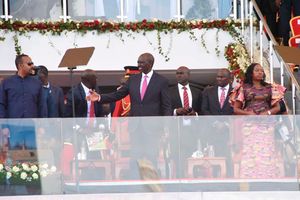
Party Leader Gideon Moi makes his address on October 10, 2025 after President William Ruto visited Kabarak Home in Nakuru County.
Photo credit: Boniface Mwangi| Nation Media Group
Mr Moi’s move to open up comes against the backdrop of President Ruto’s recently concluded campaign-style tour of the North Rift, which culminated in Mashujaa Day celebrations in Eldoret on Tuesday.
At the centre of the anticipated address is the question of what went wrong between the two leaders after their rapprochement raised hopes of a new political understanding.
Mr Moi is expected to speak about the breakdown of his deal with President Ruto and what he considers the administration’s increasingly difficult posture towards him and his family, amid complaints over developments affecting their interests.
“The deal we had with President Ruto has not worked out as expected. There are growing concerns about how the Moi family and its interests are being treated by this administration, and I believe Kenyans deserve to understand what happened and why the relationship has taken this turn,” a Kanu stalwart told Nation.
The tensions have also extended beyond the political arena, with the Moi family raising concerns over what it describes as moves targeting its land in Eldoret.
The dispute has added another dimension to the strained relationship, fuelling questions about whether the understanding between the two political families can survive competing interests and the pressures of the approaching election cycle.
But even as the Kanu chairman weighs his next move, there are indications that his political future could lie outside the arrangement with President Ruto.
Insiders told the Nation that Mr Moi could soon join the growing list of opposition presidential candidates and become a principal in the United Opposition, in what would amount to a strategic bid to challenge the President’s influence in the Rift Valley ahead of the 2027 elections.
For Mr Moi, the journey back to the centre of Kenya’s political stage was supposed to be a carefully negotiated affair, built on reconciliation, mutual trust and a bargain that would restore his family’s influence in government.
But barely months after President Ruto made a symbolic visit to Kabarak, the political arrangement that appeared to end decades of rivalry between the two men is facing an uncertain future, with growing disquiet within Kanu over what its leaders say are unfulfilled promises.
The former Baringo senator made a dramatic political calculation in September 2025 when he abandoned his bid to reclaim the seat he held between 2013 and 2022, clearing the way for the ruling United Democratic Alliance (UDA) candidate to win the November 27 by-election.
The decision, made a day after Mr Moi met President Ruto at State House, was widely interpreted as the price of a political understanding that would return Kanu to the corridors of power and restore the influence of the family of retired President Daniel arap Moi.
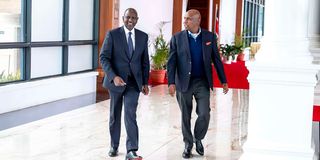
President William Ruto and KANU Party Leader Gideon Moi after a meeting at State House, Nairobi.
Photo credit: PCS
Yet, more than a year after the initial rapprochement began, questions are mounting over whether Mr Moi has secured the political dividends he anticipated or surrendered valuable electoral ground in exchange for assurances that remain largely unfulfilled.
For a politician whose family name once dominated Kenya’s political establishment, the stakes extend beyond a handful of government positions.
The rapprochement offered Mr Moi an opportunity to revive Kanu, regain national relevance and protect business interests that have faced difficulties under the Ruto administration.
But the delay has raised a difficult question: did Mr Moi miscalculate the value of the political concessions he made, or is the apparent silence simply a temporary setback in a longer strategy to reclaim influence?
The latest development threatening to complicate the rapprochement is a dispute over a five-acre parcel of land owned by the Moi family near Eldoret State Lodge, where the family claims armed officers entered the property and ordered workers to leave.
Through its lawyer, Moses Mutisya, the family has alleged that the takeover was politically motivated and intended to frustrate it. The property, registered as Eldoret Municipality Block 8/62, is located opposite the presidential residence in Uasin Gishu County.
The lawyer alleged that a senior government official had directed the eviction of occupants of properties neighbouring the presidential residence to facilitate the construction of security fences.
The family maintains that it has owned and used the property since 1996 without a dispute of this nature and has threatened legal action if the matter is not resolved.
The land dispute has thus added to the uncertainty surrounding a relationship that was expected to end years of hostility between the two political families.
The political thaw between Mr Moi and Dr Ruto began taking shape in 2025, after years of rivalry that had come to symbolise the struggle for political supremacy in the Rift Valley.
The rivalry between Dr Ruto and the Moi family dates back to 1997 and intensified during the 2013 and 2017 elections. The tensions were particularly evident in 2018, when Dr Ruto was reportedly blocked from visiting the ailing former President Moi at Kabarak.
The relationship between the younger Moi and the President subsequently underwent a dramatic transformation, culminating in a visit by Dr Ruto to the Moi family home in Kabarak on October 10, 2025.
The venue was significant. Kabarak was not merely the home of a former President; it was the centre of a political legacy that had shaped Kenya for nearly a quarter of a century.
Addressing supporters, Dr Ruto said he had consulted the late Raila Odinga, former President Uhuru Kenyatta and Gideon Moi as part of efforts to bring leaders across the political divide together.
“This is a national project,” the President said. “We must pull together as a team to move Kenya to the next level.”
He also took personal responsibility for the rapprochement, saying: “If there’s anyone to blame for Gideon’s change of heart, it is me—not him.”
In response, Mr Moi praised the President and urged unity in Baringo, joking that Dr Ruto had “washed him clean” before calling on the community to move together.
The symbolism was unmistakable. Two families whose political relationship had been marked by suspicion and rivalry were now presenting themselves as partners in a common national project.
But behind the public display of unity lay negotiations over the future of Kanu, the place of the Moi family in government and the possibility of reviving business interests that had encountered difficulties.
Multiple sources told Nation that Mr Moi’s decision to abandon the Baringo Senate race was linked to the understanding reached with Dr Ruto.
However, other Kanu leaders, including Samburu East MP Naisula Lesuuda, criticised Mr Moi for failing to consult party members, arguing that Kanu had structures from the grassroots to the national level that deserved to be involved in such decisions.
On Thursday, former Kanu Secretary-General Nick Salat urged Mr Moi, his former boss, to reconsider his political direction, arguing that he should work with Dr Ruto rather than position himself against the President.
“My advice to him is that for everything he does, let it be in the interest of the Kalenjin community and the entire nation,” Mr Salat said.
He added: “He should stand with his brother the way he stood with his father. Leadership must be protected.”
Mr Salat also invoked the legacy of the former President, arguing that Dr Ruto should be allowed to complete his term and drawing a parallel between the criticism faced by the current Head of State and that endured by the elder Moi during his 24 years in power.
“Gideon should stand with his brother to complete his term,” he said.
His remarks reflect the argument among some Rift Valley leaders that Mr Moi should consolidate the reconciliation rather than reopen political hostilities with a President who has established a firm electoral base in the region.
The uncertainty surrounding the Moi-Ruto deal has also revived speculation about whether Mr Moi could eventually turn towards the opposition.