The race for the Rongai parliamentary seat in Nakuru County is shaping up as a battle between two political families, with members of the Moi and Komen families positioning themselves to challenge the incumbent in the 2027 General Election.
Rongai, the home constituency of the late President Daniel arap Moi, is emerging as a test of whether family legacy and established political networks can withstand the popularity of President William Ruto’s United Democratic Alliance (UDA) in the Rift Valley.
With barely 10 months to the election, former MP Raymond Moi faces the prospect of going head-to-head with his sister-in -law Faith Milkah Moi, the widow of Jonathan Moi, the eldest son of the former president.
The two members of the Moi family are seeking the seat currently held by UDA’s Paul Chebor, setting up a potentially bruising contest within a family that wielded enormous influence over Kenya’s politics for decades.
Raymond, who represented Rongai for two terms between 2013 and 2022, is seeking a political comeback after losing to Mr Chebor in the last election.
He recently declared his intention to contest again during his son’s wedding ceremony in Kabarak, signaling the determination to reclaim the seat.
Raymond is banking on his development record particularly the distribution of Constituency Development Fund (CDF) resources during his tenure, to win back voters.
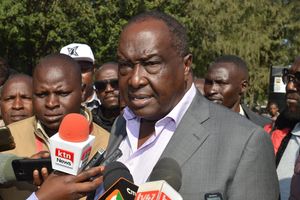
Then-Rongai MP Raymond Moi speaks to journalists at Mercy Njeri Primary School after casting his vote in the repeat Rongai parliamentary elections on August 29, 2022.
Photo credit: File | Nation Media Group
“During my tenure, I distributed resources equitably and the impact of my development projects was felt in all corners of Rongai,” he said at a recent function.
But his sister-in-law is also preparing for a fight pitching her candidacy on accountability, equitable development and a promise to give residents a greater say in how public resources are used.
“I will vie for the Rongai parliamentary seat. The people of Rongai deserve accountable leadership that serves the people,” Ms Moi said.
Campaigning under the slogan “Chukua Kura, Aminia Mama”, she has pledged to ensure that no ward is left behind in development.
“No ward will be ignored under my leadership. No funds will be misused because every shilling belongs to the people,” she said.
The Moi family is not the only political dynasty seeking to reclaim its influence in Rongai. Two sons of former MP and veteran politician Willy Komen, Andrew Kibet Komen and Raymond Komen, are also eyeing the seat, setting up another potential contest between members of the same family.
His son Andrew, popularly known as the “Rongai Hustler”, contested the seat in 2017 and finished second. He tried again in 2022 but lost to Mr Chebor.
His brother Raymond, a former County Executive Committee member for Trade and Tourism in the Lee Kinyanjui administration, also contested the seat in 2022 but lost to the incumbent.
Raymond Komen.
Photo credit: File | Nation
As the 2027 contest approaches, Andrew has increasingly aligned himself with President Ruto and his allies seeking to secure the UDA nomination.
“I am confident I will win the MP seat with a landslide in 2027 and serve the Rongai people,” he said.
The entry of the two families adds another layer to an already competitive contest with the UDA nomination likely to be a key battleground for aspirants seeking to capitalise on the ruling party’s support in the region.
Political analysts say the contest will be shaped by family loyalties, party politics, development concerns and the shifting political alliances that have defined the Rift Valley since the 2022 elections.
Lawyer and political analyst Steve Kabita said the late President Moi’s political legacy remained influential in the constituency, even six years after his death.
“Six years after President Moi’s death, his larger-than-life political stature still looms large. In 2027, it will greatly play a role in the contest,” Mr Kabita told the Nation .
He said the frosty relationship between the Moi family and President Ruto could further complicate the race alongside the UDA wave that swept through much of the Rift Valley in the 2022 elections.
Local political analyst Jesse Karanja said Faith Moi’s candidacy represented both continuity and change as she would draw on the family name while seeking to establish herself as a woman candidate in her own right.
“The contest will test whether the Moi dynasty’s influence can withstand UDA’s popularity in the area and whether voters will prioritise family legacy or development,” he said.
Beyond the family rivalries, the constituency faces pressing concerns over agriculture, particularly horticulture and dairy farming, youth unemployment, education, healthcare and infrastructure.
These issues are likely to shape campaigns as aspirants seek to convince voters that they can deliver tangible improvements to their livelihoods.
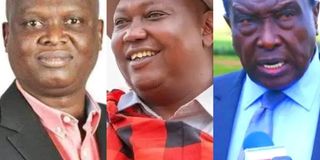
From Left: Kibet Komen, Paul Chebor and Raymond Moi
Photo credit: COURTESY
Kanu has won the Rongai seat four times since the constituency was carved out of the larger Nakuru North constituency, now Subukia, in 1988. Raymond Moi first won the seat in 2013 on a Kanu ticket.
The 2022 election was largely a two-horse contest between Kanu and President Ruto’s UDA, with Mr Chebor emerging victorious. The constituency’s political direction in 2027 will therefore be an important indicator of whether UDA can retain its grip on the region or whether established political families can stage a comeback.
Rongai’s electorate is also diverse, adding another dimension to the contest. The Kalenjin and Kikuyu communities are the dominant groups and largest landowners, while minority communities, including Luos, Kisiis, Luhyas, Turkanas and Kambas, account for an estimated 25 per cent of voters. Many work on sisal farms, while others have acquired land and settled in the constituency.
The votes of these communities could prove decisive in a closely fought race, particularly if candidates split support along party, family or community lines.