A row is brewing between governors and the Commission on Revenue Allocation (CRA) over the proposed Sh440.84 billion equitable revenue share for counties in the 2027/28 financial year.
The county bosses are demanding at least Sh500 billion to meet rising wage bills, health sector obligations and the cost of devolved functions.
The Council of Governors (CoG) has rejected the proposed allocation, arguing that the additional resources required to implement salary increments, honour collective bargaining agreements and fund functions transferred to counties have not been adequately factored into the recommendations.
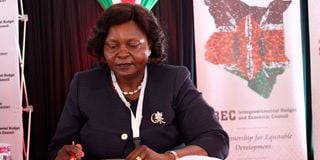
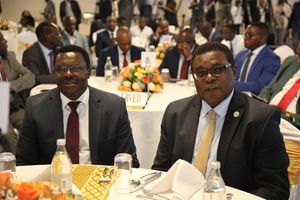
The dispute emerged during a consultative meeting between the CRA and the Council of Governors in Nairobi, where CRA chairperson Mary Chebukati defended the commission’s proposal, saying the allocation represented a three per cent increase, or Sh12.84 billion, from the Sh428 billion allocated to counties in the current financial year.
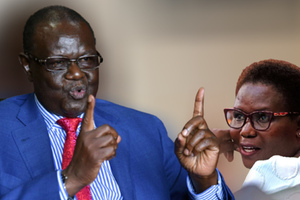
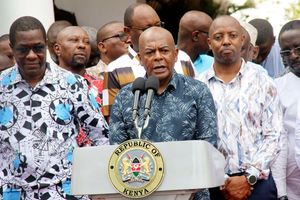
But CoG chairperson Muthomi Njoki questioned the methodology used to arrive at the figures, accusing the commission of relying on outdated financial data and failing to account for the financial implications of salary adjustments recommended by the Salaries and Remuneration Commission (SRC).
“I did mention earlier that I do not see the independence of the Treasury. There is a mischief that is clearly expected in what has been presented by the chair of CRA. Some of them are beyond probably what a commission of revenue allocation can do,” Mr Njoki said.
He took issue with the use of audited and approved revenue accounts for the 2022/23 financial year as the basis for determining the allocation for 2027/28, arguing that more recent accounts should be available to guide the process.
“How do you use audited accounts of the year 2022-2023 when we are allocating resources for 2027-2028, almost five years later?” he asked.
He argued that using more recent accounts would provide a more accurate basis for determining the resources available for sharing between the national and county governments, potentially strengthening the case for a higher allocation to devolved units.
The CRA has recommended that the national government receive Sh2.79 trillion, while the 47 county governments would share Sh440.84 billion in the 2027/28 financial year.
Ms Chebukati told governors that the proposed county allocation represented 21.5 per cent of the most recent audited and approved revenue accounts, which stood at Sh2.05 trillion for the 2022/23 financial year.
She said the commission had taken into account the risks surrounding revenue collection, particularly during an election year, when economic activity and ordinary revenue performance could come under pressure.
“Past trends in ordinary revenue performance have shown significant revenue under-performance during election years,” she said.
The commission projects that total shareable revenue will rise from Sh2.98 trillion in 2026/27 to Sh3.24 trillion in 2027/28, an increase of about Sh263.5 billion. Despite the projected growth, the proposed allocation to counties is lower than the Sh458 billion CRA had initially recommended for the 2026/27 cycle.
The council has said county governments need an additional Sh21 billion to implement salary increments recommended by the SRC, Sh2 billion to meet collective bargaining agreements covering doctors, nurses and clinical officers, and Sh8.6 billion for staff employed under Universal Health Coverage (UHC) programmes.
The governors have also identified Sh33 billion as necessary to finance unbundled functions transferred to counties, arguing that the cost of devolved responsibilities must be reflected in the resources made available to county governments.
Mr Njoki questioned why the SRC could recommend salary increases without establishing how the additional expenditure would be financed, warning that the disconnect between remuneration decisions and available resources risked fuelling industrial disputes in the public sector.
“Why does the Salaries and Remuneration Commission give recommendations of an increment of 21 billion without consideration where those resources will come from? What do they base their increment on?” he asked.
He said county governments were frequently forced to contend with industrial unrest involving health workers and other public servants because of commitments that public institutions struggled to finance.
“We have to strike a balance between those promises and the resources. Because we have to be candid in our conversation, in what we agree,” he said.
The governors say an allocation below Sh500 billion would constrain their ability to deliver services, particularly in health, where counties remain responsible for paying workers and sustaining facilities.
He also said that the Equalisation Fund, through which the CRA has proposed Sh10.25 billion for marginalised regions, should not be treated as an increase benefiting all 47 counties because the fund targets historically disadvantaged areas.
“The Equalisation Fund is not found in all counties in Kenya. It's just found in a few counties. Therefore, it cannot be seen as an increase for the 47 counties of Kenya,” he said.
Ms Chebukati said the commission remained open to consultations on the revenue-sharing recommendations, signalling that negotiations over the final allocation could continue as the proposals move through the budget process.
“We have often asked the SRC to consult us whenever they are making the salary adjustments so that we can answer questions on where the resources will come from, but they have declined to do so. We will certainly sit down and agree on the allocation,” she said.
The recommendations are expected to face scrutiny in the Senate, which has historically pushed for higher allocations to counties to support service delivery, meet recurrent expenditure and finance development projects.
CRA is still developing its official recommendations, which are legally required to be submitted to Parliament by the end of October 2026.
The ongoing consultations are aimed at building consensus and resolving differences before the proposals are formally tabled.