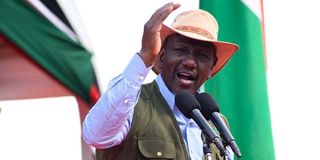
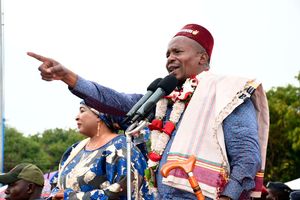
President William Ruto is laying the groundwork for his 2027 re-election bid through a range of strategic initiatives that touch on the political, economic, and social fronts.
While public attention is often on day-to-day governance, behind the scenes, President Ruto’s lieutenants are executing a silent but strategic campaign aimed at locking in support across key voting blocs.Raila Odinga . Dr Ruto has launched massive grassroots empowerment programmes spearheaded by his deputy, Prof Kithure Kindiki, as well as targeted regional development and appointments.
DP Kindiki : Our main focus as government is on development, not divisive politics
Still top of mind is a constituency he banked on to deliver victory in the 2022 elections — the Church — even as he also seeks to capitalise on his achievements in housing, health reforms, agriculture, youth empowerment, and digital initiatives. Prof Kindiki on Saturday hinted at a possible Ruto-Raila alliance ahead of the 2027 polls, even though Mr Odinga has remained non-committal on his next move.
Speaking at the Kuria East Constituency Economic Forum in Migori County on Saturday, Prof Kindiki sought to quell doubts about the strength of the emerging alliance, suggesting that his efforts, coupled with a combined Ruto-Raila voting bloc, would be too formidable for the Opposition to defeat.
“If you look at William Ruto, me, and now that we have His Excellency Raila Odinga on our team, do we look like people who can be defeated by [the Opposition] during campaigns?” Kindiki posed.
Deputy President Kithure Kindiki addressing Likoni residents at Shelly Beach Grounds in Mombasa County on July 5, 2025.
Photo credit: Wachira Mwangi | Nation Media Group
“We are focused on working for Kenyans. The time for campaigns will come,” Prof Kindiki said.
Reached for comment, ODM Secretary-General Edwin Sifuna was more cagey, only saying that they discussed “largely administrative issues.”
The Head of State is reportedly executing a performance-based campaign blueprint designed to win over voters through “delivery, discipline, and direct impact.”
Dr Ruto is painting his Kenya Kwanza administration as a stabiliser of the economy, expanding housing, revamping agriculture, reforming healthcare and education, and creating hundreds of thousands of jobs, especially for youth. At the heart of his re-election calculus lies the macroeconomic story he is crafting, in which inflation has dropped from 9.6 percent in September 2022 to 3.8 percent in June 2025.
“The shilling has gained significant ground against the dollar, rising from Sh162 to Sh129. The Treasury Bill rate has nearly halved, while foreign exchange reserves have hit a historic high of $10.8 billion,” he says.
State House spokesperson Hussein Mohamed argues that, in Kenya Kwanza’s Bottom-Up Economic Transformation Agenda (Beta) , the Affordable Housing Programme stands as a beacon.
Deputy President Kithure Kindiki (left) with the Speaker of the National Assembly Moses Wetang'ula during a youth and women empowerment drive at Shelly Beach Grounds in Mombasa County.
Photo credit: Wachira Mwangi | Nation Media Group
President Ruto has revealed that the number of Kenyans registered on the Boma Yangu housing portal has surged past 720,000—indicative of deep public buy-in.
With plans to expand Kenya’s mortgage base from 30,000 to one million borrowers, says the President, the housing programme is not just about shelter, but a political economy tool, targeting middle and lower-income voters with visible, tangible benefits.
Universal Health Coverage (UHC), under the TaifaCare initiative, has emerged as another key pillar in the President’s re-election arsenal.
Over 23.7 million Kenyans are already enrolled, with nearly 60,000 registering daily. The Social Health Authority (SHA) has cleared over Sh49 billion in reimbursements and claims—figures Dr Ruto cited during the recent Cabinet retreat to demonstrate the government's commitment to accessible healthcare.
President Ruto who rose to power as the “Hustler-in-Chief,” has not forgotten his rural power base. His administration has also highlighted major wins in agriculture: fertiliser subsidies that, he argues, have raised food production by 50 percent, while coffee prices have more than doubled and sugar production has grown from 490,000 to 815,000 metric tonnes.
Political analyst Dismas Mokua argues that President Ruto “will reap big time if his policy interventions pay dividends before the elections.”
The Head of State, he opines, “must recalibrate his national engagement agenda by abandoning visibility and engaging in strategic communications.”
In a recent interview with Prime Cabinet Secretary Musalia Mudavadi , he admitted that the Kenya Kwanza administration has fallen short in effectively communicating its achievements to the public.alleged extra-judicial killings , governance, and accountability, Mr Mudavadi acknowledged that while the administration has rolled out several impactful programmes, poor communication has hampered public understanding and support.
“That’s one key area we have some homework to do,” Mr Mudavadi said. His remarks came amid growing frustration among citizens, particularly young people, who accuse the government of being detached from public concerns and insensitive to the economic hardships gripping the country. Mr Mokua says President Ruto should craft a strategy to manage public resentment besides using innovative strategies in social media management.
With less than two years to the next General Election, Dr Ruto is crafting a quiet but potent campaign machine, one built on policy, performance, and perception.[email protected]