Kenya’s development planning has mainly been undertaken in five-year cycles since independence.
It began with the Sessional Paper No 10 of 1965 on African socialism and its application to planning in Kenya, to the Kenya Vision 2030 blueprint, which was adopted in 2008.
Vision 2030 would later be formally anchored by its own policy document- Sessional Paper No. 10 of 2012- giving it a distinct administrative and policy footing, as the Sessional Paper No. 10 of 1965 remained a foundational historic philosophy for post-independence Kenya.
Vision 2030 is anchored on three key pillars: economic, social and political.
The Economic pillar aimed at achieving a 10 percent economic growth rate annually from 2012, with the social pillar targeting the creation of a just, cohesive and equitable social development “in a clean and secure environment.”
The Political pillar targeted the realisation of an issue-based, people-centred, result-oriented and accountable democratic system.
Details from the Office of the Auditor-General (OAG) and Office of the Controller of Budget (CoB), state-funded independent oversight bodies, detail how Vision 2030 flagship projects have been disrupted by political shifts, ballooning public debt and financial mismanagement.
But as the executive defended the policy changes as strategic alignments, the OAG and OCoB have identified structural systemic issues that have watered down the original master plan.
The International Journal of Finance and Accounting (IJFA) in its 2025 publication notes that the fiscal environment directly undermines long-term national goals.
“The constrained funding and poor execution of capital projects are frequently cited as reasons for missed milestones under Kenya’s Vision 2030 development blueprint,” says IJFA.
IJFA notes that despite the adoption of the Medium-Term Expenditure Framework (MTEF) to instil fiscal discipline and strategic foresight, Kenya’s budget performance, specifically measured through its annual budget execution rate and its alignment with Vision 2030 capital project milestones, remains chronically weak.
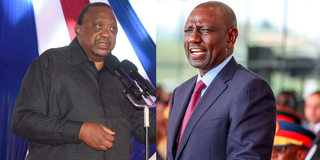
Critics argue that immediate former President Uhuru Kenyatta and his successor William Ruto watered down Kenya Vision 2030 by shifting from a structured, technocrat-led blueprint to short-term political manifestos that have succeeded in exposing the country to expensive debts currently at Sh13 trillion and slow industrial debts.
While Vision 2030 had projected the manufacturing sector to contribute 15 percent to GDP in interim measures while targeting a 30 percent contribution in the long term.
However, data from the National Treasury shows that between 2025 and 2026, manufacturing contributed between 7.1 percent and 7.2 percent of the GDP.
According to University of Nairobi lecturer Mr Herman Manyora, rather than expanding, Kenya has faced premature de-industrialisation “as capital shifted towards services and real estate rather than high-value factories.”
“Vision 2030 was designed to make Kenya a manufacturing hub. But instead, the sector’s contribution to GDP stagnated during both administrations, leaving the economy dependent on consumption and services rather than high-productivity exports,” says Mr Manyora.
Initiated and launched by former President the late Mwai Kibaki, Vision 2030 targeted a 10 percent annual GDP growth and transformation into an upper-middle-income industrialized economy.
For instance, former President Uhuru Kenyatta’s Big Four Agenda, launched in his second term, compressed Vision 2030’s broad medium goals into four economic pillars- manufacturing, affordable housing, universal healthcare and food security.
According to Kisii Senator Richard Onyonka, President Ruto-led Bottom-Up Economic Transformation Agenda (Beta) substituted the established Vision 2030 trajectory for his “own transactional interests.”
“If you look at the transformation from Mwai Kibaki’s government to Uhuru’s government and now William Ruto’s government, President Ruto dumped the Vision 2030 initiatives and decided to bring in the bottom-up approach,” said Senator Onyonka.
“Bottom-up was brought not because people loved Kenya. it is because they wanted to do business. To transact and make money as opposed to earning money,” added Senator Onyonka.
This has led to manufacturers facing steep electricity tariffs, logistical bottlenecks, and aggressive tax measures, making Kenyan products less competitive globally.
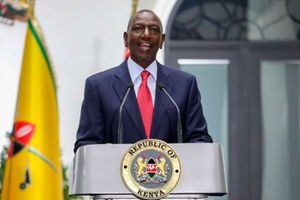
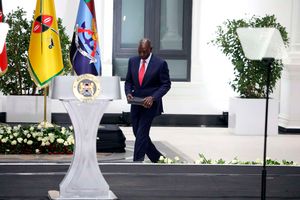
Recently, in a historic shift, President Ruto announced a national dialogue to abandon the Vision 2030 transition into a new national development charter- Vision 2060.
The president, while launching the Vision 2060 at State House, admitted that Kenya would miss Vision 2030’s core target of achieving middle-class status by 2030.
He noted that the vision lacked firm constitutional backing, leaving its implementation vulnerable to shifting political interests.
National Treasury Cabinet Secretary John Mbadi, however, defended the performance of Vision 2030, saying that Kenya has largely delivered on the blueprint and achieved major milestones.
John Mbadi the Cabinet Secretary for National Treasury and Economic Planning.
Photo credit: File | Nation Media Group
“We have largely implemented Vision 2030, and in a Vision, you don't have to hit all; there are some misses. But largely, we achieved a lot under Vision 2030. It is what has directed development in this country," said CS Mbadi during a government review meeting.
The CS also dismissed claims that the administration was abandoning its economic commitments, noting that the new Vision 2060 was not a personal project of President Ruto.
“Now is the time to sit together, engage, dialogue, agree on where Kenya is going,” the CS added.
According to the National Treasury’s April 2024 fourth Medium Term Plan, since its adoption in 2008, the Kenya Vision 2030 has been implemented through successive five-year Medium-Term Plans (MTPs).
The first three plans covered the periods 2008-2012, 2013-2017 and 2018-2022.
The medium plan III, which brought the Big Four agenda, birthed an official policy shift under President Uhuru.
Instead of broadly executing the multi-sector flagship projects designed in 2008, the government compressed state funding into the chosen Big Four agenda pillars.
This led to the Kenya Vision 2030 Delivery Secretariat issuing statements clarifying that the Big Four Agenda had not replaced Vision 2030 over policy disruption.
The fourth Medium Term Plan (MTP IV) covering 2023-2027 is the last five-year plan designed to transition the country to the next long-term development blueprint.
“These plans are informed by national development priorities and global and regional development obligations such as the United Nations 2030 Agenda for Sustainable Development and the Africa Agenda 2063 among others,” says the National Treasury document.
Launched by President Ruto, the MTP IV shifts focus toward the BETA agenda.
“The MTP IV unbundled the final stretch of Vision 2030 to focus strictly on localised informal sectors, digital jobs and agricultural subsidies,” says the State Department for Economic Planning, adding: “This redirected state priority away from the massive macro-level industrialisation clusters originally envisioned under Kibaki.”
According to the World Bank, Kenya's Vision 2030 aspired to achieve middle-income status by 2030, which required sustaining an annual average GDP growth rate of 10 percent.
“Restarting the export sector growth engine will be imperative to achieve these targets,” the World publication on the manufacturing export competitiveness in Kenya says.
The document has a specific focus on export performance and the manufacturing sector, including domestic production and sales.
In particular, the World Bank says manufacturing exports are critical because of their impact on growth, employment and economy-wide linkages.
The World Bank document further notes that Kenya's manufacturing sector exhibits several strengths and that its global share in exports increased over the last 20 years.
This is due to the strong position it enjoys in terms of exports to the regional East African Community (EAC) market, “particularly in some high value sectors like chemicals and pharmaceuticals.”
This background note aims to provide the government with policy focus and tools to tackle the constraints keeping Kenya from reaching its potential in manufacturing export competitiveness.
As the Uhuru-Ruto Jubilee government aggressively pursued massive capital projects like the Mombasa- Nairobi - Naivasha Standard Gauge Railway (SGR) that cost Kenyans Sh500 billion, it created a high commercial debt burden.
The burden shrank the country's fiscal space and left minimal capital to fund human resource development and welfare as the government resorted to more borrowing as projects stalled.
Data from the National Treasury shows that out of the 44 original flagship projects, only five have been fully completed, with the rest classified as stalled, cancelled or perpetually ongoing.
Konza Technopolis, which was envisioned under the late Kibaki administration as Africa’s premier Silicon Savannah, suffered from reduced funding and lost momentum as subsequent administrations redirected attention to different localised digital and housing goals.
A report by Auditor-General Nancy Gathungu on the accounts of the national government for the fiscal year 2024/25 reveals massive losses of Sh2 billion at Konza Technopolis smart city, a Vision 2030 flagship project.
An artist’s impression of the Konza ICT city project to be located 60km from Nairobi. Photo/FILE
Ms Gathungu cites the Sh31.2 billion stalled capital projects, the multi-billion-dollar losses at Konza Technopolis, constant delays at Galana Kulalu irrigation scheme, among others.
This has disrupted the economic pillar by failing to establish functional industrial, smart-city and agricultural hubs.
The Galana Kulalu project was intended to secure national food security under Vision 2030 but has faced financial impropriety issues.
They arise from the many audit queries as flagged by the OAG, including the Sh2.9 billion electrification that stalled at 50 percent due to underperforming contractors and lack of oversight.
Under the social pillar, the digitisation of land registries, Ardhi Sasa, was critical in stopping fraud but has not been actioned.
A forecast report released by Dr Nyakang’o warns that the country’s economy had been severely crippled by pending bills and ballooning public debt, starving the private sector- “the very engine of Vision 2030.”
Dr Nyakang’o notes that the Sh49.2 billion in pending bills and the multi-trillion national debt ceiling breaches starved private-sector contractors of cash flow, stalling projects and keeping the GDP growth far below the 10 percent target.