The 10 counties of Nyanza and Western regions account for close to a third of the five million new Gen Z voters targeted for registration ahead of the 2027 General Election, according to an analysis of official population data.
A review of the data reveals that of the 6.3 million voters the Independent Electoral and Boundaries Commission (IEBC) projects to register by 2027, 5.1 million are Gen Zs born between 2006 and 2009. They were aged 10 – 13 when the 2019 population census was conducted.
They will be eligible for voting for the first time, while the additional 1.2 million had attained the requisite age for obtaining the national identification document before the 2022 polls, but did not register to participate in the last polls.
In the event IEBC meets this target, the 2027 register will have a total of 28 million voters, up from 22.1 million in 2022. The new Gen Z voters perceived not to identify with any of the major political players, who have historically rallied the country along ethnic lines, will form a crucial voting bloc with the potential of influencing the 2027 election outcome.
Independent Electoral and Boundaries Commission clerks register voters at Eldoret National Polytechnic in Eldoret City, Uasin Gishu County, on March 30, 2026.
Photo credit: Jared Nyataya | Nation Media Group
Regional distribution of Gen Zs
Regional distribution of the Gen Z numbers shows that Nairobi will have an additional 310,486 voters in the next election. Added to its current 2.4 million registered voters, the county would have a total of 2.7 million voters to determine their next Governor, Senator, Woman Rep, among other leaders seeking elective seats.
Kakamega, which currently has a register of 844,551 voters, is second with 236,156 eligible voters. This will push its numbers to more than a million, while Nakuru County, which currently has 1,054,856 voters, has 221,164 eligible voters.
Kiambu County, which was second after Nairobi in the 2022 polls with 1,275,008 voters, has 183,783 additional eligible Gen Z voters ahead of the 2027 contest.
In terms of voting blocs, the former Nyanza and Western provinces, with 10 counties, have a relatively huge chunk of new votes in the contest. The two regions account for 1.4 million out of the 5.1 million new Gen Z voters.
Kakamega leads the pack with a projected 236,156, followed by Bungoma (216,411), Kisii (159,245), Homa Bay (147,809), Migori (146,869), Kisumu (133,740) and Siaya (123,142).
Others are Busia with projected eligible voters at 112, 283, Nyamira (76,116) and Vihiga (70,818).
The 10 Mt Kenya counties that swept President William Ruto to power in the 2022 contest have a total of 976,885 eligible voters. A breakdown of how the votes are distributed shows that Nakuru leads with 221,164, followed by Kiambu at 183,783, Meru (156,592), Murang’a (94,365), Nyandarua (65,444), Nyeri (61,365), Embu (54,313), Laikipia (52,687), Kirinyaga (48,691) and Tharaka Nithi (38,481).
Other counties with sizeable new Gen Z voters include Narok projected to have 147,768, Mandera (121,563), Turkana (117,181), Garissa (11,542), Wajir (107,836), Kajiado (106,263), Bomet (105,599), Kericho (101,881), Nandi (101,442) and Mombasa (94.307).
However, the census figures from North Eastern counties have been contested in court amid accusations of cooked up numbers.
In a recent interview, Immigration and Citizen Services Principal Secretary Belio Kipsang told Sunday Nation that between 1995 and February 2026, a total of 34.9 million national identity cards have been issued. Yet, as of March 10, only 22.3m Kenyans are registered voters.
A newly registered voter displays his voter’s card after being listed by the Independent Electoral and Boundaries Commission in Eldoret, Uasin Gishu County, on March 30, 2026.
Photo credit: Jared Nyataya | Nation Media Group
This leaves roughly 12 million eligible citizens who are not registered voters. Some of the numbers could be accounted for by those who have died and their details expunged from the voters’ register. IEBC normally conducts a clean-up of the register in the run up to every general election.
Between August 2022 and February 2026, the government issued more than 7.3 million new national identification documents.
The commission on Monday said it is pulling out all the stops to ensure eligible voters are reached and enrolled ahead of the next polls.
“The exercise targets to increase coverage by expanding enrollment, particularly for first-time registrants and youth, especially in under-registered or remote areas and also enhance inclusivity and equity to facilitate broader participation among marginalised groups,” said the commission.
The electoral body announced that it will make arrangements to have kits for universities and institutions of higher learning, to cater for students studying away from their home areas. The students are therefore not required to travel back home to be listed as voters.
“The registration kits stationed at the 57 Huduma Centres countrywide will be open such that anyone who wishes to register for the first time will be allowed to select a registration centre of their choice and their details captured at the selected centre. This will save Kenyans the trouble of having to travel long distances so as to be registered as a voter.”
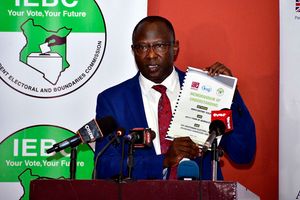
The Independent Electoral and Boundaries Commission Chairperson Erastus Ethekon makes his remarks during the signing of a memorandum of understanding between IEBC and the Kenya Media Sector Working Group in Nairobi on March 27, 2026.
Photo credit: Francis Nderitu | Nation Nedia Group
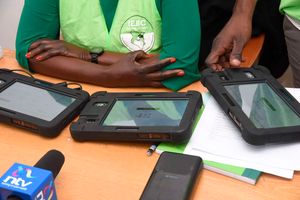
In preparation for the 2027 General Election, the commission projects to gazette 55,393 polling stations, up from 46,229 in 2022, and procure Kenya Integrated Election Management System (KIEMS) kits worth Sh7 billion to replace the 45,352 currently in use that were bought in 2017.
Only 14,000 KIEMS kits that were previously purchased in 2022 will be retained.
The Gen Zs – whose lives and lifestyles have been shaped more by the internet – have in the past been apolitical, giving the politicians a field day in running the country’s affairs. Their voter turnout in 2022 was remarkably low, as the post-election report by the IEBC showed.
But the 2024 tax bill jolted them to action. They staged a siege that forced President Ruto to make major concessions, including the dissolution of the Cabinet and withdrawal of the Finance Bill.
Born between the late 1990s and 2010, this group of young Kenyans is emerging not just as a voting bloc, but as a cultural and political movement.
According to the 2019 Kenya National Bureau of Statistics (KNBS) census, Kenya is a youthful nation with over 75 percent of its 47.6 million people under the age of 35.
Youths in a peaceful procession on the streets of Mombasa during the 'Niko Kadi' voter registration campaign on March 24, 2026.
Photo credit: Kevin Odit | Nation Media Group
A fierce scramble for the crucial Gen Z votes has already erupted, with President Ruto and opposition leaders all joining the ‘Niko Kadi’ campaign in rallying the youth to enlist as voters.
President William Ruto and opposition leaders have all joined the ‘Niko Kadi’ campaign in rallying the youth to enlist as voters ahead of the 2027 General Election.
‘Niko Kadi’ – which loosely translates to ‘I am a registered voter’ – started off as a youth-driven mobilisation for eligible youths to register as voters.
The political class has since joined the fray by rallying the Gen Zs to obtain the crucial document as a tool to either secure a second term for President Ruto or cause regime change.
Youths in a peaceful procession on the streets of Mombasa during the 'Niko Kadi' voter registration campaign on March 24, 2026.
Photo credit: Kevin Odit | Nation Media Group
‘Niko Kadi’ – which loosely translates to ‘I am a registered voter’ – started off as a youth-driven mobilisation for eligible youths to register as voters.
For President Ruto, he is rallying the youth to enlist in large numbers to secure him a second term in office so that he can continue with his development agenda, while the opposition want them to register so as to vote out the Kenya Kwanza government.
Prof David Mondo, a US-based university lecturer and political analyst, observes that Dr Ruto is carefully trying to co-opt the movement, create confusion among the youth and increase apathy within them.’
He notes that the Niko Kadi movement is designed to make Dr Ruto a one-term President based on the Gen Z grievances from the 2024 nationwide protests.
“The opposition wants to use the Niko Kadi to increase their numbers at the ballot and spread their cross-generational networks. This is potentially a game-changing movement not only because it threatens to remove the incumbent executive, but the Gen Zs also want to make all legislators who voted for the Finance Bill 2024 one-term,” says Prof Monda.
He says the movement has the potential to galvanise youth on a peer motivational and peer accountability basis, adding that the mobilisation can make Kenya cross the ethnic Rubicon.
“The challenge for Gen Zs is protecting the vote, stopping rigging and keeping up the Niko Kadi momentum till 2027 and beyond,” Prof Monda notes.