Long before the 2027 General Election ballots are printed and rallies peak, Kenya’s future is already being negotiated — and 2026 is shaping up as the most consequential year of the election cycle.
Political analysts say that the Kenya that goes to the ballot in August 2027 will already have been shaped — decisively — by choices made in 2026.
While the next General Election will deliver winners and losers, it is the year before it (2026) that will lock in political alliances, institutional reforms, voter behaviour and the economic mood that could define the future of the country.
In many respects, political observers believe that 2026 is the year when Kenya’s unresolved questions collide; whether 2022 promises maturity or collapse under public fatigue; whether the political class adapts to a restless electorate or retreats into elite pacts; and whether the State chooses structural correction or managed decline.
United Opposition leaders, led by Wiper party leader Kalonzo Musyoka (center), DAP-K Party leader Eugene Wamalwa (left), former Deputy President Rigathi Gachagua and Trans-Nzoia Governor George Natembeya (right), address the media at SKM command center in Nairobi on November 3, 2025.
Photo credit: Lucy Wanjiru | Nation Media Group
“It is the year when coalitions harden, voter blocs realign, constitutional amendments either pass or fail, and institutions such as the Independent Electoral and Boundaries Commission (IEBC) are tested long before a single vote is cast,” says political analyst Dismas Mokua.
He adds that: “Kenya’s next election may be fought in 2027, but it will be won — or lost — in 2026, a year poised to define coalitions, reforms and the limits of public patience.”
By 2026, the fluid politics of the post-2022 period will give way to hard choices, with pre-election coalitions being formalized and opposition flag bearer being named to take on President William Ruto .
The most consequential of these is President Ruto’s steady march toward a formal coalition with the Orange Democratic Movement (ODM), the party of the late Raila Odinga .
According to party insiders, the United Democratic Alliance (UDA) and ODM are planning to formally sign a pre-election coalition agreement in 2026 that would see ODM back President Ruto’s re-election bid.
The broad outlines of this deal have already been discussed informally at the highest levels, including a reported meeting at the President’s Kilgoris home in Narok County, attended by senior ODM figures led by Dr Oburu Oginga and select Cabinet Secretaries last Saturday.
“We shall now discuss this matter within the relevant party organs and believe me you, 2026 is the year to seal the deal,’ a senior ODM party official told the Daily Nation.
For Dr Ruto, such an alliance would represent the culmination of his post-Gen Z protests strategy — expanding a broad-based government into a durable electoral machine.
For ODM, it would mark a historic turning point following the death of its leader, whose political dominance had anchored opposition politics for more than three decades.
But if the ruling side is consolidating, the opposition is under pressure to resolve its internal arithmetic.
The United Opposition — steered by former Deputy President Rigathi Gachagua , the Democracy for the Citizen’s Party leader (DCP) and Wiper Patriotic Front chief Kalonzo Musyoka — has set itself a March 2026 deadline.
In his end-of-year address in 2025 on Tuesday, Mr Musyoka announced that the coalition would unveil its presidential flagbearer by March 2026, framing the early declaration as a show of unity and readiness against what he called “an oppressive and morally bankrupt regime.”
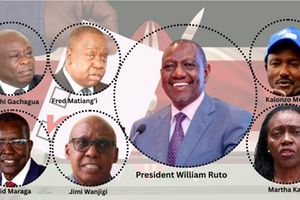
“I am running for president of the Republic of Kenya,” Mr Musyoka said, citing a direct mandate from Wiper’s National Delegates Congress. But he is not alone. The opposition constellation includes Mr Gachagua, Jubilee deputy leader Dr Fred Matiang’i, People’s Liberation Party leader Martha Karua , DAP-K’s Eugene Wamalwa, Democratic Party leader Justin Muturi, and PNU’s Peter Munya.
Outside the coalition, other presidential hopefuls — including Safina Party leader Jimi Wanjigi, human rights activist Boniface Mwangi, Busia Senator Okiya Omtatah and former Chief Justice David Maraga — are shaping an increasingly crowded field.
The risk for the opposition in 2026 is not lack of names, but failure to settle on one early enough to build a national coalition capable of matching the incumbency advantage.
Mr Wanjigi has challenged opposition leaders to abandon what he termed “boardroom alliances of legacy politicians” and instead build a united front anchored on issues affecting ordinary Kenyans.
Independent Electoral and Boundaries Commission chairperson Erastus Ethekon (centre), flanked by fellow commissioners, addresses the media at Pride Inn Paradise in Shanzu, Mombasa County on July 19, 2025.
Photo credit: Wachira Mwangi | Nation Media Group
He argues that simply unseating President Ruto cannot be the sole organising principle of the opposition ahead of the 2027 General Election.
“We talk too much about uniting to remove Ruto. That’s not a purpose,” Mr Wanjigi said, warning that any coalition that fails to address the economic grievances that have driven public protests would quickly lose legitimacy.
He noted that Kenyans are demanding solutions to jobs, taxation and the cost of living, but political leaders remain trapped in personality-driven calculations rather than listening to the electorate.
But beyond elite deals, 2026 will be the year Kenya’s major voter blocs either shift or entrench.
Political analysts argue that President Ruto’s strategy rests on three pillars; coalition expansion, opposition fragmentation, and regional arithmetic.
The first is sustaining a broad-based government by pulling in opposition figures and regional power brokers.
President William Ruto (left) confers with ODM party leader Oburu Oginga during the Piny Luo Festival in Senye Beach in Nyatike, Migori County on December 17, 2025.
Photo credit: Alex Odhiambo | Nation Media Group
The second is encouraging fragmentation by accommodating some actors while isolating others, ensuring no rival bloc achieves critical mass.
The third — and most delicate — is reworking regional support, particularly in Mt Kenya and the late Raila Odinga’s bastions of Nyanza, Western and the Coast.
Political analyst Dismas Mokua argues that Dr Ruto’s engagement with Raila Odinga before his death was part of a long-term 2027 calculation.
“Ruto is not merely courting Raila’s bastions — he is attempting to dismantle the opposition’s emotional homeland and rebuild it into friendly territory,” he says.
Martin Oloo, another analyst, notes that the President has long understood the limits of his appeal in Central Kenya.
“Knowing that Central Kenya may not vote for him to the last man, he was looking to Western and Nyanza to shore up his support,” he said before Odinga’s death.
Safina deputy party leader Willis Otieno describes it as “phenomenal,” warning that it will alter Kenya’s political fabric for years.
“Raila was the guarantor of Ruto’s stability,” he says, arguing that the détente after the Gen Z protests held back a generation that was pushing for Ruto’s ouster.
At the same time, Mt Kenya remains volatile. Analysts say Mr Gachagua is positioning himself as the region’s political gatekeeper, a strategy that could redefine power access.
Democracy for the Citizens Party (DCP) leader Rigathi Gachagua addresses the congregation during a church service at Christian Dominion Ministries in Kasarani on December 7, 2025.
Photo credit: Billy Ogada | Nation Media Group
“If he succeeds, many leaders risk becoming politically irrelevant,” says Prof Gitile Naituli, noting that the scramble by figures such as former President Uhuru Kenyatta who is fronting Dr Matiang’i for president, Martha Karua, Jimi Wanjigi, Justin Muturi, Peter Munya and others reflects anxiety over who controls the Mountain’s vote.
In the 2022 General Election, Kenya had a total of 22,102,532 registered voters, distributed unevenly across the 47 counties, reflecting long-standing demographic, urbanisation and regional population patterns.
Push for constitutional amendments
Nairobi City had by far the largest voter register, with 2,415,310 voters, underscoring its central role in national electoral outcomes. It was followed by Kiambu County, which recorded 1,275,008 voters, and Nakuru, with 1,054,856, making them the only counties with more than one million registered voters at the time.
Few issues will test Kenya’s political appetite in 2026 more than the push for constitutional amendments.
Prime Cabinet Secretary Musalia Mudavadi has proposed far-reaching changes that would alter the balance of power between the Executive, Parliament and counties.
Prime Cabinet Secretary Musalia Mudavadi.
At the centre of his proposals is an effort to address long-standing grievances among legislators. Senators would gain access to a Senate Oversight Fund, MPs would see the entrenchment of the NG-CDF, and MCAs would receive constitutionally guaranteed Ward Development Funds.
The proposals also revive politically sensitive offices, including a Prime Minister and an Official Opposition Leader, while seeking a definitive solution to the two-thirds gender rule — a constitutional requirement that has stalled for over a decade.
Supporters argue that the reforms would stabilise governance and address structural inequities. Critics see political bribery dressed as reform.
“Kenya is hurting and our people are suffering,” he said, arguing that leadership failure — not constitutional design — lies at the heart of the crisis.
Former Chief Justice David Maraga went further, accusing Mr Mudavadi of pushing a political agenda from an office not recognised by the Constitution.
Even within government, the proposal has faced resistance. Health Cabinet Secretary Aden Duale warned that a referendum could undermine ongoing parliamentary processes under the National Dialogue Committee.
Whether the referendum plot proceeds or collapses in 2026 will shape alliances, voter mobilisation and the credibility of reform politics ahead of 2027.
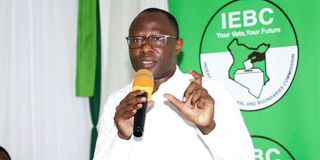
Another quiet but decisive test in 2026 will be the readiness of the Independent Electoral and Boundaries Commission (IEBC).
The Independent Electoral and Boundaries Commission Chairperson Erastus Edung Ethekon.
Photo credit: Bonface Bogita | Nation Media Group
IEBC Chairman Erastus Ethekon has pledged that the Commission is prepared, announcing plans to register 6.3 million new voters — 70 per cent of them youth — through Continuous Voter Registration.
But in Kenya, electoral credibility is built long before polling day.
Funding, staffing, procurement and public trust will all be scrutinised in 2026. Any missteps risk reopening old wounds and undermining confidence before campaigns peak.
While nullifying the August 2017 presidential election results, then Chief Justice David Maraga noted that ‘election is a process, not an event,” underscoring the importance of 2026 in the 2027 poll-plan
In his ruling, he said the IEBC committed "irregularities and illegalities" during the election, impairing the integrity of the election.
By 2026, presidential hopefuls will no longer be campaigning on personality alone. Manifestos will be unveiled, records interrogated, and promises tested against lived reality.
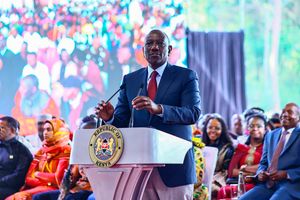
President William Ruto speaks during the World Minority Rights Day celebrations at State House, Nairobi, on December 18, 2025.
Photo credit: Wilfred Nyangaresi | Nation Media Group
President Ruto is seeking to define his re-election bid around scale, ambition and transformation, daring opponents to match his development blueprint.
“Whoever has no agenda should not be voted for,” he said in Migori last Saturday, accusing rivals of empty rhetoric.
Opposition candidates, meanwhile, are framing the contest as a referendum on governance, economic pain and moral leadership. The emerging field — from former insiders to activists and technocrats — reflects a country searching for direction.
Mr Wanjigi, a presidential hopeful, has predicted that the 2027 presidential contest would naturally narrow into a constitutional runoff between two camps defined by competing economic agendas rather than tribal or regional blocs.
He says the country needs a radical break, urging what he calls an “economic insurgency” to dismantle elite capture and rescue the nation from a debt trap.
Safina Party Leader Jimi Wanjigi during an interview at his Kwacha House offices in Nairobi on October 8, 2025.
Photo credit: Evans Habil | Nation Media Group
The businessman-turned-politician says Kenya’s debt crisis is a product of state capture, and only a lean, debt-free government can rescue citizens from poverty and restore sovereignty over the national economy.
Kenya’s economy, long weighed down by a ballooning public debt, high taxation, and dwindling household incomes, has become the centerpiece of political and policy debate, and is expected to amplify in 2026.
And Mr Wanjigi, believes the country’s economic crisis is not a result of bad luck — but of deliberate, systemic mismanagement that has turned government into a “private company” competing with its own citizens.
Ultimately, analysts say, 2026 is decisive not because it produces winners, but because it narrows possibilities.
“It is the year when alliances solidify, institutions are tested, voter loyalties shift, and reform either advances or stalls,” advocate Chris Omore says.
By the time Kenyans line up to vote in 2027, many of the most important decisions will already have been made — quietly in boardrooms, loudly at rallies, and incrementally through institutions under strain.
The future Kenya votes for will, in many ways, already have been chosen in 2026.