A fresh legislative showdown is brewing between the National Assembly and the Senate over whether to entrench the livestreaming of election results, as announced at the polling stations, into the law.
The bitter standoff between the two Houses puts the Independent Electoral and Boundaries Commission (IEBC) on the back foot in its preparations, threatening to push the critical Elections (Amendment) Bill, 2024 into a high-stakes mediation process just eight months before the August 10, 2027 general election.
The clash, which reduces the IEBC to the proverbial grass in a fight of bulls, erupted after the National Assembly rejected a Senate proposal to delete Section 39 of the Elections Act, a move that, among other things, effectively retains the requirement to livestream election results from polling centres.
By stripping out Clause 22 of the Senate-passed Bill, the National Assembly kept the provision alive, setting up a constitutional collision course, as both the High Court and the Court of Appeal have already declared parts of Section 39, including mandatory livestreaming, unconstitutional.
In a report to the Senate laid on November 11, the Justice, Legal Affairs and Human Rights Committee, chaired by Bomet Senator Hillary Sigei, tore into the National Assembly’s amendments, faulting MPs for being insensitive to the previous court judgments.
Battle over electoral reforms shifts between Senate and National Assembly
“In considering the National Assembly amendment to delete clause 22 of the Bill, the committee observed that the amendments did not address themselves to the court decisions invalidating section 39 (G) of the Act on the livestreaming of election results,” reads the Senate committee’s report.
The committee went on to recommend that “the Senate rejects the proposed deletion of clause 22 of the Bill”.
“This would pave the way for further deliberation and consensus building on how the provision should be framed in the eventual law to be enacted by parliament,” the report reads, adding: “the committee has taken great care in considering the amendments by the National Assembly to this Bill.”
This, the committee says, includes ensuring that the proposed amendments align with the constitution, the other laws, judicial precedents and that “they do not negate the extensive negotiations and consensus arrived at during the National Dialogue Committee (Nadco) process on key provisions of the Bill.”
The committee also made reference to stakeholder submissions made both during the Nadco process and to the committee when it considered the Bill after it was introduced in the Senate.
Citing tight timelines ahead of the August 2027 general election, “the committee recommends that the mediation process in respect of this Bill be fast-tracked.”
This is so that “both Houses can approve a mediated version before breaking for the long Christmas recess on December 3, 2026”.
ln the two decisions, the courts invalidated section 39 (1G), which required livestreaming but confined streamed results to public information only while excluding them as a basis for declaration of election results.
Bomet Senator Hillary Sigei.
“The courts rejected that restriction for undermining electoral transparency and accountability,” the Sigei-led committee notes.
The impugned Section 39(1G) states that “the commission shall, to facilitate public information, establish a mechanism for the livestreaming of results as announced at polling stations and the results so streamed shall be for purposes of public information only and shall not be the basis for a declaration by the commission.”
The Senate now wants the clause amended to provide: “The commission shall, to facilitate public information, allow a candidate and their agent, observers and any other person authorized to access a polling station or tallying centre to record and document the tallying, announcement and declaration of results.”
“This Bill therefore replaced the provision on livestreaming with one on access to polling or tallying centres by candidates, their agents or other authorized persons to record and document the tallying, announcement and declaration of results,” reads the Senate committee’s report.
The proposed changes by the Senate, however, fall short of the specific provision in the law requiring the commission to electronically transmit results “in the prescribed form.”
However, this provision was amended in 2017 following the Supreme Court’s annulment of the 2017 presidential election results, as it ordered a fresh presidential election.
“For purposes of a presidential election the commission shall electronically transmit, in the prescribed form, the tabulated results of an election for the president from a polling station to the constituency tallying centre and to the national tallying centre,” read the section before MPs watered it down.
The Senate building in Nairobi.
Photo credit: File | Nation Media Group
National Assembly Justice and Legal Affairs Committee chair Gitonga Murugara (Tharaka) defended the House’s move, saying the MPs were guided by High Court Judge Gregory Mutai’s September 22, 2026 judgment when passing the Bill following a petition by Busia Senator Okiya Omtatah.
“The High Court, among others, upheld the constitutionality of section 39 of the Elections Act and Regulation 83 (2) of the Elections (General) Regulations and declined to grant the request by the petitioners to quash the provisions of the law,” said Mr Murugara.
However, the Senate committee reminded the National Assembly that the decision of the High Court in the Omtatah petition “did not distinguish, vacate or overturn the said decisions on the invalidity of section 39 (1G) of the Elections Act as currently framed.”
The Senate committee went on to lecture the National Assembly that “no adequate justification had been given for the proposed deletion of the entire clause 22 of the Bill.”
The Senate committee noted that the National Assembly move was insensitive considering that the Bill comprised the negotiated outcome of the National Dialogue Committee (Nadco) report, which the two Houses adopted.
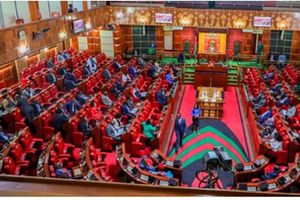
Members of the National Assembly during a past sitting.
Photo credit: Dennis Onsongo I Nation Media Group
Under Article 112 (1) of the constitution, if one House passes an ordinary Bill concerning counties and the other rejects it, it goes to a mediation committee under Article 113.
If amended, it returns to the originating House for reconsideration.
Consequently, once the originating House reconsiders the returned Bill, passing the amended version requires its speaker to forward it to the President for assent within seven days, whereas rejecting the amendments sends the Bill to a mediation committee.
The Bill, co-sponsored by the Senate majority leader Aaron Cheruiyot (Kericho) and his minority colleague Stewart Madzayo (Kilifi), was one of the Bills originating from the Nadco process.
The Bill was published on May 7, 2024 and introduced in the Senate on July 4, 2024.
It underwent the legislative process in the Senate and was passed, with amendments, on December 5, 2024, following which it was referred to the National Assembly for review, consideration and concurrence.
On October 22, 2026, the National Assembly considered and passed the Bill with amendments and referred it back to the Senate for reconsideration.