The livestreaming of election results, as announced at polling stations, is back in the statute books ahead of the 2027 general election after a brief hiatus, but only for public information, following the latest court judgment.
Tharaka MP Gitonga Murugara, who chairs the Justice and Legal Affairs Committee in the National Assembly, said that the judgment delivered by High Court Judge Gregory Mutai on September 22, 2026, is what guided the National Assembly when passing the Elections (Amendment) Bill 2024.
“The High Court, among others, upheld the constitutionality of Section 39 of the Elections Act and Regulation 83 (2) of the Elections (General) Regulations and declined to grant the request by the petitioners to quash the provisions of the law,” said Mr Murugara.
According to Mr Murugara, “this is what informed the National Assembly in the passage of the Elections (Amendment) Bill 2024, which, among others, sought to delete the provision for the livestreaming of the election results as guided by the High Court and Court of Appeal decisions.
“The prayers seeking to quash Section 39, Section 39 (1C) and (1G) and Regulation 83 (2) of the Elections (General) Regulations in their entirety are declined,” ruled Justice Mutai following a petition filed by Busia Senator Okiya Omtata.
The petition followed the 2017 High Court judgment, which declared the provisions unconstitutional as upheld by the Court of Appeal.
The Judge also declared that “the claim that sections 39 (1C) and (1G) of the Elections Act and the National Tallying Centre's role occasion unjustified differentiation contrary to Article 27 of the Constitution is dismissed.”
Bomas of Kenya, which was the Independent Electoral and Boundaries Commission's national tallying centre in the 2022 General Election.
Photo credit: File | Nation Media Group
The Judge also issued a declaration that the IEBC Chairperson does not possess the authority to alter, re-tally, or further verify results declared at the constituency level, but is only authorised to collate and declare the results.
Justice Mutai’s judgment effectively restores section 39 (1G), which provides for livestreaming, back into the laws of the country while setting aside the 2018 judgment by then High Court Judge Chacha Mwita declaring the section unconstitutional and affirmed by the Court of Appeal.
The restored section 39 1G provides that the commission shall, to facilitate public information, establish a mechanism for the live-streaming of results as announced at polling stations.
It goes on to state that the results so streamed shall be for purposes of public information only and shall not be the basis for a declaration by the IEBC.
Justice Mwita specifically questioned the wording: “the results so streamed shall be for purposes of public information only and shall not be the basis for a declaration by the commission.”
“The import of the new subsection is to make live streaming of results from polling stations of no value when it comes to the finality of the declared results,” said Justice Mwita in his April 6, 2018 judgment.
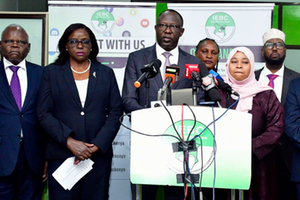
Independent Electoral and Boundaries Commission chair Erastus Edung (center) flanked by fellow commissioners address the media at the commission offices in Nairobi on January 27, 2026.
Photo credit: Francis Nderitu | Nation Media Group
The judgment, upheld by the Court of Appeal, also questioned why the government would invest heavily in a technology whose output is legally deficient.
Justice Mwita established that “looking at the effects of the amendments introduced by section 39 (1G), I am persuaded that they have the effect of weakening rather than strengthening our electoral process.”
However, Justice Mutai issued a declaration that, “in the event of any discrepancy between electronically transmitted and physically delivered results, the result that is an accurate record of what was tallied, verified and declared at the respective polling station shall prevail.”
“The Elections (Amendment) Bill 2024, received from the Senate, sought to delete and replace section 39 of the Elections Act on determination and declaration of results and replace it with a new section, which does not speak to the aspect of livestreaming,” says the JLAC chairperson.
Justice Mwita struck off the provision on account of it being too weak to stand the legal test as he took a swipe at the MPs for failing to fix the live transmission of election results when they enacted it.
Justice Mutai also affirmed that a Constituency Returning Officer's declaration and certification of presidential election results for a Constituency are final and may be challenged only before an election court.
“Neither the commission, its chairperson, nor any Returning Officer has power to alter, cancel, confirm or otherwise vary those certified figures at any stage of tallying at the county or national tallying centre, save pursuant to an order of a court of competent jurisdiction.”
According to the judge, “the polling-station record is thus the irreducible point of truth, even in resolving a transmission discrepancy.”