Rival camps are already positioning their preferred leaders, with Deputy Party Leaders Jeremiah Kioni and Fred Matiang’i emerging as key figures in the unfolding contest.
At the centre of the battle is control of the party’s assets, billions and political machinery ahead of the 2027 General Election.
Mr Kioni’s declaration to lead the party on Tuesday came barely a day after the High Court cleared the way for Mr Kenyatta to relinquish the leadership of the former ruling party, setting the stage for a potentially bruising contest over who takes charge of the outfit.
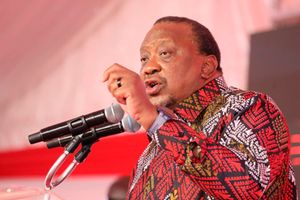
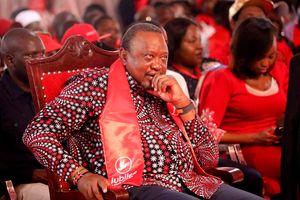
In a statement, Mr Kenyatta welcomed the court decision and said he was ready to hand over the Jubilee leadership through a process guided by the party constitution.
He had previously remained at the helm amid an internal leadership dispute that had delayed the transition. The former President eventually regained control of Jubilee in March 2025 after a protracted struggle involving rival factions.
But with the court now ruling that retired presidents cannot hold political party leadership positions beyond six months after leaving State House, Mr Kenyatta's departure has become a matter of law rather than political discretion.
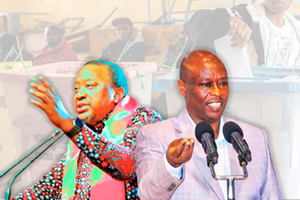
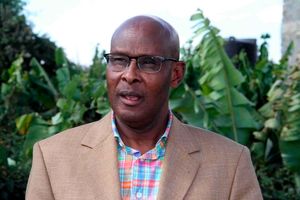
Jubilee Co-Deputy Party Leader Jeremiah Kioni.
Photo credit: File | Nation Media Group
Justice Lawrence Mugambi held that the restriction does not bar a retired president from belonging to or participating in a political party; it limits the holding of a formal party leadership position.
The ruling has consequently opened a new contest inside Jubilee, with competing interests now focused on who will inherit the party structure, its national network and its role in the 2027 political equation.
“In light of His Excellency’s call for an open, transparent, and lawful process of handing over the leadership of the party, I hereby offer myself for the position of Party Leader of the great Jubilee Party,” Mr Kioni said.
He stressed that the position should not be handed to an individual through an informal arrangement, arguing that Jubilee leaders are elected by delegates at a National Delegates Convention (NDC).
“Jubilee is a national party and a former ruling party. As such, our leaders are not installed, they are elected by the party delegates at the National Delegates Convention,” he said.
His declaration immediately complicates the succession calculations around Dr Matiang’i, the party’s 2027 presidential candidate.
The expectation among sections of Dr Matiang’i’s allies has been that his position as Jubilee’s presidential candidate, coupled with his political stature, would put him in pole position to inherit the party leadership after Mr Kenyatta.
But Mr Kioni’s entry introduces a different interpretation of the succession question — that the party leader and presidential candidate are not necessarily the same office and that the former cannot simply be transferred to the latter.
“The beauty with Jubilee is that when the Party Leader exits, the two deputies have equal right, equal opportunity and equal ability to seek the top office. That's what democracy means in its exact definition,” a Jubilee insider said.
Both Mr Kioni and Dr Matiang’i occupy deputy leadership positions, meaning the succession contest could now develop into a direct test of competing constituencies within the party.
Jubilee was one of the dominant political parties during the Kenyatta presidency and commanded a large parliamentary and county presence.
Its institutional strength has since declined, but analysts say that the party remains an important vehicle in the opposition and coalition politics surrounding the 2027 election.
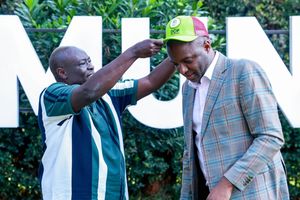
Jubilee Presidential hopeful Dr Fred Matiang'i in Borabu, Nyamira County on April 24, 2026.
Photo credit: Ruth Mbula | Nation Media Group
Jubilee has historically been one of the largest beneficiaries of the Political Parties Fund. Official figures from the Office of the Registrar of Political Parties show that it received about Sh240.4 million in 2017/18, Sh434.6 million in 2018/19, Sh564.2 million in 2019/20, Sh515 million in 2020/21 and Sh1.02 billion in 2021/22 — more than Sh2.77 billion over those five financial years.
The party's allocation has since fallen sharply as its electoral strength has diminished. For the 2026/27 financial year, Jubilee has been allocated Sh128.86 million from the Political Parties Fund.
“The money is therefore only part of the attraction. Control of the party also means control of its organisational machinery, membership structures, political brand and the authority to negotiate its place in the shifting alliances ahead of 2027,” argues political analyst Geoffrey Mboya.
The Independent Electoral and Boundaries Commission and the Office of the Registrar of Political Parties have already set deadlines requiring parties to regularise their structures ahead of the election.
Political parties must submit the names of their authorised persons and specimen signatures to the IEBC by October 15, 2026. They must also submit nomination rules to the commission by November 6 after certification by the Registrar.
For Jubilee, these deadlines arrive at an awkward moment.
The party is entering a leadership transition while still dealing with the consequences of a series of internal disputes over changes to its officials.
The latest was the Political Parties Disputes Tribunal decision nullifying the appointment of Koitalel Ole Kenta as Secretary-General. The tribunal found that Mr Kenta did not meet the party's eligibility requirements when he was appointed and declared his nomination, appointment and recognition unlawful and void from the outset. It ordered that a fresh process be undertaken if the party wished to fill the position.
The case had been brought by former Nyeri Town MP Ngunjiri Wambugu, who challenged changes to Jubilee's leadership and their subsequent recognition by the Registrar of Political Parties.
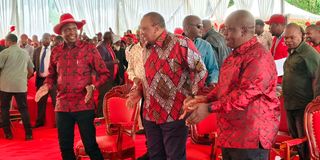
Former President and Jubilee Party leader Uhuru Kenyatta (left) with former Interior Cabinet Secretary Dr Fred Matiang’i during Jubilee Party Special National Delegates Conference at Ngong Racecourse in Nairobi on September 26, 2025.
Photo credit: Bonface Bogita | Nation Media Group
The tribunal's ruling has added another layer to the leadership transition and strengthened calls for the party to return to a delegate-based process.
“Actually, only an NDC can deliver a party leader with the legitimacy required to move Jubilee forward from where we are today,” he said.
“As Jubilee we must now call an NDC urgently. Those interested in party positions will propose themselves, or those they want and then the members decide. No shortcut.”
His position echoes Mr Kioni's insistence that the next party leader must emerge through the party's constitutional mechanisms rather than through an informal succession arrangement.
Analysts say that who convenes it, who determines the delegates, which officials remain recognised to organise it and which leadership structures are in charge when the convention is called are all questions that could shape the outcome.
In Mr Kenta’s case, the tribunal specifically found that the process surrounding his appointment was unlawful because he did not meet the party's membership requirement at the time of his appointment.
But according to a Jubilee insider, Mr Kenta became a bonafide party member on December 24, 2025 before his subsequent appointment to the Secretary General’s post in March 2026 by the party’s NEC.
The former Interior Cabinet Secretary is already the party's presidential candidate, but the emergence of Mr Kioni means that the leadership of the party and the presidential candidature may have to operate as separate political centres.
“That could have implications for how Jubilee approaches coalition negotiations, fundraising, mobilisation and the management of its presidential campaign,” says advocate Chris Omore.
The former President has been a central figure in opposition politics and the Azimio la Umoja One Kenya Coalition Party. Following the High Court ruling, Wiper leader Kalonzo Musyoka said the Azimio Council would meet to consider the implications of the judgment on Mr Kenyatta's position as coalition council chairman.
He said the council would act in accordance with the law, the coalition constitution and its agreement.
The court ruling does not, however, prevent Mr Kenyatta from remaining a member of a political party or participating in political activities.
This leaves open an important distinction in Jubilee's succession: while Mr Kenyatta is required to surrender the formal party office, his political influence does not automatically disappear with the position.
Already, questions are being raised over whether Mr Kenyatta's political and financial support remains aligned with the Jubilee presidential campaign.
Kitutu Chache South MP Anthony Kibagendi has publicly claimed that the former President has stopped funding Dr Matiang’i's 2027 campaign, alleging that Mr Kenyatta has instead shifted financial support towards other political figures.
“But the larger question is whether Jubilee can manage the transition without another internal rupture,” adds Mr Omore.
The party has already experienced competing factions, leadership disputes and battles over officials recognised by the political parties regulator.
The court and tribunal decisions have now placed additional pressure on the party to regularise its leadership before the electoral machinery enters a more demanding phase.
For Mr Kioni, the strategy appears to be to frame the succession as a constitutional and democratic process.
For Dr Matiang’i's allies, the challenge will be to reconcile his presidential candidature with the possibility that the party leadership itself may be contested.
But for Mr Wambugu and other officials demanding an NDC, the immediate priority is legitimacy through delegates.
With the October 15 deadline for authorised party officials fast approaching, analysts maintain that the pressure is no longer simply about who occupies the chair.
“It is about who controls Jubilee when the party enters the decisive organisational phase of the 2027 election — and who has the authority, machinery and resources to speak for the party,” says Mr Dismas Mokua.