Former President Uhuru Kenyatta’s continued roles in the Jubilee Party and Azimio coalition has come under renewed scrutiny after the High Court upheld a law restricting retired Presidents from holding political party office beyond six months after leaving State House.
The court dismissed a petition challenging Section 6(1) of the Presidential Retirement Benefits Act, ruling that the provision limits formal party leadership but does not bar retired presidents from belonging to parties or participating in political activities.
Justice Lawrence Mugambi said the restriction was a lawful safeguard against former heads of state exercising power indirectly through political proxies. The court said that the law was designed to protect democratic transitions and preserve the special status of retired Presidents.
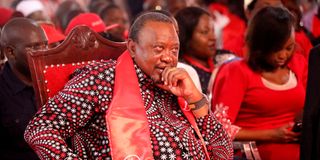
Jubilee Party leader Uhuru Kenyatta during a meeting of his party's delegates at Kiambu Golf Club in Kiambu County on May 25, 2026.
Photo credit: Evans Habil | Nation Media Group
“A reading of Section 6 (1) is clear, as was strongly submitted by the respondents and the Interested parties, it does not forbid the retired President from being a member of a political party, what it restricts is taking up a leadership role in the political party for more than six months after retiring," Justice Mugambi stated.
The decision directly touches on the leadership dispute that has surrounded Jubilee Party since President William Ruto took office in September 2022 and Mr Kenyatta's role in its leadership. Mr Kenyatta also serves as the Chairperson of the Azimio la Umoja–One Kenya Coalition Council.
Allies of President Ruto have been criticizing him for actively participating in national politics. They have repeatedly accused him of violating the law. The dispute played out from 2024 through severe funding blockades to Mr Kenyatta's office and benefits and proposed legislative rollbacks to strip him perks.
Mr Kenyatta has been the Jubilee Party's leader since its formation in 2017 and retained the position after retiring as President in September 2022.
In May 2023, a faction of party members declared his position vacant and installed nominated MP Sabina Chege as acting party leader, citing the six-month legal restriction.
The move triggered competing claims over who had authority to convene party meetings, remove officials and communicate with the Registrar of Political Parties.
Mr Kenyatta's allies rejected the changes and maintained that the process violated the party constitution.
The Political Parties Dispute Tribunal later upheld the leadership changes, while the Registrar of Political Parties recognised Ms Chege as party leader and EALA MP Kanini Kega as secretary-general.
Mr Kenyatta regained the leadership in June 2025 through a court ruling, which invalidated the resolutions that installed the Ms Chege-led faction to office.
Justice Mugambi's judgment, however, arose from a separate constitutional petition filed in May 2023 by rights activists Peter Odhiambo Agoro, Paul Muiruri Kiguathi and Damon Onyango Osawa.
The petitioners sued the Attorney-General and the National Assembly. The Registrar of Political Parties and the Law Society of Kenya were joined as interested parties.
They argued that Section 6 of the Presidential Retirement Benefits Act discriminated against retired presidents by imposing restrictions not placed on other citizens.
They said the provision violated equality before the law, freedom of association and political rights guaranteed under Articles 27, 36 and 38 of the Constitution.
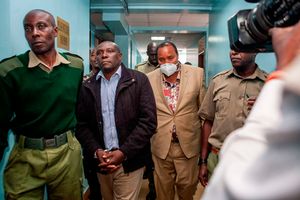
Former President Uhuru Kenyatta (right) with former Interior Cabinet Secretary Fred Matiang'i during a Jubilee Party meeting in Murang’a County on November 7, 2025.
Photo credit: Martin Mwaura | Nation Media Group
They maintained that leaving Office of the President did not strip a former President of citizenship or the right to participate fully in political life.
They also argued that retired Presidents should retain the same political freedoms as other citizens, including the ability to hold office in political party.
The respondents opposed the petition, saying the law did not impose a total ban on political participation.
"Political rights are subject to the limitations contemplated under Article 24 of the Constitution," said the Attorney General. The respondents argued that the contested law only stopped a retired President from holding a party office after six months, while leaving other political rights intact.
The court agreed with that position. Section 6(1) provides: “A retired president shall not hold office in any political party for more than six months after ceasing to hold office as president.”
The provisions require a retired President to play a consultative and advisory role to the Government and the people of Kenya. They also allow the Government to request a former President to perform specific official duties for a reasonable allowance.
Justice Mugambi said the rights relied on by the petitioners were not absolute. He held that they could be limited under Article 24 of the Constitution where the restriction was reasonable and justifiable in an open and democratic society.
“Article 36 and 37, including Article 27 upon which the Petition is premised are not absolute and may be limited by law to the extent that the limitation is reasonable and justifiable in an open and democratic society,” the judge said.
The court rejected the argument that retired Presidents should be compared with ordinary citizens for purposes of determining discrimination.
It found that a retired President occupies a distinct constitutional position because of the office previously held, the influence attached to it and the ability to shape national politics even after retirement.
The court also considered the history behind the law. It noted that the Presidential Retirement Benefits Act was enacted in 2003, after Daniel arap Moi’s 24-year presidency, when Kenya was dealing with concerns about former leaders continuing to exercise power through allies.
The court accepted that Parliament intended to prevent retired Presidents from continuing to control political parties indirectly while receiving retirement benefits from the State.
The petitioners were also faulted for failing to demonstrate how the law had caused them personal harm or affected their rights in concrete terms.
The court said their arguments were broad and unsupported by evidence showing that the provision had distorted elections, weakened competition or prevented them from exercising identifiable rights.