A new wave of youthful lawmakers under the banner Kenya Moja is mounting a bold challenge against the established political order.
The group is positioning itself as potentially the Third Force — distinct from the President William Ruto-Raila Odinga camp and the united opposition steered by former Deputy President Rigathi Gachagua .
Kenya Moja says its mission is to champion the welfare of Kenyan youth and vulnerable groups in the country.
Politicians allied to Kenya Moja have promised to overhaul the political order and usher in what they call “generational change” in leadership.
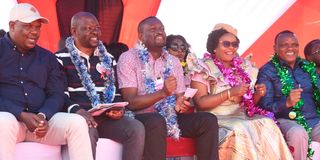
But whether the team led by Orange Democratic Movement (ODM) Secretary-General Edwin Sifuna, MPs Gathoni Wa Muchomba (Githunguri), Caleb Amisi (Saboti), and Babu Owino (Embakasi East) will survive the inevitable squeeze from party chieftains remains to be seen.
Mr Sifuna is opposed to the broad-based government arrangement between President Ruto and his party leader, Mr Odinga.
Mr Amisi and Mr Owino are also ODM members, while Ms Wa Muchomba belongs to President Ruto’s United Democratic Alliance (UDA).
The movement, fronted by the young parliamentarians, claims to have attracted 36 MPs and seven senators from across the political divide, including independents.
Its members say they are determined to end decades of what they term “political patronage” by the same crop of leaders.
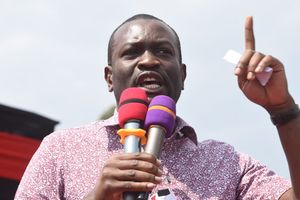
“I have been overwhelmed by the outpouring of support from Kenyans all around the country and the world. I just want to assure them that we hear what they are saying, and we shall do whatever it takes not to be a disappointment to their hopes and dreams,” the Nairobi senator said.
Ms Wa Muchomba described Kenya Moja as a platform for leaders committed to issue-based politics, not personality cults.
“We have realised that the country has been under the patronage of party leaders for far too long. We cannot allow a crop of old guards to sink the country into oblivion. They do not have the interests of Kenyans at heart.”
While the group’s emergence has stirred speculation about its role in the 2027 polls, Ms Wa Muchomba said their present focus is on social and economic reforms.
“Our focus is on how the youth and the vulnerable in society can get assistance. We must ensure that all children get equal opportunities for education. We must reshape the politics of this country,” she said, adding that they will not be deterred by threats from party hierarchies.
“If whatever we are doing pleases the public and they want us to form a political party or a coalition and front candidates, including for the presidency, why not? We are ready.
“Let Kenyans not recycle leaders in 2027. Raila has been a prime minister, Kalonzo (Musyoka) has been a vice president—what new thing are they bringing to the table?”
Sifuna, Amisi threaten to lead a mass walkout of ODM
For his part, Mr Amisi said that the Kenya Moja push is a deliberate gamble.
“We have taken the risk. Everything in life is a risk. From the time of conception to the time you are born, the higher the risk, the higher the returns,” the Saboti MP said.
“We have made this bold move because many people are suffering in silence. Even many leaders in this government only defend it in public, but in private, they confess to us that the administration is terrible.”
Mr Amisi envisions the caucus as the spearhead of a “political renaissance” driven by younger, more innovative leaders.
“The current political dinosaurs we have in the country cannot lead this renewal,” he charged. “There is increased interest by Kenyans in the diaspora and among a young, highly knowledgeable, educated, tech-savvy generation in the renewal and rebirth of a new Kenya. Well, it must succeed, or else the succeeding regimes will be very brutal against us.”
“Let’s not approach the change of a despotic regime like it is a Sunday school choir. It must be focused and intentional, devoid of lip service. Kenya needs a renaissance,” he said.
The young legislators’ push for a Third Force has jolted the 2027 race — stitching together a restless bloc of lawmakers across party lines. Mr Sifuna and his Kenya Moja allies have lately appeared together in consultative tours and empowerment drives from Bumula to Saboti. Kenya Moja aims to project itself as a national, youth-first movement rather than a coalition of convenience.
Its playbook borrows from the grassroots “hustler” optics: harambee-style fundraisers for women and youth groups, stopovers at local projects, and tight social-media amplification.
Their itinerary—Bumula, Saboti and Busia (Teso), which will be the next stop—suggests a methodical attempt to build county-by-county visibility while testing whether cross-party collaboration can survive Kenya’s allergic reaction to ideological ambiguity.
Politically, Mr Sifuna’s pivot is delicate. He maintains that he is still in ODM, but has vowed not to midwife any pact that delivers ODM to President Ruto in 2027.
The Third Force rhetoric implicitly challenges the old calculus of Mr Odinga’s big-tent bargaining, already under strain as veteran allies weigh government alignments and succession math.
For Dr Ruto’s camp, a Sifuna-led formation is a double-edged threat. On one hand, it could splinter the opposition vote; and on the other, it may pry away disaffected youth who feel reforms have stalled and household budgets worsened.
Political analysts have questioned whether it will be the elusive “third way” that forces policy concessions and ticket reconfiguration on both sides—or just another banner under which familiar politicians regroup.
Advocate Chris Omore said the alliance’s breadth is promising but mixed loyalties invite questions about its durability.
“Party whips, disciplinary threats, and resource wars will test it. If Kenya Moja can translate on-the-road optics into county-level structures, candidate pipelines, and a disciplined message, it could become the swing machine that forces coalition arithmetic to reckon with a new centre of gravity,” he argued.
“Bold, because it attempts to recast 2027 as a referendum on generational leadership rather than tribe or lineage; risky, because Kenya’s politics punishes fence-sitters and rewards hard blocs,” he said.
He added that if Kenya Moja clears the party and loyalty hurdles, it won’t just be a spoiler, but could be the bargaining chip that redraws the ticket board in 2027.