President William Ruto’s launch last Friday, August 8, of a State-backed framework to look into compensation for victims of protests and riots caps a whirlwind array of political developments over the past fortnight as manoeuvring ahead of the next 2027 elections picks up pace.
Compensation for those injured or killed in political protests has been one of the key sticking points on implementation of the 10-point Memorandum of Understanding between President Ruto’s UDA party and former Prime Minister Raila Odinga’s ODM that birthed the broad-based government.
Other notable and related events in the same period included ODM Secretary-General Edwin Sifuna headlining the launch of a possible breakaway faction by those opposed to an alliance which might lead to ODM backing Dr Ruto’s 2027 re-election bid, as many senior figures around Mr Odinga propose.
Orange Democratic Movement Party's Secretary-General Edwin Sifuna in Saboti Constituency, Trans Nzoia County on August 3, 2025.
Photo credit: Jared Nyataya | Nation Media Group
Mr Sifuna made the breakaway threat just days after reading an ODM party statement following a meeting of the Central Management Committee, which affirmed support for the broad-based government arrangement, albeit with a provision for the establishment of a joint committee of the two parties to drive implementation of the pact.
Indeed, appointment of the victims’ compensation team — to be headed by Prof Makau Mutua, a key strategist and confidante of Mr Odinga who has been officially appointed Dr Ruto’s adviser on constitutional issues and human rights — followed shortly on establishment of UDA-ODM technical team to oversee implementation of the 10-point agenda.
All those are part of a frenetic series of events which impact on the Ruto-Raila marriage and the road to 2027, disquiet within both UDA and ODM, the mainstream opposition’s delicate search for a single candidate to field against Ruto come the next polls, and the role of former President Uhuru Kenyatta in both Mt Kenya leadership the wider opposition arena.
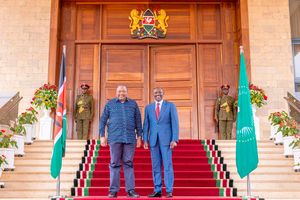
For instance, President Ruto taking his predecessor on a walkabout around State House on the first day of August excited a lot of chatter about a possible rapprochement between two once firm allies who had a messy divorce in the run-up to the 2022 elections.
The photo op was gleefully exploited by Dr Ruto’s social media communications team to push narratives of a truce that might see Mr Kenyatta throw his weight behind the President, and therefore halt the mass exodus of a populous Central Kenya vote which propelled the Kenya Kwanza candidate to victory in the last elections, but is now walking away with ousted Deputy President Rigathi Gachagua .
Mr Kenyatta was actually in State House in his capacity as facilitator of the East African Community intervention on the conflict in the eastern Democratic Republic of Congo, where he was warmly received by President Ruto and taken on a tour around the grounds and the new facilities taking shape.
Incidentally, speculation of a thaw in the relationship did not go down well with some of Mr Odinga’s key lieutenants, notably Treasury Cabinet Secretary John Mbadi, who dismissed as inconsequential and unwelcome any prospect of Mr Kenyatta joining Dr Ruto’s camp.
Mr Mbadi did not give reasons for his discomfort, but it might be that if the former president joined Dr Ruto’s entourage, he would do so as a principal partner and therefore dilute Mr Odinga’s influence.
Jubilee Party Vice Chair David Murathe addressing participants during the 62nd birthday party of former President Uhuru Kenyatta in Nairobi on October 26, 2023.
Photo credit: Bonface Bogita | Nation Media Group
Interestingly, the Treasury CS, one of the ODM stalwarts “donated” by Mr Raila to Dr Ruto’s Cabinet, pleaded that he did want to talk politics when a few days later, a key Uhuru point-man, Jubilee Party Vice Chairman David Murathe, said that the party headed by the retired president was ready to revive its backing for another presidential bid by Mr Odinga.
The statement, which followed a Jubilee executive committee meeting chaired by Mr Kenyatta, suggested that it had official imprimatur, but inquiries by The Weekly Review indicate that no such issue came up at the meeting of the party organ. Chances are that Mr Murathe was expressing personal sentiments and was more likely just out to cause political mischief.
It is instructive that the so-called offer came with the condition that Mr Odinga break links with President Ruto. Mr Murathe said that Jubilee still recognises Mr Odinga as leader of the opposition Azimio coalition — a position he abandoned on teaming up with Dr Ruto’s Kenya Kwanza Alliance.
Mr Murathe’s apparent mischief extended to throwing broad analysis on Mr Odinga’s political genius, seemingly suggesting that the veteran opposition pioneer could be taking Dr Ruto for a ride with the broad-based arrangement. What comes to mind is the pre-2002 election scenario when Mr Odinga cemented a pact with then President Daniel arap Moi, gaining power and influence in government and ruling party, and then jumping ship just ahead of the polls — and taking with him almost the entire political machinery to ensure victory for main opposition candidate Mwai Kibaki against Moi’s hand-picked heir, Mr Uhuru Kenyatta.
One thing that should be clear, though, is that Mr Odinga, at this juncture, will not take the bait. He has stated oftentimes his commitment to the broad-based government arrangement, which he said was motivated by need to save the country from descending into chaos and anarchy on the back of the Gen Z uprising of June last year. He repeated this position last Friday in Dr Ruto’s presence at the funeral of pioneer woman politician Phoebe Asiyo, pointing to the 2010 “Arab Spring” revolts in Egypt, Tunisia, Libya, Yemen and other countries in North Africa and the Arabian Peninsula, which led either to state collapse or military takeovers.
But he also made reference to the more likely motivation, that he was not saving Dr Ruto from the Gen Z movement, but from the threat posed by Mt Kenya rebellion fronted by Mr Rigathi Gachagua.
Indeed, Mr Gachagua, with his seeming obsession with pushing Mt Kenya interests to the exclusion of everything else, has become handy for proponents of the broad-based alliance.
Even Mr Sifuna’s constant outbursts from within, against the broad-based arrangement, have often met with accusations that he is working for Mr Gachagua. One can expect more such condemnations in the coming weeks as Mr Odinga’s stalwarts move to counter the unveiling of the new Kenya Moja grouping within ODM that is firmly opposed to backing Ruto in 2027.
It is interesting that Mr Sifuna went into open rebellion mode shortly after reading the ODM statement affirming support for the broad-based arrangement.
The important point, however, is that the statement released after a crucial meeting of a top party organ dealt only with the implementation of the 10-point agenda rather than backing for Dr Ruto’s re-election bid.
This is the distinction many of Mr Sifuna’s critics within the party do not make every time he speaks out of turn, and under fierce fire, but wins Mr Raila’s support.
The 10-point agenda does not endorse Dr Ruto’s quest for a second term, and Mr Odinga has never voiced that position either.
Mr Mbadi, Energy Cabinet Secretary Opiyo Wandayi, Homa Bay Governor Gladys Wanga, Homa Bay Town MP Peter Kaluma and even Mr Odinga’s elder brother, Siaya Senator Oburu Oginga, would therefore seem to be voicing personal rather than party positions when they hit out at Mr Sifuna over his obdurate stance.
ODM’s Central Management Committee meeting was called in the midst of a fierce internal fight, with Mr Sifuna under withering criticism for his anti-Ruto stance. Mr Odinga came out to back Mr Sifuna’s right to air his personal views, but also pointed out that the secretary-general is the official spokesman.
When Mr Sifuna read the statement backing the broad-based arrangement, some opined that he had been forced to back down. The reality, however, is that he emerged victorious. He was not sacked or censured as many expected, and he stated the party's position, demanding the implementation of the 10-point agenda.
Sifuna, Amisi threaten to lead a mass walkout of ODM
In the meantime, what unfolds with the Kenya Moja alliance remains to be seen. It could be the beginning of a Third Force in the run-up to 2027 power plays presently dominated by Dr Ruto up against the mainstream opposition fronted by Mr Gachagua, Wiper leader Kalonzo Musyoka , former Interior CS Fred Matiang’i, Martha Karua of People’s Liberation Party and Eugene Wamalwa of DAP-Kenya.
But there is already a Third Force, or two of them, in the declared presidential aspirations of former Chief Justice David Maraga and Busia Senator Okiya Omtatah. The two are running separate campaigns, but it is known that they have had quite talks on a possible alliance. Both have also spurned approaches from Mr Gachagua.
From left: MPs Jack Wamboka (Bumula), Caleb Amisi, Edwin Sifuna (Nairobi), Gathoni Wamuchomba (Githunguri) and Joshua Kimilu (Kaiti), during a women's empowerment funds drive in Saboti Constituency on August 03, 2025.
Photo credit: Jared Nyataya | Nation Media Group
It has also emerged from the meeting in Saboti, Trans Nzoia County, where Mr Sifuna spoke that Kenya Moja is targeting the disaffected Gen Z movement, which felt betrayed when Mr Odinga embraced Dr Ruto. But the other opposition aspirants are also claiming to speak.
Launching the movement in Trans Nzoia might also have been deliberately targeting Western Kenya voters. Mr Sifuna, host MP Caleb Amisi, Bumula MP Jack Wamboka, Kabuchai MP Majimbo Kalasinga and others who spoke all indicated growing frustration that the populous region is playing second fiddle in ODM.
There could also be ground to exploit disgruntlement within the Western Kenya brigade in Kenya Kwanza, which has been moved down the pecking order since Mr Odinga and ODM moved in.
Mr Mudavadi’s seemed to be positioning himself to succeed Dr Ruto by controlling the second-biggest regional bloc within UDA, especially with Deputy President Kithure Kindiki unable to show what he brings to the table as the Mt Kenya continues to abandon the coalition.
However, the broad-based government arrangement scuttled the best laid plans as Mr Odinga stepped powerfully into the fold, even without a formal government position.
Mr Sifuna, the Senator for Nairobi, appears to be seeking a solid political base in his Western Kenya home ground. Whether he is indeed seeking to relocate remains to be seen, but he will be a politician to watch closely in the coming days.