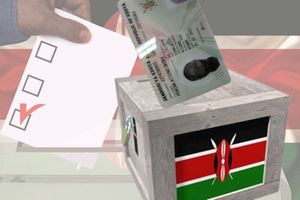
A high-stakes political storm is brewing along the Kenya-Uganda border over the alleged illegal registration of foreign nationals as voters ahead of the 2027 General Election.
The controversy has consequently ignited a fierce national debate: where does the constitutional right of Kenyans living abroad to participate in elections end, and where does the unlawful registration of foreigners begin?
While Interior CS Kipchumba Murkomen has aggressively defended the issuance of IDs to citizens residing in neighbouring countries, local leaders—including Trans Nzoia Governor George Natembeya—are demanding independent investigations, warning that the country’s sovereign right to elect its own leaders is under direct threat.
For communities living along the Kenya-Uganda border, this is an increasingly sensitive issue.
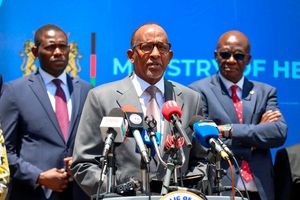
On Thursday, Mr Murkomen sought to draw that distinction, defending the issuance of Kenyan IDs to citizens living in neighbouring countries, while insisting that this process should not confer voting rights on foreign nationals.
Mr Murkomen said a Kenyan citizen does not lose their right to identification or other constitutional rights simply because they live or work outside the country’s borders.
“Every Kenyan, regardless of where they live or work, has a right to an identity card and to be registered to vote in the next election,” he said.
He made the remarks while touring the construction of Kiminini Market in Trans Nzoia County, amid heightened debate over allegations that foreigners, particularly Ugandan nationals, were being helped to obtain Kenyan identification documents and register to vote in the 2027.
Mr Murkomen urged the Independent Electoral and Boundaries Commission (IEBC) to facilitate the registration of eligible Kenyan citizens living in neighbouring countries. He cited Kenyans living in Uganda and said that their temporary or permanent residence outside Kenya should not prevent them from accessing government identification services.
“We have told every Kenyan that even if they live in Uganda, they have the right to an ID and the opportunity to register to vote,” he said.
He added that the government was working to enable Kenyans living in neighbouring countries to access identification services via Kenyan diplomatic missions. However, he stressed that this was intended for Kenyan citizens only and should not be interpreted as granting foreign nationals the right to vote in Kenya.
This came as residents of Endebess constituency and local leaders continued to demand an investigation into allegations that Ugandan nationals had been helped to obtain Kenyan IDs and register as voters.
This issue has become increasingly contentious in the lead-up to the 2027 elections, particularly with regard to the registration of Kenyans residing in neighbouring countries.
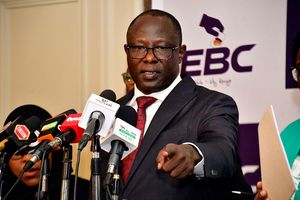
The IEBC has emphasised the importance of the integrity of the voters’ register as the foundation of a credible election in 2027, and has called on stakeholders to avoid alleged misinformation and interference with the registration process.
Independent Electoral and Boundaries Commission officials register voters at Kondele Roundabout in Kisumu on June 25, 2026.
Photo credit: Alex Odhiambo | Nation Media Group
In Trans Nzoia, however, some leaders and residents are still concerned that the distinction between Kenyans living across the border and foreign nationals could be exploited.
Governor Natembeya, who has previously expressed concerns about the process, stated that non-Kenyans should not be permitted to participate in Kenya’s electoral process.
“We want to tell our brothers and sisters in Uganda that they should not interfere with our sovereign right to elect our own leaders,” he said.
These allegations followed a television exposé which claimed that some Ugandan nationals had been helped to obtain Kenyan identification cards and register as voters.
Speaking at Mowlem Market in Chepchoina Ward, residents demanded investigations into any attempts to influence Kenya’s elections by registering foreigners, as this would undermine the electoral process.
A resident, Mr Victor Walunywa, said that border communities supported peaceful relations and legitimate cross-border trade, but would oppose any attempt to influence elections through foreign nationals.
“We know where our borders are, and we respect our neighbours. But nobody should be allowed to cross into Kenya and decide who our leaders should be. That would be a direct insult to our sovereignty,” he said.
Mr Nashon Simiyu said residents wanted leaders chosen by Kenyan citizens. “We want leaders who are chosen by Kenyans and who have the mandate of Kenyan citizens. Nobody should bring outsiders into this country to determine who leads us.”
Peter Nangai called on electoral authorities to strengthen voter registration safeguards to ensure that only those legally entitled to vote are included in the electoral register.
“Kenyans must be the ones to choose their leaders. Our electoral system must ensure that only those legally entitled to vote can participate in deciding the country’s leadership,” Mr Nangai said.
Dennis Wanjala, a local boda boda chairman, said that residents were also grappling with poor infrastructure and inadequate government services, and he urged the authorities to address the wider challenges facing border communities.
The IEBC has previously rejected claims that foreigners were being illegally registered as Kenyan voters in the region, stating that it had not received any credible evidence to substantiate the allegations.
IEBC chairperson Erastus Ethekon has stated that claims of illegal voter registration, unlawful voter transfers, and the registration of foreigners remain unsubstantiated. He added that the Commission would act if credible evidence was presented.
The DCI has also dismissed claims linked to the television report, including allegations that its officers had intercepted election-related materials or investigated an attempt to move voter registration equipment across the border. The DCI described the claims as false, stating that no officer, arrest or transfer was connected to such an investigation.
Nevertheless, the debate has continued, with recent reports examining claims of vulnerabilities in the systems used to identify citizens and register voters along the Kenya-Uganda border. According to IEBC records cited by local officials, Trans Nzoia currently has about 398,000 registered voters.
The IEBC’s Trans Nzoia County Coordinator, Patrick Wanyama, said that the Commission was targeting 500,000 registered voters by 2027 through its continuous voter registration drive. The expansion of the register makes the question of eligibility particularly significant in a county that shares a border with Uganda.
Governor George Natembeya.
Photo credit: File | Nation Media Group
A group of Trans Nzoia leaders, including Mr Natembeya and Saboti MP Caleb Amisi, have called for an independent investigation into the allegations, stating that anyone found to be at fault should face prosecution.
“This is a serious issue that cannot just be ignored. We have informed the government before, yet no action has been taken. I was the first to blow the whistle on this issue a few months ago,” said Mr Natembeya.
Mr Amisi alleged that foreigners had been systematically registered, particularly in the Saboti and Endebess constituencies, which border Uganda. He also questioned Mr Murkomen’s involvement with Kenyans living in Uganda.
“We are surprised that the CS for the Interior, Kipchumba Murkomen, flew to Uganda to meet people said to be Kenyan citizens, even though he is not the Minister for Foreign Affairs,” said Mr Amisi.
He urged Kenyans living along the border to remain vigilant during the elections, to protect the country’s sovereignty and electoral integrity.
“This is a Kenyan election, and Kenyan leadership cannot be determined by foreigners. It also boils down to respect for our nation and the status of Kenya in the international arena, as well as the territorial integrity of our nation. We don’t want this to be dismissed as mere propaganda,” Mr Amisi told the Nation.
However, Mr Murkomen maintains that the government’s responsibility is to ensure that eligible Kenyan citizens are not denied identification and electoral rights simply because they live or work outside the country. He also said that the government had scrapped charges for issuing national identity cards, and warned registration officials against demanding money from applicants.
“Getting an ID is free. If you hear anyone asking for money during registration, report them,” he said.
The CS linked possession of identification documents to access to other civic rights, saying eligible Kenyan citizens should not be excluded because of their place of residence or work.
Kiminini MP Kakai Bisau dismissed allegations by opposition leaders that the government had favoured particular communities in the recent recruitment of chiefs in the region.
Endebess MP Robert Pukose urged residents to support government development programmes, saying cooperation among elected leaders was necessary to accelerate development projects in the county.
Mr Murkomen's visit to Trans Nzoia was not confined to the voter-registration controversy. During the tour, the minister said Kiminini Market was part of a wider government programme aimed at providing modern and organised trading spaces for small-scale businesses.
He said similar market projects were being implemented in other parts of Trans Nzoia, with the combined investment estimated at Sh3 billion.
Kiminini MP Kakai Bisau dismissed allegations by opposition leaders that the government had favoured particular communities in the recent recruitment of chiefs in the region.
Endebess MP Robert Pukose urged residents to support government development programmes, saying cooperation among elected leaders was necessary to accelerate development projects in the county.
Mr Murkomen also addressed concerns over insecurity and the spread of illicit alcohol in Trans Nzoia. He said security agencies would continue pursuing people involved in the manufacture, transportation and distribution of illegal alcoholic drinks.
According to the CS, 71 suspects had recently been arrested and presented in court as part of an ongoing crackdown. He called on residents to work with security agencies in combating illicit alcohol and cautioned politicians against mobilising young people to engage in violence.
The CS also graced the groundbreaking ceremonies for the Saboti Sub-County Deputy County Commissioner’s office and the Chepchoina Assistant County Commissioner’s office in Endebess.