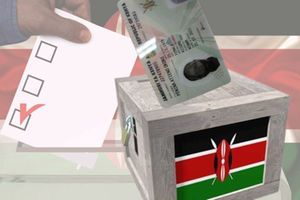
The over 5 million Kenyans living in the diaspora may have the alternative of using a national identity card (ID) as a valid voting document other than the passport ahead of the 2027 General Election, if Parliament approves regulations recognising the document.
The National Assembly Committee on Constitutional Implementation Oversight (CIOC), in a report that was adopted by the House, made the proposal on account that the requirement for a passport “limits some diasporans since a passport has an expiry date.”
This, the committee says, is critical so as to expand electoral inclusivity and remove barriers to participation ahead of the 2027 general election and beyond.
“Other than the voting card issued by the electoral commission upon registration, the national identity card should also be considered as a valid voting document for Kenyans in the diaspora,” the CIOC report on the status of implementation of the Constitution by the IEBC reads.
Currently, regulation 37 of the Elections (Registration of Voters) Regulations of 2012 requires Kenyans living outside the country to be holders of valid passports to apply for voter registration.
However, the same regulation provides an exception for Kenyans residing within the East African Community (EAC), who are permitted to use their national identity cards (IDs) instead.
The CIOC report was tabled in the National Assembly on November 19, 2025, debated and adopted on February 24, 2026, paving the way for the IEBC to come up with regulations for approval by the House.
Busia Senator Okiya Omtatah.
Photo credit: File | Nation Media Group
Busia Senator Okiya Omtatah, in a 2022 petition filed in court, challenged the constitutionality of the regulation, arguing that the passport mandate “unreasonably” limits the constitutional right to vote for millions of citizens overseas who may only hold national identity cards.
But the High Court in a judgment of May 22, 2025, upheld the law, ruling that requiring a passport is a reasonable limitation. The court noted that a passport serves as a natural condition precedent and proof of lawful residence for individuals living outside the country.
Tiaty MP William Kamket.
Photo credit: File | Nation Media Group
CIOC, chaired by Tiaty MP William Kamket Kasait, is responsible for overseeing the implementation of the constitution by government agencies, among them constitutional commissions.
Article 83 of the Constitution provides for the qualifications for one to register as a voter, with the legal requirements being possession of a national identity card or a valid Kenyan passport, with the requirement for voting in Kenya’s foreign missions abroad limited to a passport.
Kenya’s population in the diaspora has seen a significant rise recently, reaching a milestone as per documents from the Parliamentary Budget Office (PBO) and the State Department for Diaspora Affairs at the Ministry of Foreign Affairs.
The diaspora population is widely distributed across key global hubs, according to the latest data, with the United States (US) at about 159,000 as of early 2025, hosting the largest single community.
The United Kingdom (UK) is the second most popular diaspora community for Kenyans, with at least 144,000 Kenyan residents.
In the Middle East, about 30,000 Kenyans live in Saudi Arabia, the United Arab Emirates (UAE) and Qatar.
In Africa, thousands of Kenyans live and work in the neighbouring countries of Uganda and Tanzania, Rwanda, as well as down south- South Africa.
The other regions with notable Kenyan diaspora communities include Canada, Australia and Germany, with a combined population of at least 13,000.
Other than pushing for the recognition of the national identity card as a voting document for Kenyans in the diaspora, the Kamket-led committee wants IEBC to provide detailed plans for expanding the diaspora voter registration centers beyond the current 12 countries utilized in the 2022 general election.
This is with specific targets for the 2027 General Election and a roadmap for progressive realization of diaspora voting rights as decreed by the Constitution.
Already, the electoral commission has expanded its diaspora voter registration outreach.
During the recent nationwide voter registration drive, the commission announced that it is doubling the number of participating countries, expanding voter registration for citizens residing outside Kenya from 12 to 26 countries.
The IEBC documents before parliament show that the 2013 elections, the first under the 2010 constitution, marked the first-ever diaspora voting exercise in Kenya's history, with implementation limited to four East African Community (EAC) member States- Uganda, Tanzania, Rwanda and Burundi.
“The 2017 polls saw an incremental expansion of diaspora voting to include South Africa, bringing the total number of participating countries to five,” reads the CIOC report.
According to the CIOC report, the 2022 elections marked “the most significant expansion of diaspora voting to date, with the operationalisation of voting rights in the 12 countries.”
This expansion, the CIOC report says, included the addition of the United States of America (USA), Canada, the United Kingdom (UK), Germany, the United Arab Emirates (UAE), Qatar and South Sudan to the existing list.
Articles 38 and 82 of the Constitution guarantee all Kenyan citizens the right to political participation, including voting, regardless of their geographic location.
Article 82 (1) (e) of the constitution further guarantees the progressive realization of the voting rights for Kenyan citizens residing outside the country.
The policy on voter registration and voting for citizens residing outside Kenya, established in 2015 and reviewed in 2021, provides the framework for operationalising the diaspora voting right.
The IEBC documents further note that despite the progress made in the realisation of the diaspora voting right, a paltry 10,443 diaspora voters were registered for the 2022 general election across the 12 countries, with 58 percent turning out to cast their ballots.
The commission noted that the Elections Act 2011 and the Elections (Registration of Voters) Regulations of 2012 established the legal framework for diaspora voting and assigned the IEBC the responsibility to operationalise “these provisions.”
Before the commencement of the voter registration exercise in the diaspora, the IEBC published in the Kenya Gazette the names of registration centres and countries in which registration and voting were scheduled to take place and the period of registration.
The committee notes that to enhance voter registration and voting for citizens residing outside Kenya, the IEBC “is in the process of reviewing and developing its implementation plan to, among others, continue expanding voter registration centres for Kenyan citizens residing outside Kenya.”
“This is to ensure progressive realisation of their voting rights as mandated by the constitution,” says CIOC.