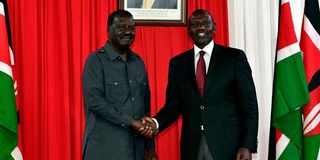
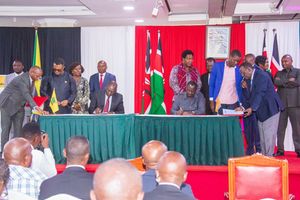
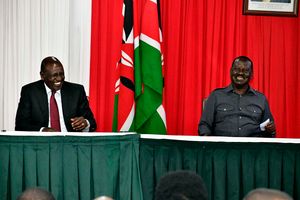
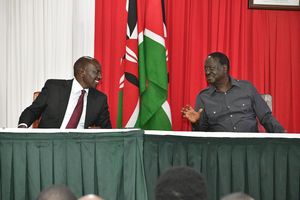
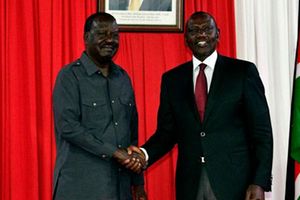
However, the party says it is committed to ensuring the full implementation of the ten-point agenda agreed upon between former Prime Minister Raila Odinga and President Ruto.
ODM chairperson Gladys Wanga, speaking on NTV's Fixing the Nation morning show, described the MoU as "imperfect," noting that several provisions remain unfulfilled.
The Homa Bay Governor revealed that the party is carefully reviewing the progress of the agreement with a view to strengthening its impact.
"The ODM party is reviewing the implementation of the Ruto-Raila MoU to identify areas needing improvement. While it hasn't been fully implemented, we are committed to ensuring that the agreed-upon issues are addressed," said Ms Wanga.
"We recently held a meeting to review the MoU and will have another soon to assess the implementation status. There has been progress on job creation for young people, but others, such as compensation for victims of the Gen Z protests, remain pending," she explained.
Homa Bay County Governor Gladys Wanga before the National Assembly Budget and Appropriations Committee at Bunge Tower Nairobi on April 14, 2025.
Photo credit: Dennis Onsongo | Nation Media Group
The Homa Bay governor confirmed the party’s intention to engage the President further to ensure the agreement delivers tangible results. She also defended Mr Odinga’s renewed call for dialogue with the government, saying unresolved issues will be addressed in upcoming talks.
At the same time, she reiterated that ODM will continue to push for justice over extra-judicial executions and police brutality—including the killing of teacher Albert Ojwang—while remaining part of the government.
Ms Wanga emphasised that state violence and extra-judicial killings are incompatible with the spirit of the agreement and that ODM will not condone such actions.
"We are holding this broad-based government accountable to its commitments. Our support does not extend to extrajudicial executions or illegal repression. We draw the line here," she affirmed.
She condemned recent incidents of police brutality and extra-judicial killings, calling for swift legal action against those responsible.
One of ODM's major concerns is the lack of compensation for individuals injured during protests—an issue the MoU promised to resolve. She criticized delays in fulfilling this pledge.
The MoU also calls for amnesty for individuals charged in connection with the peaceful exercise of their constitutional rights under Article 37 and urges reforms in how the National Police Service handles public demonstrations.
However, Ms Wanga noted that no victims of police brutality have been compensated, and some protestors still face serious charges—including terrorism—for allegedly setting fire to police stations during recent demonstrations.
While she condemned violent acts disguised as protests, she also defended individuals in police custody, saying due process must be followed.
"One cannot be charged without evidence. Arrests must be based on direct involvement in crimes. I am not defending the accused blindly, but the process must be just," she added.
The Ruto-Odinga pact, which gave rise to a broad-based government, has recently faced criticism following numerous reports of extra-judicial killings and forced disappearances.
Allegations of grave human rights violations—including torture, inhumane treatment, and unlawful detentions—have placed the MoU under increased scrutiny.
Last week, the Kenya National Commission on Human Rights (KNCHR) revealed that at least 115 people had been killed across the country during anti-government protests over the past year. The July 7 Saba Saba protests, which claimed more than 30 lives, were the deadliest.
The governor also voiced ODM's support for Mr Odinga's call for dialogue to address the country’s urgent issues.
The March 7, 2025, MoU signed at the Kenyatta International Convention Centre (KICC) between President Ruto and M Odinga aimed to ease political tensions, promote unity, and address pressing national concerns.
The ten-point agenda included implementation of the National Dialogue Committee (NADCO) report, creation of a Prime Minister's position, curbing government opulence, ending abductions, and fighting corruption.
It also addressed the high cost of living, youth unemployment, and respect for the right to peaceful assembly and protest.
However, political observers argue that many of the pledges remain unmet amid ongoing demonstrations by Kenyan youth over governance and accountability.
The NADCO report, co-chaired by Wiper leader Kalonzo Musyoka and Kikuyu MP Kimani Ichung'wah, was formed in response to the 2022 post-election tensions. Released in November 2023, it recommended, among other things, restructuring the IEBC and establishing the offices of the Prime Minister and Leader of the Official Opposition.
Mr. Odinga has repeatedly defended his working relationship with President Ruto, saying it was necessary to reduce political tension and shift focus toward national development.
"I signed the MoU so that we could move forward as a country and focus on development rather than politics for five years. What’s important is that Kenya stays united—Kenyans need to live between now and 2027," he said last week.