National Assembly Speaker Moses Wetang’ula had pledged to fast-track the legislation, but a year on, little progress has been made, raising concerns about Kenya’s preparedness for a credible poll.
The Independent Electoral and Boundaries Commission (IEBC) has warned that enacting electoral laws too close to an election “severely compromises” its operational planning and procurement, which are bound by strict statutory timelines.
The proposed reforms stem largely from the recommendations of the National Dialogue Committee (Nadco), including changes to the Elections Act, Election Offences Act, and Political Parties Act.
There is also the draft Election Campaign Financing (Amendment) Bill and the draft Election Campaign Financing Regulations, which are intended to ensure a level playing field for candidates and political parties.
The Bills were published in 2024, passed by the Senate and transmitted to the National Assembly for consideration and concurrence. So far, the amendment to the IEBC Act, which provides for a selection panel to recruit commissioners in the event of a vacancy, is the only major legislative success arising from the Nadco recommendations.
With less than a year to the August 10, 2027 General Election, the process of enacting the remaining laws is already behind schedule, despite recommendations by the now-defunct Independent Review Commission, which was chaired by retired South African Judge Johann Kriegler, whose report was adopted by Parliament in 2008.
Drawing from the Kriegler report, the IEBC has warned Parliament that persistent enactment or amendment of electoral laws too close to a general election undermines planning and implementation of electoral activities within prescribed timelines.
“This tendency upsets the recommendations of the Kriegler commission that legal reforms ought to be undertaken at least two years before a general election,” the IEBC says in a document presented to Parliament.
Mr Wetang’ula did not respond to our enquiries yesterday on the progress made in fast-tracking the Bills. However, when he met Dr Ed Barnett, the Deputy British High Commissioner to Kenya and Permanent Representative to the UN Environment Programme and UN-Habitat in his office last year, the Speaker said Parliament would not allow delays that could undermine the country’s electoral credibility.
National Assembly Speaker Moses Wetang'ula.
Photo credit: Pool I Nation Media Group
“As a House, we have resolved that within the next two or three months, we will be done with the Bills. We cannot be reviewing laws six or seven months to a general election,” Mr Wetang’ula said in October 2025.
He also acknowledged that restoring public trust in the IEBC remained a work in progress and urged the commissioners to intensify public engagement to dispel fears and rebuild confidence in the electoral agency.
Nadco, a bipartisan initiative, was established to cool political temperatures following deadly protests after then-Azimio leader Raila Odinga disputed the outcome of the August 9, 2022 presidential election. Beyond the Nadco Bills, the IEBC has identified additional gaps in the electoral legal framework and submitted what it describes as “a raft of proposals in Bills and their accompanying statutory instruments” to Parliament.
These include the Elections (Amendment) Bill, 2024; County Governments Election Laws (Amendment) Bill, 2024; Draft Referendum Bill, 2020; Draft Referendum Regulations, 2020; and Rules of Procedure for the Settlement of Disputes. The others include the Rules of Procedure on Delimitation of Boundaries, 2021; Election (Voter Registration) (Amendment) Regulations, 2022; Election (General) (Amendment) Regulations, 2022; and Election (Voter Education) (Amendment) Regulations, 2022. The list also includes the Elections (Party Primaries and Party Lists) (Amendment) Regulations, 2022, and Elections (Technology) (Amendment) Regulations, 2022.
The Elections (Amendment) Bill, 2024, among other provisions, seeks to give effect to Article 88(4)(g) of the Constitution, which requires Parliament to appoint an independent firm to evaluate the electoral process within a year of a general election. The Bill was passed by the Senate in December 2024 and transmitted to the National Assembly for consideration and concurrence, receiving its first reading in February 2025.
It proposes an audit of the register of voters used during an election, an assessment of the role of the media and civil society, a review of voting procedures on Election Day, and an examination of vote-counting procedures.
The evaluation would also cover the legal framework, processes and costs associated with an election, with the independent firm required to submit its report to Parliament within 90 days of appointment.
The review is intended to inform subsequent electoral reforms, strengthen the credibility and efficiency of the electoral system and ensure value for money. To facilitate this, it proposes the insertion of new sections 87A, 87B and 87C into the Elections Act.
The evaluation would cover the cost of conducting a general election, including procurement of goods and services, as well as the legal framework under which the election was conducted.
It would also examine the information and communication technology deployed during the election, the human resources involved and the mechanisms for resolving electoral disputes.
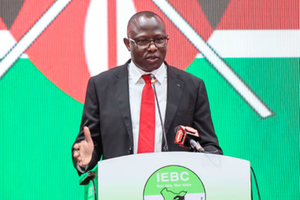
The Independent Electoral and Boundaries Commission Chairperson Erastus Edung Ethekon.
Photo credit: Bonface Bogita | Nation Media Group
The proposed reforms further require the IEBC to publish and implement campaign financing regulations to ensure a level playing field for competing candidates. The Election Offences (Amendment) Bill, 2024, proposes a fine of up to Sh2 million, a jail term of up to five years, or both, for those conducting an election outside gazetted polling stations.
The Bill also targets IEBC officials and other persons who “unreasonably delay in declaring election results or knowingly alter declared election results”.
It seeks to amend Section 6 of the Election Offences Act to ensure results declared by IEBC officials originate from gazetted polling stations. “It shall be an offence for members and staff of the IEBC to conduct or hold an election in an ungazetted polling station,” the Bill states.
It further proposes the inclusion of Section 6(n), making it an offence for an IEBC official or any other person charged with a duty under electoral law to fail or unreasonably delay in declaring election results. Ahead of the 2022 General Election, the IEBC gazetted 46,232 polling stations, up from 40,883 in 2017.
The issue of polling stations was also central to a petition that successfully challenged the 2017 presidential election. The petitioners alleged that the IEBC had illegally established ungazetted polling stations in Mandera County, which were manned by ungazetted and undesignated returning and presiding officers.
The petition further alleged that results from more than 11,000 polling stations outside the gazetted stations were transmitted and included in the final tally, contrary to Regulation 7(1)(c) of the Elections (General) Regulations.
The Bill also proposes the inclusion of Section 6(o), making it an election offence for an IEBC official or staff member to “knowingly or intentionally” interfere with, alter or cause another person to interfere with or alter declared results.
Regulation 7(1)(c) of the Elections (General) Regulations requires the IEBC to publish and publicise a Gazette notice specifying the polling stations established for each constituency.
The notice must also identify the distinguishing number, letter or combination assigned to each polling station and specify the places, vehicles or vessels designated for polling where applicable.
The Political Parties (Amendment) Bill, 2024, proposes to repeal Section 14A of the Political Parties Act, a move that could make it easier for elected leaders to switch political allegiances without automatically losing their seats.
If enacted in its current form, the provision would allow party members, including MPs, MCAs, governors and the President, to promote the ideology and interests of rival parties without being deemed to have resigned from their original parties.
Critics could argue that the change risks turning political parties into vehicles of convenience, allowing members to abandon them when political interests shift and weakening party discipline, a key pillar of multiparty democracy.
Section 14A currently sets out circumstances under which a person is deemed to have resigned from a political party. It provides that a person is deemed to have resigned if, while a member of a political party, they form another party, participate in the formation of another party, or join another political party.
The law also covers members who publicly advocate the formation of another political party or promote the ideology, interests or policies of another party.