The political partnership President William Ruto and Raila Odinga began building before the former Prime Minister’s death on October 15, 2025 is entering a decisive phase. The ruling United Democratic Alliance (UDA) and the Orange Democratic Movement (ODM) are preparing a joint manifesto and negotiating an electoral alliance for the August 10, 2027 General Election.
But as the two parties seek to turn their broad-based government arrangement into a campaign vehicle, the partnership faces two tests: ODM’s demands for a greater share of political power and the government’s record in implementing the National Dialogue Committee (NADCO) recommendations that formed the basis of the deal.
The pressure is compounded by delays in electoral reforms, many of which arose from the same dialogue process that brought the former rivals together.
With less than a year to the election, the failure to enact key laws threatens to undermine preparations for a contest whose credibility will be central to the political parties’ campaigns.
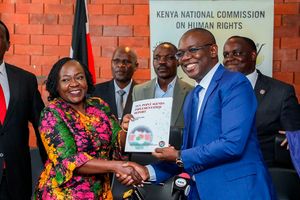
Azimio leader Raila Odinga holds a copy of a copy of Nadco report flanked by Wiper Party Leader Kalonzo Musyoka, Majority leader Kimani Ichung’wah and other leaders at Capital Hill.
Photo credit: File | Nation Media Group
At the centre of the alliance-building effort is a team of experts tasked with preparing a joint manifesto that will combine the parties’ policy priorities and assess their performance against previous promises.
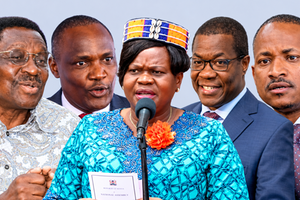
The team comprises five nominees from each party, with UDA Executive Director Nicodemus Bore and ODM Executive Director Oduor Ong’wen serving as ex-officio members.
ODM’s nominees are Isaac Wanuge, Maryam Abdullahi Mbaruk, Prof Leonida Kerubo Omosa, Carey Orege and Prof Bernard Muok. UDA has nominated Dr Emmanuel Nzai, Dr Daniel Mwai, Bramwel Simiyu, Mohammed Hassan and Dr Cecilia Ng’etich.
“We want to make sure that what we promised in 2022 are fully accomplished,” Mr Bore said, adding that the exercise should capture the aspirations of all regions and identify areas where delivery has fallen short.
This marks another step in the transformation of the broad-based government from a power-sharing arrangement into a potential pre-election coalition. Yet a shared policy document may prove easier to negotiate than the political terms under which the two parties intend to campaign together.
Raila died in India on October 15, 2025, before the partnership he negotiated with Dr Ruto could be converted into a formal electoral alliance. His death left ODM leader Dr Oburu Oginga and the President to determine the future of the arrangement, even as competing interests within both camps sought to influence the terms.
The roots of the deal lie in the political turmoil that followed the Gen Z-led protests of 2024. Facing mounting public pressure, Dr Ruto reached out to the opposition, bringing senior ODM figures John Mbadi (Treasury), Opiyo Wandayi (Energy), Hassan Joho (Mining) and Wycliffe Oparanya (Cooperatives) into his Cabinet in July that year.
The rapprochement culminated in a cooperation agreement signed by Dr Ruto and Raila at the Kenyatta International Convention Centre on March 7, 2025. Raila maintained that the agreement was not a coalition deal but a framework for addressing national challenges, easing political tensions and advancing governance reforms.
Its 10-point agenda covered implementation of the NADCO report, strengthening devolution, youth empowerment, leadership and integrity, protection of peaceful assembly, review of national debt, the fight against corruption, reduction of public wastage, inclusivity and protection of constitutionalism and the rule of law.
The coffin of Kenya's former Prime Minister Raila Odinga, who died while receiving medical treatment in India, lies in a grave surrounded by floral wreaths during his burial at the Kango Ka Jaramogi home in Bondo, Siaya County, Kenya, October 19, 2025.
Photo credit: Thomas Mukoya | Reuters
Following Raila’s death, ODM’s Central Management Committee reaffirmed its commitment to the broad-based arrangement through the 2027 election. Dr Oginga, the incumbent ODM leader, has since urged the government to demonstrate goodwill by implementing the commitments before Kenyans return to the ballot.
UDA Secretary-General Hassan Omar has also said implementing the NADCO recommendations and the 10-point agenda would honour Raila’s contribution to the agreement.
The NADCO recommendations emerged from efforts to ease tensions following the 2023 demonstrations and the contested political environment. They proposed reforms to strengthen democratic institutions, improve parliamentary oversight, protect civic freedoms and address the cost of living.
Among the politically significant proposals were the creation of the office of the Official Leader of the Opposition, which would require further legislative and constitutional work.
For ODM, insiders insist that implementation is a measure of whether cooperation with a former political rival has produced meaningful gains or simply given its leaders access to government. For Dr Ruto, it will determine whether the joint manifesto can credibly present the administration’s record while promising a new programme for the next term.
National Assembly Speaker Moses Wetang’ula pledged in October 2025 that Parliament would fast-track electoral reform Bills arising from NADCO, saying the House would not allow delays that could undermine the credibility of the 2027 election.
“As a House, we have resolved that within the next two or three months, we will be done with the Bills. We cannot be reviewing laws six or seven months to a general election,” he said.
A year later, however, several proposals remain pending before Parliament.
The Independent Electoral and Boundaries Commission (IEBC) has warned that enacting electoral laws too close to an election “severely compromises” operational planning and procurement, which must follow strict statutory timelines.
Drawing on the recommendations of the Kriegler Commission, which reviewed the disputed 2007 election, the commission had said legal reforms should be completed at least two years before a general election.
The IEBC Act amendment providing for a selection panel to recruit commissioners in the event of a vacancy is among the major legislative successes arising from NADCO. Other proposals, including amendments to the Elections Act, Election Offences Act and Political Parties Act, remain part of the unfinished reform agenda.
The Elections (Amendment) Bill, 2024, seeks to provide for an independent evaluation of the electoral process within a year of a general election. The proposed review would examine the voter register, voting and counting procedures, election technology, dispute-resolution mechanisms, procurement and the overall cost of conducting an election.
The evaluation would inform subsequent reforms and assess whether public resources were used efficiently.
Another proposal, the Election Offences (Amendment) Bill, 2024, seeks to impose penalties of up to Sh2 million, imprisonment for up to five years, or both, for conducting an election outside gazetted polling stations.
The Bill also targets officials who unreasonably delay declaring results or knowingly interfere with declared results.
The proposed changes follow concerns raised during previous elections, including the 2017 presidential petition, in which questions were raised about polling stations and the officers who managed them.
Meanwhile, the Political Parties (Amendment) Bill, 2024, proposes repealing Section 14A of the Political Parties Act, which defines circumstances under which a person is deemed to have resigned from a political party.
If enacted in its current form, the amendment could make it easier for elected leaders to shift political allegiance without automatically losing their seats. Supporters of greater flexibility could see this as allowing political realignments, while critics warn it could weaken party discipline and turn parties into vehicles of convenience.
The changes could have direct implications for the emerging UDA-ODM alliance, where questions of party identity, loyalty and electoral cooperation are already contentious.
Beyond the NADCO Bills, the IEBC has submitted additional proposals covering voter registration, voter education, election technology, party primaries, party lists, boundary delimitation and the settlement of electoral disputes, some of which have already faced setbacks in parliament.
The commission’s warning is significant because the parties are negotiating a political arrangement that will depend on the rules governing nominations, campaigns and the declaration of results. Delays could leave both the electoral agency and political parties working against compressed timelines.
The draft Election Campaign Financing (Amendment) Bill and accompanying regulations are also intended to establish a level playing field for candidates and parties. Their fate will matter in an election where the financing of campaigns and the use of public resources are likely to attract scrutiny.
But even as the parties pursue reforms, the negotiations have exposed a more immediate dispute: how political power will be shared if they agree to support a joint presidential ticket.
In June, Dr Oginga said negotiations should be based on a 50-50 sharing formula, including discussions on the presidency and other elective positions. In July, he publicly declared that ODM would not field its own presidential candidate in 2027 and would instead support Dr Ruto’s re-election.
The demand has since become more specific, with ODM leaders insisting that the party should provide the President’s running mate, a position currently held by Deputy President Kithure Kindiki.
Deputy President Kithure Kindiki speaks during a UDA polling centre officials’ event in Manyatta Constituency, Embu County on September 12, 2026.
Photo credit: DPCS
The demand has unsettled some of Dr Ruto’s allies, particularly those supporting Prof Kindiki’s retention as running mate. For ODM, however, the argument is that its political support and contribution to the broad-based government must translate into a meaningful stake in the next administration.
The two parties must also negotiate constituency-level contests, nominations, zoning and the distribution of other positions. Cooperation during previous by-elections has demonstrated the advantages of avoiding competition between allies, but extending such arrangements nationwide, analysts say, could prove more difficult.
The manifesto team is not expected to resolve these political questions. Its work will proceed alongside negotiations on the coalition framework, including its leadership, decision-making structures and distribution of positions.
In an interview with the Sunday Nation on August 21, Dr Ruto acknowledged that Raila’s death had removed a formidable political force at a critical moment.
“Raila was a very formidable leader,” the President said. “His presence in this team would be influential. It would not be honest for anybody to say that his presence would not have influenced the situation.”
Raila’s national political network and long experience negotiating alliances made him a consequential partner. His absence has changed the character of the negotiations, leaving Dr Oginga to balance the party’s commitment to his brother’s agreement against dissenting voices demanding stronger guarantees.
The manifesto experts now face the task of reconciling UDA’s development agenda with ODM’s emphasis on equity, devolution and governance reforms. Their programme, insiders say, must also demonstrate what the government has achieved and what remains unfinished.
“Ultimately, the alliance will be judged on more than the promises contained in a joint document. It must show progress on NADCO, resolve disputes over political power and establish whether its electoral cooperation can withstand competing ambitions,” an ODM official told Nation .
The deal Raila negotiated has survived his death, but whether it can deliver the reforms that justified it, overcome delays in electoral legislation and hold together through the contest for the 2027 election will depend on what UDA and ODM are willing to concede before the campaign begins.
But former ODM Secretary General Edwin Sifuna insists that the cooperation between the two parties was only intended to preserve democratic stability and give Kenyans an opportunity to remove President Ruto through the ballot.
Mr Sifuna points to Raila’s remarks at a public event less than three weeks before his death, when the former Prime Minister questioned why anyone had assumed ODM would not field a presidential candidate in 2027.
For the Nairobi senator, the statement reinforces his belief that the party had not surrendered its right to contest the presidency.