When former President Mwai Kibaki launched Vision 2030 in 2008, he gave Kenya a future destination. Nearly two decades later, President William Ruto is asking Kenyans to determine where the country should go next.
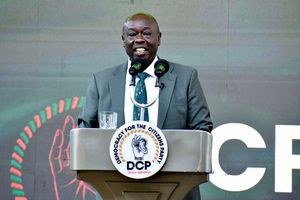
Launching the National Conversation on Kenya’s Future Beyond Vision 2030 at the Kenyatta International Convention Centre (KICC) in Nairobi yesterday, Dr Ruto called for a new long-term blueprint anchored in the aspirations of citizens and insulated from the pressures of electoral politics.
The President said the government would provide the platform and resources for the exercise but leave Kenyans to shape its outcome.
The approach marks a deliberate departure from a conventional government-led development plan, placing citizens, experts, young people, business, counties, academia, civil society, religious leaders and other stakeholders at the centre of defining Kenya’s next destination.
The initiative inevitably evokes the legacy of the late President Kibaki, whose administration conceived and launched Vision 2030 as a national framework aimed at transforming Kenya into a globally competitive, newly industrialising, middle-income economy.
But while Kibaki's blueprint established a long-term destination, Dr Ruto is seeking to build broader ownership of what comes next, arguing that the next vision must transcend the administration that initiates it and survive successive political transitions.
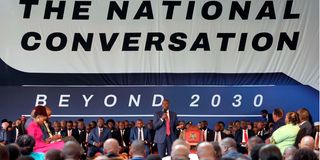
President William Ruto speaks at the Kenyatta International Convention Centre (KICC) during the launch of the National Conversation Beyond 2030 on Wednesday, August 12, 2026.
Photo credit: Dennis Onsongo | Nation
“This is not a government project. It is a people’s project,” Dr Ruto declared.
He added that the government would provide the platform and resources necessary for Kenyans to participate but would not dictate the outcome.
“Government is not going to lead the talks. We’ll provide the platform for the people to decide,” he said, inviting Kenyans to bring together a “cocktail of ideas” on the country's future.
The platform brought together political leaders, governors, business leaders, civil society, religious leaders, private sector, academics, students and children, with each offering a different interpretation of what Kenya's future should look like.
“My dream for Kenya, is seeing good schools for all children, good hospitals for everyone, clean water for every home, clean roads everywhere and jobs for young people,” he said.
At seven, Adrian is unlikely to have experienced an election campaign, watched a parliamentary debate or studied the intricacies of economic policy.
But his contribution captured the central challenge of the exercise, translating grand national ambitions into improvements that ordinary citizens can see and feel.
By 2060, Adrian will be 41.
“The Kenya being discussed at KICC, therefore, is not primarily about the politicians occupying State House today. It is about the Kenya that Adrian and millions of other young people will inherit,” Ms Daisy Amdany, a governance, development and women’s rights enthusiast, said.
At the event, President Ruto openly acknowledged Kibaki's past contribution.
Vision 2030, he said, gave Kenya clear development targets and a framework through which progress could be measured.
Today, he noted, the country has a scorecard showing what has been achieved and where it has fallen short.
And the verdict, according to President Ruto, is mixed.
“Of all the pillars, it’s the economic pillar where we have not done quite well,” he said.
Rather than simply celebrating Vision 2030, the exercise is expected to interrogate it: What worked? What failed? What was overtaken by changing circumstances? And what should Kenya retain as it designs its next long-term development trajectory?
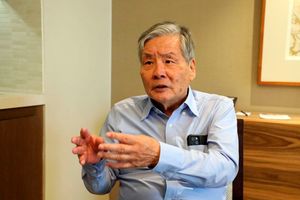
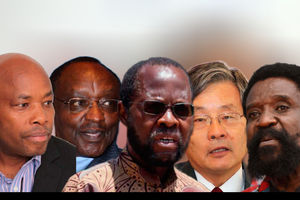
Japanese economist and former IMF official Professor Hiroyuki Hino, speaks at the Kenyatta International Convention Centre (KICC) during the launch of the National Conversation Beyond 2030 on Wednesday, August 12, 2026.
Photo credit: Dennis Onsongo | Nation
Dr Emmanuel Nzai, chairman of the Vision 2030 Delivery Board, offered a strong defence of the outgoing blueprint.
“Vision 2030 has changed the country. It is evidence; it is not talk,” he said, pointing to the Lamu Port-South Sudan-Ethiopia Transport corridor (LAPSSET) and noting that major investors would not be considering projects such as the proposed Dangote oil refinery in Lamu without the infrastructure foundation created under Vision 2030.
Experts who drew the guidelines for the vision, including Kisumu Governor Prof Anyang’ Nyong’o, however, posed the question that now hangs over the entire process: Why now?
His answer was that Vision 2030 has guided Kenya since 2008, but the country must confront what happens after 2027 and beyond 2030. Simply replacing one five-year programme with another, he argued, could leave Kenya trapped in a cycle of projects without a sufficiently clear national destination.
“Vision 2030 has guided our country to some measure of industrialisation, political stability and modern infrastructure,” Prof Nyong’o said. But more must be done to transform Kenya into a high-income, high-value and resilient economy whose wealth is broadly shared among citizens.
Nation established that Prof Nyong’o will lead a yet-to be established multi-sectoral team to draw a roadmap for the conversation, a dialogue to be cascaded to the grassroots.
As the talk begins, one of the strongest themes emerging from the KICC conversation was the need to prevent Kenya's long-term plans from becoming casualties of political succession.
President Ruto argued that Kenya must learn to distinguish between the interests of an election cycle and those of the nation.
“Kenya is bigger than any election. An election is not a matter of life and death,” he said.
He warned that some development targets had been missed because leaders often think about the next election rather than the next generation.
“The next election will come and go. Kenya must think of the next generation,” he said.
Deputy President Kithure Kindiki took the argument further, warning against what he called policy disruption.
He said the biggest threat facing developing countries was the tendency for new administrations to abandon policies initiated by their predecessors rather than improve them.
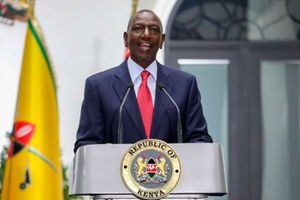
President William Ruto gestures as he speaks during the launch of the 'National Conversation Beyond 2030' at the KICC, Nairobi, Kenya, August 12, 2026.
Photo credit: Reuters
“The biggest threat of African countries, the biggest threat of developing countries, is policy disruption,” Prof Kindiki said.
He argued that Kenya needed to insulate its development agenda from political changes and individual egos. National Assembly Majority Leader Kimani Ichung’wah offered a possible institutional solution, to have the national vision anchored in law so that a change of leadership does not automatically result in a change of direction.
“Anchor national vision into law so that no leadership change takes us back,” the MP said.
His message was that a vision can be ambitious on paper, but unless its core objectives enjoy broad political and public ownership, it can easily become vulnerable to the arrival of a new administration.
The lesson from Kibaki's Vision 2030, according to the proponents of the new blueprint, is not merely that Kenya needs another manifesto, but that the plan must outlive the president who launches it.
Prof Kindiki used his presentation to provide a detailed defence of the Ruto administration's record.
He pointed to foreign exchange reserves, lower inflation, increased foreign direct investment, agricultural production, education funding, health insurance coverage, roads, digital connectivity, infrastructure and job creation.
He cited a register of 7.2 million farmers, increased maize production, growth in processed milk, increased coffee earnings and expanded education funding.
He also pointed to infrastructure projects, digital jobs, fibre-optic connectivity and stadium construction across the counties.
His message emphasised the need for Kenya not to begin the post-Vision 2030 conversation as though nothing has been achieved.
“We have done some progress,” Prof Kindiki said. “A lot of work needs to be done.”
But if there was one idea capable of provoking both excitement and scepticism at KICC, it was the comparison with Singapore.
Prof Hiroyuki Hino, a senior fellow at Duke University, acknowledged that many Kenyans would consider Singapore an unrealistic benchmark.
Prof Hino is a scholar with long experience studying Kenya’s development, and who was part of Prof Nyong’o’s team that worked on the new vision’s guidelines.
Singapore's income per person exceeded $80,000 in 2025, compared with just over $2,000 in Kenya, he noted.
Yet Prof Hino's argument was not that Kenya should copy Singapore, but that Kenyans should refuse to define their future by today's limitations.
“The Asian Miracle,” he argued, was driven by the strength of people, their hard work, motivation, discipline and cooperation.
A national vision, he suggested, should ultimately be judged by whether it improves the lives of citizens.
He pointed to household incomes, childhood nutrition, education and access to basic services as measures that should matter as much as major roads, airports and other symbols of development.
His prescription included improving education, supporting poor households, strengthening small informal enterprises, narrowing inequality and confronting corruption.
Kenya, Dr Oginga emphasised, can reach the level of Singapore if it deals with “this animal called corruption.”
The message was reinforced by Prof Hino, who argued that corruption damages both the economy and the social fabric and that citizens have a role in exposing wrongdoing and demanding accountability.