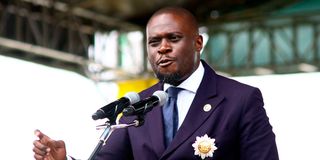
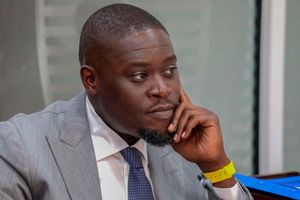
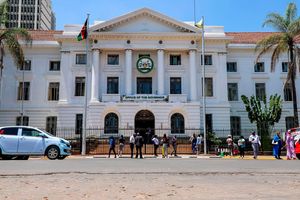
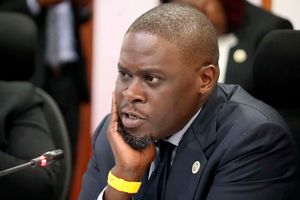
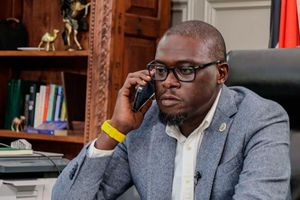
Nairobi Governor Johnson Sakaja has claimed that certain powerful individuals within the national government are keen on wresting control of key City Hall functions, a move he insists he will not allow.
The governor clarified that, unlike the former Nairobi Metropolitan Services (NMS) arrangement, the current framework is not a transfer of functions but a support mechanism.
He defended the partnership with the national government, saying the devolved unit requires special financing due to its status as Kenya’s capital city.
President William Ruto in a past photo. President Ruto named Frank Ole Kibelekenya Kenya’s ambassador to the new Copenhagen, Denmark mission.
Photo credit: PCS
The development comes after Nairobi County sought enhanced national collaboration in key sectors, including transport and road infrastructure, solid waste management, water source development and supply, sewerage expansion and public lighting.
In a wide-ranging interview with Nation , Governor Sakaja explained that the framework established with President William Ruto’s administration is meant to provide additional support and not to cede county functions.
“There are speculations, and some people are pushing that agenda. Think about the political stakes in Nairobi after the Presidency; there is no bigger position to contest than the governorship of Nairobi.
“We have not ceded any functions. A transfer of functions is not what we are discussing and it is not something we will do. If there were a transfer of functions, there would be a formal document as provided for in Article 187 of the Constitution. Have you seen any such document? There is none,” said Governor Sakaja.
The governor noted that Nairobi County requires closer collaboration with the national government because it carries responsibilities far beyond those of an ordinary county, making cooperation unavoidable.
The Nairobi City Skyline on April 27, 2023.
Photo credit: Wilfred Nyangaresi | Nation Media Group
As Kenya’s capital, he said, the city’s unique status demands a funding structure that reflects its national and international obligations. Consequently, the collaboration aims to improve service delivery to the city’s millions of residents without surrendering county authority.
He cited Section 6 of the Urban Areas and Cities Act, 2019, which recognises Nairobi as Kenya’s capital and calls for formal cooperation between county and national governments on funding and service delivery.
According to Mr Sakaja, the law provides a clear framework for joint planning and resource sharing. He pointed out that major capitals such as New York or Paris receive substantial national support while remaining under locally elected leadership, a precedent Nairobi is increasingly mirroring.
“I have not transferred any functions but have entered into a collaboration with the national government. This partnership allows both levels of government to jointly address financing gaps without complex legislative approvals, enabling faster delivery of services such as roads, transport systems, and large infrastructure projects,” he said.
Can Nairobi work? Governor Johnson Sakaja speaks about the city's successes and struggles
Section 6 of the Urban Areas and Cities Act, 2019, states that Nairobi shall be governed and managed like any other county government.
Sub-section 5 of the Act further provides that the two levels of government shall enter into an agreement regarding the performance of functions and service delivery, including funding of operations and joint projects.
The county boss explained that Nairobi has grown faster than its infrastructure and systems, leaving ordinary residents to bear the brunt despite promises by successive governments.
He noted that Nairobi hosts the Presidency, Parliament, Judiciary, foreign embassies, key national institutions and global offices and therefore needs a special financing model similar to other major cities worldwide.
“Paris, with a population of 2 million, has a budget of Sh13 trillion yet Nairobi, with over 6 million people, has a budget of about Sh38 billion. If we want to compete with international cities, we must embrace special financing and strategic partnerships,” he said.
“You cannot expect a city that hosts embassies, multinational firms and national institutions to compete globally without a financing model that matches its responsibilities,” he added.
As part of the collaboration aimed at accelerating service delivery in the capital, the national government has committed additional funding, including an estimated Sh2.1 billion. Implementation of select projects will be undertaken through agencies such as the Kenya Urban Roads Authority.
The capacity enhancement of the Pangani - Muthaiga - Kiambu - Ndumberi road project falls under KURA
Photo credit: File | Nation Media Group
The county will, however, continue constructing, rehabilitating and maintaining urban roads alongside national interventions.
For water and sewer infrastructure, national agencies, particularly the Athi Water Works Development Agency (AWWDA), are expected to spearhead large-scale, long-term supply projects, including the construction of a new dam in Murang’a, advancement of the Northern Collector II Tunnel and expansion of trunk sewer lines.
Unfinished roads, sewerage and lighting projects initiated under the defunct NMS will also be completed under the supervision of the agency as the contracting authority. These initiatives aim to ensure water sustainability and sanitation resilience for a rapidly expanding metropolis whose needs exceed county-level financing capacity.
On public lighting, nationally funded road projects will incorporate street lighting as a contractual requirement, with the national government covering electricity bills.
In the environment and waste management sector, Nairobi County has already contracted a firm to deliver consolidated services, including collection, transportation, recycling and value addition.
Long-term plans include establishing material recovery centres within residential areas to support aggregation and sorting, as well as converting waste into power and fertiliser.
“Nairobi is a service county with international aspirations. With the right financing model and sustained national support, we can position our city among the world’s leading capitals,” Mr Sakaja said.