Article 138(4)(a) of the Constitution requires that for a candidate to win Kenya's presidential election in the first round, he or she must secure more than 50 per cent of the total valid votes cast (50%+1).
According to the Independent Electoral and Boundaries Commission (IEBC), after vote counting is completed, the 50%+1 threshold is among the factors considered in determining the winner in a presidential race.
The rule simply means that the presidential winner must obtain more than half of the total votes cast.
For example, if 15 million valid votes are cast, a candidate needs at least 7,500,001 votes to meet this threshold.
This means the candidate must obtain at least 25 per cent of the votes cast in each of the 24 counties.
A candidate must satisfy the two conditions before being declared a winner, as enshrined in Article 138(4) of the Kenyan Constitution, which dictates that:
"A candidate shall be declared elected as President if the candidate receives– (a) more than half of all the votes cast in the election," reads part of subsection 4.
At the same time, the candidate must have attained 25 per cent in the majority of the counties across the country.
"The candidate must obtain at least twenty-five per cent of the votes cast in each of more than half of the counties," reads part (b) of subsection 4.
In the event that no candidate gets the required 50%+1, a fresh presidential election will be held within 30 days of the initial election.
"If no candidate attains the threshold, a fresh election shall be held within thirty days after the previous election and in that fresh election the only candidates shall be– (a) the candidate, or the candidates, who received the greatest number of votes; and (b) the candidate, or the candidates, who received the second greatest number of votes," reads subsection 5.
A runoff election is held between the top two candidates: those who received the highest and second-highest number of votes in the first round.
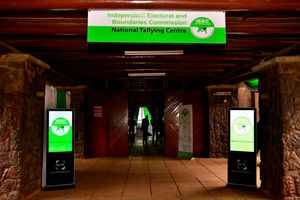
IEBC officials compile data at the national tallying centre at Bomas of Kenya on August 11, 2017.
Photo credit: File | Nation Media Group
How Kenya’s presidential vote tallying works
This is the official process of collecting, verifying and counting all votes cast for presidential candidates to determine the winner.
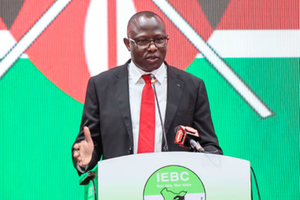
Kenya's presidential vote tallying follows a strict legal process from individual polling stations up to the national centre, managed by the Independent Electoral and Boundaries Commission (IEBC).
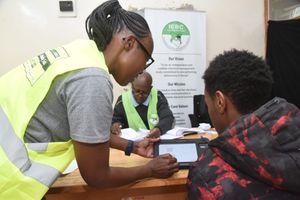
Immediately after voting closes, normally at around 5pm, votes for each candidate are openly counted and sorted by a Presiding Officer appointed by the IEBC at the polling station in front of observers and political party agents. The results are tallied and recorded on an official, serialised physical form called Form 34A. The Presiding Officer (PO) and agents sign the form and receive copies. Another copy is pinned to the station door for public viewing. Form 34A captures the polling station's total registered voters, total valid votes cast and votes per candidate. Once candidate agents and the PO sign Form 34A, the results at that polling station are final and legally binding. They cannot be changed later.
In a landmark case between the IEBC and activist Maina Kiai and others in 2017, both the High Court and the Court of Appeal ruled that the polling station is the primary and lowest voting unit.
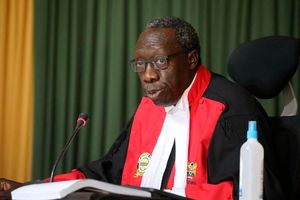
"The lowest voting unit and the first level of the declaration of presidential election results is the polling station," stated Court of Appeal judge William Ouko in 2017.
Bomas of Kenya, which was the Independent Electoral and Boundaries Commission's national tallying centre in the 2022 General Election.
Photo credit: File | Nation Media Group
The physical Form 34As from all polling stations within a constituency are securely transported to the Constituency Tallying Centre. The PO then uses the KIEMS (Kenya Integrated Election Management System) kit to take a picture of Form 34A and transmit it alongside numerical data directly to the IEBC public portal in what is called electronic transmission of results. These electronic results provide a real-time public view and media tallies, but they are provisional and legally serve as tracking tools rather than the final declaration. The physical hard copies of Form 34As are transported by the POs to their respective Constituency Tallying Centre. Here, the Constituency Returning Officer (CRO) puts together the results from all polling stations within that constituency on Form 34B. Political party agents scrutinise the compilation to ensure that the numbers transferred onto Form 34B exactly match the original Form 34As. The CRO then announces the constituency results. The Constituency Returning Officers then physically travel to the National Tallying Centre in Nairobi to hand over the hard-copy forms. At the National Tallying Centre, the IEBC Chairperson and commissioners aggregate all 290 Form 34Bs into one national document, Form 34C.
Once compliance is confirmed using Form 34C, the IEBC Chairperson issues Form 34D before officially declaring the President-elect.
To win the presidency, a candidate must secure more than half (50%+1) of all votes cast nationally and at least 25 per cent of the votes cast in each of more than half of Kenya's 47 counties (at least 24 counties).
A recent High Court ruling by Justice Gregory Mutai held that the IEBC Chairperson cannot alter figures or results declared and certified at the constituency level.
The court said the results cannot be altered, varied or cancelled by the national authority; physical documents verified at the polling station level prevail.
The judge described tallying as the arithmetic aggregation of constituency figures into county and national totals.