Mbeere North, the semi-arid constituency in Embu County that folds into the dusty plains of Tharaka, is hosting a heated debate that is rising to the hum of national consequence.
The constituency—small, sun-beaten, and often overlooked—has suddenly become the crucible of Kenya’s most volatile political experiment of President William Ruto's mid-term: the test of whether the President still commands political weight in the Mountain region that once crowned him king.
A by-election here, in another time, might have been a mere formality. In 2022, the electoral map of Central Kenya was a sea of yellow, Ruto’s United Democratic Alliance sweeping through the region with evangelical energy. “A by-election anywhere in Central Kenya would have been an easy sail,” the pundits would have said then. Not now. Not after the great political unravelling of the last two years.
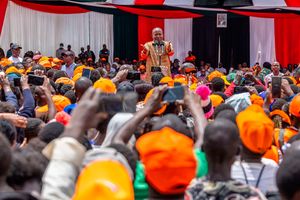
President William Ruto addressing a rally at Siakago Market, Mbeere North, Embu County, in the past.
Photo credit: File | Nation Media Group
Now, the contest is more than a search for a new Member of Parliament—it is a referendum on loyalty, revenge, and the slow fragmentation of a once-united political bloc.
The seat fell vacant when the president appointed Mr Geoffrey Ruku, the sitting MP, to the Cabinet in April, months after he had sacked another son of Embu, Justin Muturi, from the same table. The by-election has now drawn into its orbit some of the most powerful and wounded figures in contemporary Kenyan politics, each seeing in it something personal to prove.
Dr Ruto’s first reshuffling of the mountain came last October, when he engineered the impeachment of his deputy, Rigathi Gachagua—a political earthquake that redrew the map of power in the highlands. To steady the aftershocks, he appointed Prof Kithure Kindiki, the calm, professorial lawyer from Tharaka Nithi, as deputy president. But the mountain has not been pacified. It remains restive. Mr Gachagua, far from being silenced, has become Ruto’s loudest adversary.
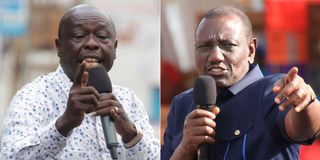
“Ruto thought impeachment would silence me,” Gachagua likes to tell his rallies, his voice rising into the microphone. “They impeached me because I stood against the oppression of Kenyans. If that was my mistake, I accept it.”
Since his removal, Mr Gachagua has traveled through the central counties, building what he calls a movement for “the betrayed.” His unlikely ally: Justin Muturi, the former Speaker and Cabinet Secretary, who now joins him and a constellation of opposition leaders plotting for 2027.
But Mbeere North, with its 55,124 registered voters, is where all these rivalries condense into a single moment of truth. It is here, in this patchwork of dusty roads and mango farms, that Dr Ruto’s United Democratic Alliance (UDA) has chosen to plant its flag again—with determination bordering on desperation.
The president’s candidate, Leonard Muriuki Njeru—known locally as Wa Muthende—is a familiar figure, having once vied unsuccessfully for the Embu governorship in 2017. This time, the stakes are existential. Governor Cecily Mbarire, UDA’s national chairperson and a fixture in Mbeere North’s rallies, has made the campaign a personal mission. “She’s everywhere,” one local trader in Siakago said. “If they lose here, it won’t just hurt Ruto. It will hurt her.”
Indeed, a defeat would ripple through the ruling party’s hierarchy.
For Deputy President Kindiki, whose rural home lies just 21 kilometers away in Tharaka Nithi, it would mean a blow to his credibility as the mountain’s new custodian. “We had eight candidates who were all qualified,” Kindiki said at a rally. “But they all agreed to support Leo since they didn’t want to risk splitting the support and end up losing.”
Deputy President Kithure Kindiki and former DP Rigathi Gachagua.
Photo credit: File | Nation
That unity came at a price. Several aspirants—including former Speaker Justus Kariuki Mate and university lecturer Dr Murage Njagagua—were persuaded to step aside after a retreat in Naivasha and a presentation of the candidate at State House in late July.
Many have since been compensated with government appointments. One of them, Muriuki Njagagua, is now a presidential advisor; his brother Murage was appointed acting CEO of Consolidated Bank.
The message was unmistakable: loyalty, properly expressed, will be rewarded. But in Mbeere, loyalty has never been straightforward.
On the other side of the divide, the newly formed United Opposition has scented opportunity. Its leaders—from Kalonzo Musyoka to Rigathi Gachagua—see Mbeere North as the opening through which they might pierce Ruto’s armor.
“We sincerely regret to inform you that the Jubilee Party is unable to issue a nomination certificate at this time,” Jubilee’s Secretary-General Jeremiah Kioni announced. “This decision arises from a resolution made by the United Opposition... to field a single candidate under the Democratic Party.”
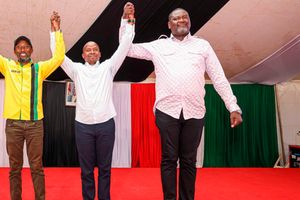
That candidate is Newton Kariuki—“Karish” to his supporters—an MCA from Muminji Ward, musician by passion and political survivor by instinct. His sponsors, Muturi and former senator Lenny Kivuti, have set aside years of rivalry to back him. For them, this election is less about a parliamentary seat and more about political retribution—an early skirmish in the long war for 2027.
But the opposition’s unity is fragile. Evurori MCA Duncan Mbui, also known as Dunfeather, felt betrayed when his party, Gachagua’s Democracy for Citizens, withdrew its ticket. “I was the frontrunner,” he lamented privately before defecting to Chama Cha Kazi, the small party led by former CS Moses Kuria. His defiance has added another unpredictable twist to the race.
The arithmetic of Mbeere politics is delicate and deeply clan-bound. The Mbeere community—comprising thirty-nine clans—organises itself into two loose alliances: Thagana and Irumbi. JB Muturi belongs to Irumbi; Kivuti to Thagana. Their current unity is therefore as symbolic as it is strategic, an attempt to collapse generations of clan rivalry into one shared purpose: defeating UDA.
Like Muturi, Kivuti is also a former MP of the constituency when it was known as Siakago.
Yet the constituency’s history suggests that voters here are capable of heresy. In 2002, when the Narc wave swept across Central Kenya, Mbeere North re-elected Muturi on a Kanu ticket. In 2007, he lost to Kivuti of Safina. In 2022, Ruku won by a margin of only 647 votes. Mbeere North is a place that delights in confounding expectations.
Its electorate has over the years demonstrated that they have little regard for political parties and, at times, vote against the mood of the country. The first by-election was in 1995 when then MP, Gerald Ireri Ndwiga defected from the Kenya National Congress (KNC) to Kanu. He was the only KNC MP in Parliament at the moment.
In 1997, Mr Ndwiga lost the seat to Silas Ita (DP). Another by-election was held in 1999 following the death of Mr Ita. Mr Muturi won the seat on a Kanu ticket and successfully defended it in 2002 when the Narc Coalition was the toast in the region. However, in 2007 he lost to Mr Kivuti (Safina). The other interesting statistic about the constituency is the narrow margins between the winner and the loser often being less than 1,000 votes. In 2013 polls, Mr Muturi lost to Mr Charles Njagagua by 298 votes only.
Its geography mirrors its temperament: a borderland constituency abutting Tharaka Nithi to the north and drawing settlers from the Gikuyu, Embu, and Meru communities. In Ishiara, traders from Nyeri mingle with farmers from Chuka, and few care much for clan arithmetic. “People here vote differently,” said a retired teacher in Evurori. “They watch who’s winning, but they also like to remind Nairobi that they can surprise you.”
For Ruto, the by-election is a test of survival—his first real reckoning with the discontent of the mountain. For Gachagua, it is vindication. For Muturi, it is a homecoming. And for Kindiki, it is a baptism by fire.
Observers have called it a local poll. But the truth is that Mbeere North, this unlikely crucible of ambition and betrayal, has become the stage on which the future of Kenya’s mountain politics will be written.
In Mbeere South Constituency, the same grouping of clans is used but with different names. There, Thagana is referred to as Mururi while Irumbi is known as Ndamata. It is instructive that Mr Muturi belongs to the Irumbi while Mr Kivuti is from Thagana.
Non-ethnic Mbeere voters in the constituency will also have an impact on the final outcome. Many people from the Gikuyu, Embu and Meru communities have settled in the constituency. These are mainly found in Nthawa Ward where they have farms and businesses in Siakago Town. Evurori also has a sizeable non-ethnic Mbeere voters around Ishiara Town. These are unlikely to be influenced by clan politics but rather the mood of the wider Mt Kenya region.