A total of 30 new political parties have obtained provisional registration in an upsurge that points to major realignments ahead of the 2027 General Election.
Three of the parties were enlisted this month, while the other 27 were registered between March and December 2025.
Those registered in January are Forum for Economic Development Agenda (FEDA), People’s Renaissance Movement (PM), and Forward Kenya Party (FKP).
The Office of the Registrar of Political Parties (ORPP) has also issued notice for provisional registration for another four new outfits. They include People Centred Party (PEC), United Super Alliance Party (USAP), Freedom and Opportunity Party (FOP) and Prosperity Alliance Party (PALL).
John Lorionokou has been picked as the next registrar of political parties.
Photo credit: File | Nation
PEC has listed little-known Martin Mutua, Nancy Omweri, Joseph Karuri, Mbogai Mkarie, James Gichana and Brian Inzai as its founding members, while USAP has Yunia Machuka, Paul Nyabuto, James Karanja, Samson Opap and Franscicah Banareri.
FOP has Dean Anindo, Emily Misheni, Maureen Ndirangu, Richard Mathai, Lucia Loko, Job Munene and Jacob Bwana, while PALL has listed Catherine Chepto, Margaret Mwende, Brian Wangechi and Kipkirui Ronoh.
The new rush has lifted the lid on how billions of shillings from the Exchequer have made running of the outfits a money-minting venture.
The trend also points to growing political jitters and fears linked to party primaries in major formations where politicians at times end up being shortchanged and denied party ticket. Others also enlist parties for purposes of negotiating coalition agreements.
Mr Eliud Owalo, who recently resigned as the Deputy Chief of Staff, Delivery and Government Efficiency so as to run for the presidency, is among leaders from Nyanza scouting for new political parties.
Eliud Owalo addresses the media at the Nomiya Church headquarters in Oboch, Asembo, Siaya County, on January 11, 2026, shortly after announcing his intention to run for presidency in the 2027 General Election.
Photo credit: Alex Odhiambo | Nation Media Group
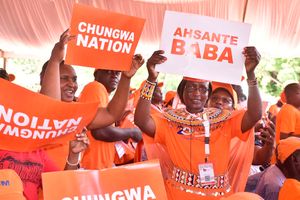
Some Orange Democratic Movement (ODM) politicians have already sounded the alarm that the party risks losing out on its traditional bastions to new entrants amid the emergence of factions in the 20-year-old outfit following the death of its founding leader, Raila Odinga.
“Even as we appear to self-cannibalize, we can’t help but curiously observe that small parties are aggressively and strategically moving to occupy the spaces previously held by our beloved ODM party,” Rarieda MP Otiende Amollo said in a recent press conference.
ODM has been for successive elections been faulted for not conducting free and fair nominations in successive elections. Those apprehensive of being shortchanged in the party primaries are already plotting to join other partner parties ahead of the next elections.
The billions of shillings for political parties have also made running a political party a lucrative business. At least 48 political parties that participated in the 2022 elections are benefiting from the billions of taxpayers’ money to run their affairs.
Dozens of parties that had never benefited from millions of shillings disbursed by the exchequer have, for the first time, received the monies after the 2022 elections. This was after the changes to the Political Parties Act.
The Act provides that 70 per cent of the money be distributed proportionately, based on the total number of votes secured by a political party in the preceding election.
Another 15 per cent is to be distributed proportionately to parties based on the number of candidates from special interest groups elected in the preceding General Election.
Ten per cent shall be shared out proportionately to parties, based on the number of representatives from the party elected in the preceding General Election, while the remaining five per cent is for administration expenses by the ORPP.
The provision implies that any political party that participates in a General Election stands to benefit from the funds, based on the number of votes attributed to its candidates, even if a majority of them lose at the ballot.
According to the Registrar of Political Parties, Mr John Cox Lorionokou, Kenya currently has 92 fully registered political parties.
“Our Constitution provides for multi-party democracy and political rights for all Kenyans,” Mr Lorionokou told the Nation .
“There is no capping on the number of political parties we should have. However, increased awareness of political rights and the need for expanded democratic space and voice are contributing factors,” he added.