As the General Election approaches, the scramble to own political parties has turned the country’s democratic landscape into a hyper-fluid, high-stakes arena, driven by a dizzying proliferation of more than 100 registered parties.
Some politicians and brokers have acquired and rebranded existing parties, while others rush to register new ones. The clamour to own parties ahead of the polls is unprecedented.
Far from being grounded in institutional bases built on enduring ideological philosophies, analysts say the outfits operate primarily as temporary special-purpose vehicles designed for single election cycles – offering individuals direct nomination and political leverage.
In some cases, the outfits function as special-purpose vehicles designed to catapult regional “kingpins” into power, with the party leader serving as patron, whose exit or change of tune often kills the party.
What was once the domain of ideological platforms has become a strategic investment for many actors, offering financial returns, bargaining power and protection against exclusion. Behind the lofty language of democracy and representation lies the reality that parties are becoming cash-minting assets.
Power is mobilised through dominant figures and regional or ethnic strongholds rather than policy platforms, triggering a cycle of party-hopping and pre-election coalition mania.
Records from the Office of the Registrar of Political Parties (ORPP) show that there are 101 fully registered parties and several with provisional registration.
Analysts say the surge is less about civic awakening, ideologies and democracy and more about money, survival and leverage. According to University of Nairobi don X N Iraki, the proliferation of parties is driven more by thirst for power-brokering, financial gain and strategic leverage.
“Owning a party has become lucrative and a status symbol. During primaries, party owners dish out nomination certificates for money. Aspirants pay nomination fees – sometimes running into hundreds of thousands of shillings – creating a steady revenue stream for party owners. Some brokers form parties and then sell them,” Prof Iraki says.
“Most parties are established or utilised primarily as vehicles for one election cycle. During this period, party owners position themselves as kingmakers or brokers to negotiate coalitions, bargain for Cabinet slots, demand payouts or frustrate rivals.”
According to Prof Iraki, many parties are like matatus, where owners alight after getting to their destinations.
Mr Steve Kabita, a lawyer, agrees that owning a party offers some assurance of access to positions, a guarantee of a seat at the negotiating table and protection against party dictatorship during primaries.
“Being a party leader provides clout crucial for bargaining. Politicians use parties to bargain for personal interests,” he says.
“To avoid chaotic party nominations and ticket allocations, politicians prefer their own parties where control is guaranteed and a ticket is assured.”
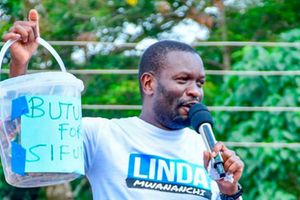
Linda Mwananchi Movement leaders (from left) Embakasi East MP Babu Owino, Siaya Governor James Orengo, Nairobi Senator Edwin Sifuna and Murang'a Governor Irungu Kang'ata address a public rally at Kivulini Grounds in Thika, Kiambu County, on June 14, 2026.
Photo credit: Dennis Onsongo | Nation Media Group
“Registered parties that meet statutory thresholds qualify for allocations from the Political Parties Fund, a taxpayer kitty meant to strengthen democracy. Some politicians form parties with intentions to gain from the funds,” he says.
At least 48 parties that took part in the 2022 General Election are benefiting from billions of taxpayers’ shillings.
The Political Parties Act provides that 70 per cent of the money be distributed proportionately, based on the total number of votes secured by a party in the preceding election.
Another 15 per cent is distributed proportionately to parties based on the number of candidates from special interest groups elected in the preceding election.
Ten per cent is shared out proportionately to parties based on the number of representatives from the party elected in the preceding election, while the remaining five per cent is for administration expenses by the ORPP.
Some observers, however, say commercialisation of parties risks eroding democracy and making manifestos roadside declarations.
“When parties are primarily vehicles for profit or personal ambition, ideology takes a back seat. We risk scenarios of manifestos being hollow generic plans,” Turkana University don Tom Nyamache says.
Former Mukurwe-ini MP, Kabando wa Kabando, warns against parties being used to advance individual interests.
“We need strong parties and movements capable of mobilising Kenyans nationally. There is a difference between a party and a vehicle for personal aggrandisement,” he says.
Without reforms, the political marketplace risks becoming saturated with parties that exist only on paper or as profit centres. The Political Parties Act defines the functions of a party, which go beyond fielding candidates during elections.
Other functions are formulating public policy and manifestos, organising and running government, mobilising citizen participation and informing and educating the electorate on complex national matters.
The rush for new parties comes against the backdrop of plans by Linda Mwananchi movement leader and Nairobi Senator Edwin Sifuna to unveil the party he will use to contest the presidency in 2027.
Mr Sifuna was cleared by the ORPP to reserve the Linda Mwananchi name on Friday. Amid reports of infighting in the movement, Siaya Governor James Orengo – one of the principals of the outfit – has indicated plans to launch a political party this month as he seeks to contest the presidency too.
Records at the ORPP show that newly registered outfits include the Democracy for Citizens Party (DCP), led by former Deputy President Rigathi Gachagua; the We Alliance Party; and the National Economic Development Party.
Others are the People’s Forum for Rebuilding Democracy, Nationalists Patriotic Party, Vision for Development Alliance, Msingi wa Taifa, the United Patriotic Movement associated with Kakamega Senator Boni Khalwale; People’s Renaissance Movement of Saboti MP Caleb Amisi; the Kenya United Generation Party; and the Forum for Economic Development Agenda.
Mr Gachagua and former Meru governor Kawira Mwangaza – who were impeached – have stated that their troubles were due to not having parties under their control. Ms Mwangaza has acquired Umoja na Maendeleo Party.
Kiharu MP, Ndindi Nyoro, recently took over the People’s Party of Kenya. He declared presidential ambitions and aligned himself with the opposition.
Kiharu MP Ndindi Nyoro when he announced that he had defected from UDA to the People's Party of Kenya at Safari Park Hotel, Nairobi on August 17, 2026.
Photo credit: Lucy Wanjiru | Nation Media Group
Embakasi East MP, Babu Owino, has acquired Mwananchi Party as he prepares to contest the Nairobi governor seat.
“I will also ensure many MCAs are elected on my party,” he said last week.
Trans Nzoia Governor, George Natembeya, is said to be rebranding the United Democratic Party, the outfit founded by former Lugari MP Cyrus Jirongo.
Amid the growing unpopularity of the ruling United Democratic Alliance (UDA) in Mt Kenya, President William Ruto’s allies are acquiring the leadership of alternative parties, a strategy aimed at seeking re-election while consolidating Dr Ruto’s support.
Former Laikipia Governor and current chairman of the Kenya Revenue Authority (KRA) Board, Ndiritu Muriithi, is now the leader of the Kenya Reform Party (KRP).
Mr Muriithi was elected unopposed during KRP’s National Delegates Conference in Nairobi on September 28.
“KRP aims at positioning itself as an alternative platform ahead of the General Election. Our main focus is industrialisation,” he said.
Trade Cabinet Secretary Lee Kinyanjui, who wants to recapture the Nakuru governor seat, is said to be considering vying on Ubuntu People’s Forum, a party he formed before the last General Election.
Thirty six outfits have obtained provisional registration, including the People’s Prosperity Party of former ICT Cabinet Secretary Eliud Owalo. He recently launched the party, but records at the ORPP show he has not applied for full registration.
Others with provisional registration are the Movement United for Super Action, associated with politician Victor Ngatia; the Co-operators Development Party; the Democratic Development Party of Kenya; and Kenya Liberation Movement.
Provisionally registered parties have 180 days to recruit at least 1,000 voters as members in at least 24 counties and establish physical offices in those regions before they can obtain registration.
Registrar of Political Parties, John Cox Lorionokou, has notified the secretaries-general of registered parties of his intention to conduct inspection of their headquarters and county offices. He revealed plans for a crackdown on “briefcase parties” .
“We will conduct an inspection... to ascertain compliance with the maintenance of a registered head office and branch offices in more than half of the 47 counties,” Mr Lorionokou said on September 14, 2026.
Running offices in at least 24 counties is costly. In the run-up to the 2022 General Election, dozens of new parties were registered by the ORPP, but most fizzled months later. Politicians behind their formations retreated as others quit to take up government jobs.
More than 30 parties were formed in the run-up to the 2022 polls, among them the UDA, Mr Mwangi Kiunjuri’s The Service Party, Usawa Kwa Wote of then-Murang’a governor Mwangi wa Iria, Tujibebe Wakenya associated with Mr William Kabogo, Mr Eugene Wamalwa’s Democratic Action Party-Kenya (DAP-K) and Roots Party of Prof George Wajackoyah.
National and regional party offices, which initially experienced a flurry of activity as politicians jostled for nomination slots and party officials undertook manual and digital recruitment, were abandoned.
As the country heads to the General Election, registration and acquisition of political parties have accelerated, driven by money, leverage and political survival.