President William Ruto’s win in the Mbeere North by-election is expected by political pundits to trigger at least 10 significant political ramifications in the Mt Kenya region.
While many observers anticipated a bruising contest, the United Democratic Alliance (UDA), led by President Ruto, was not rated as the favourite.
Yet when tallying concluded, the Independent Electoral and Boundaries Commission (IEBC) declared UDA’s Leonard wa Muthende the narrow winner with 15,802 votes, edging out the United Opposition’s Newton Karish who garnered 15,308 votes.
Suba North MP Millie Odhiambo (right) and Majority Leader in the National Assembly Kimani Ichung’wah (left) with Mbeere North MP-elect Leonard wa Muthende before his swearing-in at the National Assembly on December 2, 2025.
Photo credit: Dennis Onsongo | Nation Media Group
Another contender, Duncan Mbui of the Chama Cha Kazi party, got 2,480 votes.
Kikuyu Council of Elders Chairman Wachira Kiago says the outcome is a clear indication that democracy is doing well in Mt Kenya, but that the region is divided.
Mr Kiago adds that the results point to “a hotly contested sense of belonging where we are not unanimous on whether we have the ability to be united by one issue.”
He further notes that narratives circulating in the region suggest Mt Kenya must be in government to access development, which he calls blackmail, arguing that public resources belong to all without discrimination.
According to him, there is a need for the region to decide what we want for 2027, as a matter of urgency.
"We must approach the General Election as a united bloc… we are not doing well in the unity test, especially in light of schemes to create Mt Kenya East, Kiambu, Diaspora and Aberdares cocoons as independent political entities.”
Deputy President Kithure Kindiki has declared himself the region’s king on the basis of holding the most senior office from the area.
Democracy for Citizens Party (DCP) leader Rigathi Gachagua, however, insists he is the legitimate political king, arguing that he was elected Deputy President in 2022 but was “maliciously impeached against public will so that President Ruto can effectively capture us through a ‘Yes Sir’ Deputy President who is Kindiki.”
Former President Uhuru Kenyatta, through the Jubilee Party, remains the elders’ endorsed kingpin.
He has expressed interest in influencing the 2027 elections, proposing Dr Fred Matiang’i as his preferred presidential candidate—a move that challenges Mr Gachagua and People’s Liberation Party leader Martha Karua, who have also announced presidential ambitions.
Mr Kenyatta’s position is also seen as a strategic attempt to elevate Dr Matiang’i as a potential Mt Kenya kingpin.
Ndia MP George Kariuki says the Mbeere North win will embolden Prof Kindiki to spread his influence from Mt Kenya East to the entire region, while also positioning himself as President Ruto’s possible successor in 2032.
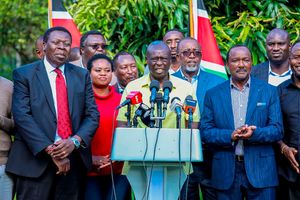
Former Deputy President Rigathi Gachagua, Democratic Party (DP) leader Justin Muturi, DAP–K candidate in Malava Seth Panyako, DP’s Mbeere North candidate Newton Karish, MP-elects Leonard Muthende (Mbeere North), David Ndakwa (Malava) Deputy President Kithure Kindiki and President William Ruto.
Photo credit: Nation Media Group
“The Mbeere North by-election victory is a clear endorsement of Prof Kindiki, who now becomes our Mt Kenya region present and future,” Mr Kariuki says.
He adds that the outcome signals to Mr Gachagua and other contenders for the regional crown that “they can only succeed if they seek permission from Prof Kindiki.”
The fifth impact, according to Laikipia East MP Mwangi Kiunjuri, is that Mt Kenya politics has received a “factory reset” that allows the region to prioritise consensus on issues that will shape its 2027 agenda.
“The good thing is that the Wantam and Tutam political enmity has reduced. We are hopeful that this newfound peace will promote regional dialogue so that we can outline the critical issues that will define our negotiation agenda for 2027,” he says.
The sixth lesson is Mt Kenya’s openness to renewed alliance courtship especially from President Ruto.
“We might see rapid development projects. President Ruto has been convinced by his loyalists that all Mt Kenya voters need are development, handouts and intimidation to toe the line,” says Murang’a Senator Joe Nyutu.
He warns that “Mt Kenya people must be prepared for an influx of political courtship gimmicks as President Ruto seeks to win them over for 2027.”
Mr Joe Nyutu.
Photo credit: Joseph Kanyi | Nation Media Group
Another effect of the Mbeere North result is that it gives fence sitters more time to study emerging formations. The region currently includes Wantam, Tutam and undecided politicians who shift positions depending on political winds.
“We must understand our people and ensure we walk into leadership contests carrying their aspirations. We should abandon pride, hubris and the habit of undermining each other,” she says.
“Aalready in Mbeere North there are United Opposition loyalists rejoining the government in the belief that Mr Muthende’s win is a clear endorsement of the government,” Political analyst Malila Munywoki notes.
He adds that others now view Mr Gachagua’s DCP as “a promising special-purpose vehicle” after it won critical seats in Kariobangi North, Kisa East and Narok Town wards, and emerged a strong second in Purko ward and Magarini constituency.
Another major takeaway is the intensifying competition for the presidential ticket within the United Opposition.
While the coalition has multiple aspirants—including Mr Gachagua, Mr Musyoka, Ms Karua, Dr Matiang’i, DAP-Kenya leader Eugene Wamalwa and his deputy George Natembeya—Mr Gachagua has already unilaterally endorsed Kalonzo Musyoka.
Speaking at Kariobangi PCEA church on Sunday, Mr Gachagua said he and Mr Musyoka have already agreed on how to share power.
The final issue highlighted by the by-election is whether Gen Z voters have the enthusiasm to participate in actual voting.
“Gen Z have been telling us how committed they are to the liberation cause… how they will shape the 2027 discourse through technology, messaging and vigilance over IEBC integrity. But in the by-elections we did not feel anything from Gen Z,” says Jubilee Party youth coordinator in Mt Kenya Simon Warui.
He adds that Gen Z were most active in “online wars, escorting aspirants and dancing for them, and in some cases participating in violence.”
Mr Warui concludes that “the by-elections have taught us to treat the Gen Z hype as a risky political investment of hope.”