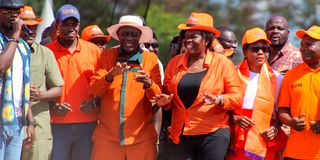
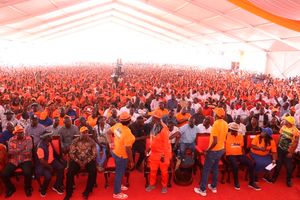
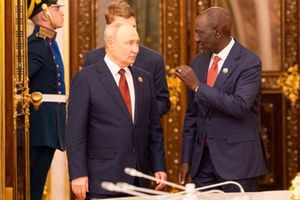
A fresh political storm is brewing in ODM over its proposed pre-election political deal with President William Ruto, with senior leaders divided on whether to back his re-election unconditionally or first secure a written power sharing coalition agreement.
At the heart of the dispute is what ODM stands to gain from supporting Dr Ruto in the August 10, 2027 General Election and whether the party can trust political goodwill to deliver a share of power or must bind the President to a formal agreement.
The divisions are exposing competing calculations within the party as it mobilises support across the country and prepares to negotiate with the president’s UDA party. While some leaders argue that ODM should embrace the government’s development agenda and goodwill shown so far without imposing conditions, others insist that the party must secure firm written guarantees before committing its political base to Dr Ruto’s re-election.
The debate has also re-opened questions over ODM’s bargaining power following the death of its former leader Raila Odinga, whose political influence shaped the party’s negotiations with successive administrations.
Party leader Oburu Oginga and Cabinet Secretaries who joined the broad-based government— John Mbadi (National Treasury), Opiyo Wandayi (Energy), Hassan Joho (Mining), Wycliffe Oparanya) Cooperatives) and Beatrice Askul of East African Community Affairs — have publicly backed Dr Ruto’s re-election.
“In a shared commitment, the leaders also agreed to our continued support of President William Ruto’s bid for a second term, reaffirming our collective resolve to advance unity, development and shared prosperity,” Mr Wandayi said after a recent meeting with Siaya politicians.
Mr Mbadi has already set his eyes on 2032 and has publicly said he is not backtracking on supporting Dr Ruto, insisting that ODM has to work with the head of state, who has shown goodwill.
National Treasury Cabinet Secretary John Mbadi during a press briefing at Sarova Imperial Hotel in Kisumu on September 16, 2026.
Photo credit: Alex Odhiambo | Nation Media Group
“There is this trend where Luo leaders have become indecisive, confusing our people. This is not our way of doing things. We must take a firm stand, and if you are a veteran leader guiding people, you must demonstrate that through your actions. Our people must take a clear position, and those who are still sitting on the fence and have not made up their minds should do so, so that we know whether they are with us or not,” Mr Mbadi said last weekend when he met professionals in Kisumu.
The prospect of supporting Dr Ruto has exposed a fundamental disagreement over the terms of engagement.
ODM, which has fielded presidential candidates since its formation in 2005, is now weighing whether to enter a formal coalition with UDA and what guarantees it should demand in return.
The party has floated a 50-50 power sharing arrangement including the Deputy President’s position but there is no consensus on whether such demands should be conditions for backing Dr Ruto or whether support should come first and negotiations follow. The dispute has been sharpened by recent remarks from Interior PS Raymond Omollo, who has argued that ODM should not attach conditions to its support for the president.
Interior Principal Secretary Raymond Omollo addresses members of minority communities from Bahati Sub-County at St Michael Catholic Church in Maili Sita on October 24, 2026.
Photo credit: Bonface Mwangi | Nation Media Group
Speaking over the weekend during a meeting with livestock traders and sugarcane farmers, Dr Omollo said Dr Ruto’s development record should be enough to earn him another term.
“The president has worked for the people, and he will continue to deliver. We must not put conditions on him. He has delivered for the whole country in equal measure. It would be shameful if the Luo community gives a condition to the president that he must fulfil something. His re-election should be unconditional,” he said.
Dr Omollo’s remarks have divided ODM leaders who argue that the party is a national political outfit and not a regional voting bloc whose support can be taken for granted. Nyando MP Jared Okello is among those who oppose making a written agreement for supporting Dr Ruto.
He argues that ODM should demonstrate goodwill and remain close to the government and allow its supporters to benefit from development projects.
“We need to open our hearts and be with the president so that if other opposition leaders come, they will find us already with him. For now, we are benefiting from the projects started by this regime, yet we didn’t vote for him,” Mr Okello said.
He warned that opposition leaders Kalonzo Musyoka (Wiper) and Fred Matiang’i (Jubilee) could also negotiate with Dr Ruto, leaving ODM at a disadvantage if it delayed committing to the president.
“Nothing can prevent Mr Musyoka and Dr Matiang’i from working with the president due to the feeling of being unwanted in the opposition. If they come and negotiate with the president, where will our place be?. If we agree with the Head of State and his performance, we should be with him so that in such a situation we don’t push for signing another document when any opposition leader comes on board,” he said.
MP Okello questioned whether a written agreement would offer any real protection, citing past political partnerships that, in his view, failed to honour their promises.
“Raila signed an agreement with (Daniel) Moi to support him in 2002, but he went for another person. (Mwai) Kibaki short-changed Raila after the 2002 election and reneged on his plan to serve for one term. Even if we were to sign an agreement with President Ruto, nothing prevents him from trashing it if he has no goodwill,” he said.
But Homa Bay Senator Moses Kajwang and Homa Bay Town MP Opondo Kaluma insist that ODM must formalise any partnership before committing its political support.
Mr Kajwang likened the proposed arrangement to a marriage that requires clear commitments, warning that the party must learn from previous alliances in which one side helped secure an electoral victory but was later left disadvantaged.
“We must be careful out of historical experience. We can see those who are our friends, but allow us to apply a little bit of risk management in this arrangement,” he said.
Mr Kaluma said negotiations between ODM and UDA were progressing well and urged party members to wait for the outcome of the talks.
“The talks between ODM and UDA are going on well. When it is done, there will be a written agreement, so let us avoid talking much until the report from the committee is out,” he said.
He called on supporters to register as voters ahead of the election arguing that a strong voter base would improve the party’s bargaining position. He said the Luo community should aim to deliver at least four million votes.
“We will field and elect only ODM candidates, but we will support Ruto through our ODM party, but only after the written agreement,” Mr Kaluma said.
Kisumu County Woman Representative Ruth Odinga during an interview with the Daily Nation in Nairobi on May 22, 2026
Photo credit: Sila Kiplagat | Nation Media Group
Kisumu Woman Representative Ruth Odinga has also insisted on a binding agreement, warning against reducing ODM to a Luo political outfit.
Ms Odinga criticised remarks that risked undermining the party’s national character and weaken its negotiating position.
“Let it be made clear that ODM is a national political party with representation across the counties. Its strongholds include Western, Coast and Turkana, among others; Nyanza is only one of them. Even within Nyanza, we have both Luo Nyanza and Kisii Nyanza. Any attempt to reduce ODM to a Luo party is therefore troubling, and one reads bad faith into it,” she said in a statement yesterday.
She cited the history of unfulfilled political agreements, arguing that ODM could not afford to enter another arrangement without enforceable commitments.
“ODM would not, and cannot, enter any coalition agreement that is not a binding legal agreement, given what we have seen and stated. The party retains its identity and uniqueness, as stated and written in the various documents published by Baba. Anything short of that would be unacceptable to the great masses of the party,” she said.
Ms Odinga also referred to the Waki Commission’s findings on unimplemented memoranda of understanding in past presidential elections, arguing that the consequences of broken political promises must inform the current negotiations.
“The Waki Commission, which investigated the 2007/2008 post-election violence, recorded how unmet political understandings, including the 2002 MoU (Memorandum of Understanding) within Narc, fed the grievances that fed the crisis. Today, voices from Western and Central Kenya are lamenting the very same experience,” said Ms Odinga.
The push for a written agreement is closely tied to ODM’s demand for an equal share of power in a possible post-election government. Homa Bay Governor Gladys Wanga and Dr Oburu have previously indicated that the party intends to negotiate an MoU with Dr Ruto based on a 50-50 arrangement.
Speaking last week during ODM’s grassroots mobilisation campaign in Turkana, Ms Wanga said the broad-based partnership would form the next government if it won the 2027 election.
Suna East MP and Minority Leader in the National Assembly, Junet Mohammed, recently said in Garissa that UDA cannot form the next government on its own and will have to negotiate with ODM.
Suna East MP and National Assembly Minority Leader Junet Mohamed.
Photo credit: Sila Kiplagat | Nation Media Group
Speaking during an ODM delegates meeting in Funyula, Busia County, on Sunday, October 11, 2026, Mr Mohammed said the two parties should share government positions equally.
He told ODM supporters that the party would distribute its share of government positions among its members.
“ODM will get half of the government to distribute it to its members. We are going to divide the government with Ruto after reaching an agreement with UDA,” said Mr Mohamed.
Governor Arati said ODM is a strong party and should only enter into a political arrangement where it is guaranteed fair representation.
ODM Party Deputy party leader and Kisii County Governor Simba Arati.
Photo credit: Boniface Bogita | Nation Media Group
“There are no other stories because in the next government we have to get half of all positions. The way I’m looking at things in the unfolding political arrangement, ODM will get even more than half . We are very serious,” said Mr Arati.
The argument over whether to trust the President’s word has revived memories of Dr Ruto’s falling-out with his former deputy Rigathi Gachagua, whose political relationship with the President deteriorated before his impeachment in October 2024.
Mr Gachagua and his allies have since expressed regret over entering into a political partnership with Dr Ruto without a formal coalition agreement or a separate political party.
The irony is that during a campaign rally in Nyeri in May 2022, Mr Gachagua had defended the political arrangement, saying the Mt Kenya region did not need a written agreement because it trusted the President’s word.
“As Mt Kenya region, we do not need to sign any agreement with President William Ruto because he is our son and he is a gentleman. We have trusted his word, and I have told our leaders that we don’t need any agreement,” he said.
The subsequent fallout has become a cautionary tale for leaders debating whether political goodwill alone can protect their interests after an election.
ODM youth league member Kasmuel McOure, who supports the broad-based government arrangement, argues that the party’s negotiating strength has weakened following Raila’s death and divisions among its leaders.
He said ODM’s previous influence in negotiations with Dr Ruto was anchored by Raila, former secretary-general Edwin Sifuna and other leaders who have since departed from or fallen out with the party’s current political direction.
“The ODM that had real negotiating power with President Ruto was the ODM of our founding father Raila Odinga, of our former Secretary-General Edwin Sifuna, with whom I disagreed politically and of the proverbial third of the angels who left with him,” he said.
Mr McOure urged the party to focus on voter mobilisation and building a credible political base rather than allowing individual politicians to pursue personal interests.
He said negotiations should be led by leaders without personal electoral ambitions who are firmly committed to Dr Ruto’s re-election, citing Dr Oburu and Dr Omollo as examples.
“We must demonstrate that political cooperation, grounded in mutual respect and a shared commitment to development, can deliver far more than perpetual confrontation and endless bargaining for positions,” he said.