President William Ruto calls it the year of implementation while his critics see it as a time of reckoning; either way, 2026 is shaping up as the most consequential stretch of his presidency.
While Kenya’s political calendar may point to 2027 as the decisive moment when Kenyans will go to the ballot, for President Ruto, the real fight is unfolding a year earlier.
“For the first time in a long while, Kenya is not guessing. We are not drifting. We are not gambling. We have set our targets. We have begun the journey. And we now have a clear roadmap to make 2026 a defining year in Kenya’s history,” President Ruto said during his New Year’s address.
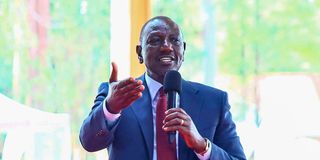
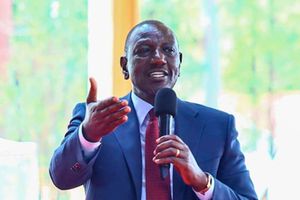
President William Ruto addresses the nation at Eldoret State Lodge on December 31, 2025 moments before Kenyans ushered in the New Year.
Photo credit: PCS
The Head of State reckons that this will be “a watershed year in the story of our Republic. A turning point in our march from promise to prosperity. A year that future generations will look back on and say; that is when Kenya changed course.”
Political analysts say this is the year when promises collide with patience, economics tightens its grip on politics, and performance becomes the only credible campaign language.
President Ruto has framed it as the year of “implementation” — the moment when reforms mature, flagship projects take shape and Kenyans finally “see the full picture” of his administration.
“…let us be clear about our goals. We are committing ourselves to a measurable national mission; to cut the number of Kenyans living below the poverty line by half, lifting millions into dignity and opportunity as well as cutting unemployment by half, ensuring that millions of our citizens are productive, earning, and contributing,” the president says.
But analysts say that politically, the framing is deliberate as it reflects a classic incumbency strategy; “delay judgement, buy time and concentrate delivery narratives in the final stretch before re-election campaigns peak.”
Yet history offers a sobering warning where governments are not ultimately judged by intentions or timelines, but by lived experience.
And by that measure, 2026 may become less a year of consolidation and more a year of reckoning for Dr Ruto, as political analyst Prof Gitile Naituli puts it.
According to Prof Naituli of management and leadership at Multimedia University of Kenya, the central challenge facing President Ruto is not communication — it is credibility.
“Implementation is not a switch that can be flipped in the fourth year of a term,” Prof Naituli says. “Development outcomes are cumulative. When early policy choices generate pain, later promises struggle to reverse hardened sentiment.”
Dr Ruto took office amid economic turbulence and moved quickly to reset policy direction — reviewing subsidies, adjusting fiscal priorities and aligning Kenya’s economy with global lenders’ expectations.
Some of those corrections are beginning to show results, with the Head of State maintaining that inflation has eased, the shilling has stabilised and foreign reserves have improved.
Shrinking disposable incomes
But politics is not lived on spreadsheets, as Prof Naituli puts it.
“Kenyans experience the economy at the kitchen table,” Prof Naituli notes. “Food, rent, transport, school fees and healthcare. That is where elections are won or lost.”
High taxation, shrinking disposable incomes and rising household pressure have steadily eroded the bottom-up promise that powered Dr Ruto’s 2022 campaign, hence the urgent need for him to put things straight this year.
Infrastructure remains one of the administration’s most visible arenas, but also one of its most politically exposed.
The dualling of the Rironi–Mau Summit road is not merely a transport project; it is a political symbol tied to safety, productivity and long-standing public anger over deadly accidents.
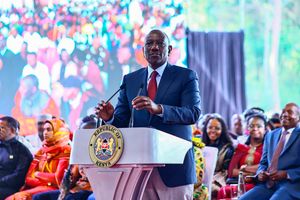
President William Ruto addresses Mau Summit residents when he launched the dualing of the Rironi-Mau Summit Highway on November 28, 2025.
Photo credit: Boniface Mwangi | Nation Media Group
Dr Ruto has promised to accelerate the tarmacking of 6,000 kilometres of roads including the Rironi-Mau Summit road, “which will be completed and open to traffic by mid-2027”
Equally charged is the promise to extend the standard gauge railway from Naivasha to Kisumu and eventually to Malaba beginning this month, a project loaded with economic and emotional significance for western Kenya and Nyanza.
The President made the promise during the Orange Democratic Movement (ODM) party’s 20th anniversary celebrations in Mombasa, in November last year.
“We will commence the construction of the Naivasha-Narok-Bomet-Nyamira-Kisumu-Malaba standard gauge railway, creating a modern transport and logistics corridor linking Kenya to the east and central Africa region.”
“Equally, we will launch the Galana-Kulalu Dam, whose contract has been signed, and several others as part of the expansion of our irrigation infrastructure across the country, with the ultimate objective of bringing 2.5 million acres of land under irrigation.”
The Head of State also promises start of the construction of a modern, world-class airport at the Jomo Kenyatta International Airport, “to anchor our nation as the aviation capital of our region and to boost our trade and tourism sectors.”
Stranded travelers awaiting clearance at JKIA terminal 1A during the Kenya Aviation Workers strike on September 11, 2024.
Photo credit: Wilfred Nyangaresi | Nation Media Group
Despite the criticism, the Head of State insists that “changing and transforming a country does not require a miracle. It requires a clear and bold vision, and a leadership equal to that vision.”
Yet Kenya’s fiscal reality has tightened dramatically. Debt servicing now competes directly with development spending, social protection and basic services. He’s faced with a tight balancing act, between fulfilling the lofty promises while ensuring he doesn’t attract public anger by increasing taxes.
“In this environment, every new project raises uncomfortable questions,” Prof Naituli says. “Who pays? Who benefits? And what is being sacrificed?”
Politically, analysts and critics believe that the economy remains Dr Ruto’s steepest uphill climb.
Treasury projections point to moderate growth and improving indicators, yet households tell a harsher story.
Taxes remain high, food prices volatile, fuel costs unpredictable and disposable incomes squeezed.
“This is the year when macroeconomic stabilisation must translate into lived relief,” says Safina Party Leader Jimi Wanjigi. “If Kenyans don’t feel better by 2026, which I don’t foresee, political consequences are inevitable.”
Safina Party Leader Jimi Wanjigi during an interview at his Kwacha House offices in Nairobi on October 8, 2025.
Photo credit: Evans Habil | Nation Media Group
Dismas Mokua, a political analyst, argues that President Ruto has spent most of his time in the economic space — managing policy corrections — at the expense of grassroots politics and trust-building.
“Kenya Kwanza has faced serious communication and expectations-management challenges,” Mr Mokua says. “A vacuum has emerged, and it has been filled by misinformation, disinformation and frustration.”
“Presidents lose elections when kitchen-table conversations contradict official narratives,” he says, citing US President Joe Biden’s struggles despite economic recovery.
Few sectors carry greater political risk than health and education — areas with what analysts call high negative salience. Failures here are immediate, visible and emotionally charged.
Universal Health Coverage reforms continue to face turbulence. Public hospitals struggle with staff shortages, delayed payments and eroding trust.
The Social Health Authority building in Nairobi.
Photo credit: File | Nation Media Group
“Across the country, stories of care, relief, dignity, and support are being told, quietly and powerfully, by ordinary citizens whose lives have been transformed.”
Education faces an equally volatile moment. The Competency-Based Curriculum enters its most critical phase with the rollout of senior schools.
The Head of State however, boasts of the expansion of what he terms “merit-based systems.”
“…we helped nearly a million Kenyans access jobs through housing, labour mobility, and the digital economy, with many more opportunities coming in 2026 and beyond,” Dr Ruto says.
For President Ruto, it is the year when vision must become reality — when state power must persuade rather than defend, and when trust must be rebuilt, not demanded.