Seasonal farming cycles, school calendars, tourism hubs and public transport are the drivers of femicide and gender-based violence (GBV) in Kenya, a report by the Technical Working Group on Gender-Based Violence established by President William Ruto says.
The task force was chaired by former Deputy Chief Justice Nancy Baraza.
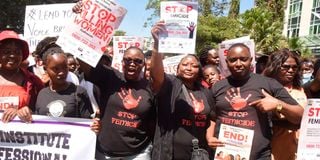
The chairperson of the Technical Working Group on Gender Based Violence, Including Femicide, Dr Nancy Baraza, makes her remarks during a public participation session at Moi Girls Secondary School on May 28, 2025.
Photo credit: Francis Nderitu I Nation Media Group
Coastal counties record high incidences of sex tourism, with Shinyalu and Mumias East in Kakamega County emerging as GBV hotspots.
According to the report, women and girls in border regions like Busia, Migori and Kwale are particularly vulnerable to sexual exploitation and trafficking, often under the guise of job offers.
In Uasin Gishu, physical violence increases sharply during harvesting seasons, likely due to economic stress, labour exploitation or domestic rows over resources and roles.
“These situational pressures create fertile grounds for violence to erupt in households and communities,” the report says.
The working group conducted research, public and in-camera hearings, consultations with GBV survivors and visits to state and non-state institutions.
The report blames the rise in violence on systemic failures and calls for urgent targeted safeguards during high-risk periods.
The Coast is still a hotspot for child sex tourism, trafficking and sexual exploitation, with Kwale, Mombasa, Kilifi, Lamu and Malindi recording most incidents.
Girls from poverty-stricken households are lured into exploitative situations with promises of financial support or jobs.
Most femicide cases are linked to romantic relations, social isolation and online dating, with victims primarily in their 20s and 30s.
Matatus crews and boda bodas facilitate sexual harassment and assaults, especially early in the morning and late-night hours. Children who rely on these services are vulnerable as illustrated by cases in Kajiado where boda bodas exploit schoolgirls.
“These accounts not only reflect the predisposition of girls using public transport to school but also expose the existing challenges in child protection, poverty and gender-based violence in the region,” the report says.
Women working night shift, market vendors, bar attendants and those at funeral vigils are harassed or sexually assaulted.
Learning institutions are sites of sexual harassment too. There is grooming and exploitation by teachers, caretakers and older peers, the report adds.
“Reporting mechanisms in these institutions are weak or biased. Female students are sometimes blackmailed into sexual submission in exchange for good grades,” the report says.
Defilement in primary and secondary schools, including by drivers and other support staff, often go unreported due to coercion or victim-blaming.
The report adds that cultural practices like female genital mutilation (FGM) and child marriage remain prevalent in Kisii, Narok and Samburu counties, while Vihiga, Kakamega and Busia report high levels of sexual violence and incest, frequently occurring in extended families and often unreported due to stigma or customary dispute resolution.
Adolescent girls out of school are vulnerable to rape, transactional sex and early marriage.
Physical violence – hitting, slapping, choking, burning or use of weapons – and sexual violence – rape, defilement, forced prostitution and exploitation – affect victims’ physical, emotional, economic and social well-being.
The report cites a lack of political will to enforce laws or allocate sufficient funds for survivor support, creating a culture of impunity.
National action plans are often delayed or underfunded. Poor coordination between national and devolved governments results in fragmented responses.
Insecurity increases risk, especially during elections. Women and girls in conflict-affected areas, border counties and refugee camps are disproportionately exposed to sexual violence, sometimes at the hands of armed groups or security personnel.
Other drivers of GBV are diminished respect for life, a sense of entitlement over women’s bodies, alcohol and drug abuse and gambling, particularly among unemployed or distressed men.