Ruto: Kenya must cut Sh3 trillion food import bill
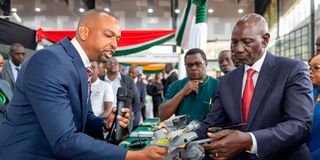
President William Ruto is shown the operations of a drone by the General Manager, Fahari Aviation Limited, Hawkins Musili, during the Agriculture and Food Security Transformation Summit at the Jamhuri ASK Showground in Nairobi on Thursday, October 8, 2026.

President William Ruto has called for an overhaul of Kenya’s food production system, saying the country must urgently reduce its Sh3 trillion food import bill by increasing domestic production of commodities that account for a large share of the import burden.
Speaking on Thursday at the ongoing Agriculture and Food Systems Transformation Summit (AFSS) 2026 at the Jamhuri Showgrounds in Nairobi, President William Ruto said edible oils, fats, wheat and rice were among the leading imports, warning that Kenya could not prosper when households spend more than half their income on food.
The President said the government had responded through measures including lowering the price of maize, digitising farmer registration and subsidising fertiliser. He noted that the fertiliser programme, launched in 2023, had reduced the price of a 50-kilogramme bag from about Sh7,000 to Sh2,000, helping farmers lower production costs and increase output.


More than 34 million subsidised bags of fertiliser have been supplied to farmers so far, according to government figures. Dr Ruto said the programme was part of a wider effort to make farming profitable and reduce Kenya’s dependence on imported food.
“The digital farmer registration programme has also changed how the government delivers support to farmers,” the Head of State said. The database has grown from about 300,000 farmers to 7.2 million registered crop farmers, alongside 3 million livestock keepers.
The registration system gives the government information on farmers, their crops, acreage and input requirements, allowing fertiliser and other support to be targeted more accurately, alongside having the right policies to support farmers.
Agriculture Cabinet Secretary Mutahi Kagwe said the subsidy had significantly reduced the amount farmers pay for fertiliser.
“Although the market price of a 50-kilogramme bag remains about Sh7,000, farmers can obtain it at Sh2,000 through National Cereals and Produce Board (NCPB) depots,” he explained.
Mr Kagwe said the government was effectively paying the difference to support individual farmers, describing the intervention as one of the major changes in agriculture under the Ruto-led administration.
He said Kenya’s agricultural sector must prepare for a much larger population. “In 1963, agriculture fed about seven million Kenyans, compared with about 55 million people today. By 2063, when Kenya marks 100 years of independence, the population is projected to reach 95 million. Therefore, we need to rethink how farming is done,” he emphasised.
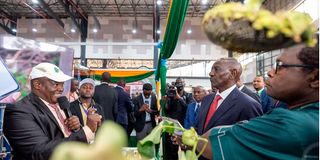
President William Ruto during the Agriculture and Food Security Transformation Summit at the Jamhuri ASK Showground in Nairobi on Thursday, October 8, 2026.
The President also pointed to reforms in the coffee and sugarcane value chains, saying his administration was working to improve farmer incomes, strengthen cooperatives, enhance payments and improve production and marketing.
Dr Ruto said Kenya must also reduce its dependence on rain-fed agriculture and invest more in irrigation and water harvesting.
The first in the country’s command said the Government’s plan to sell its Safaricom shares remained on course despite a temporary court halt. He said proceeds from the transaction would be directed to development projects, including agriculture.
Trade Cabinet Secretary Lee Kinyanjui said Kenya also needed to take greater advantage of international markets. “The country is using only a fraction of the available opportunities, particularly in the Middle East, Europe and other destinations,” he stated.
Mr Kinyanjui said Kenya’s biggest challenge was moving from exporting raw agricultural products to selling processed, packaged and branded goods. He cited tea, with more than 95 per cent exported in sacks, as an example of the value lost through limited processing.
He said 17 County Aggregation and Industrial Centres were under construction, with eight ready for finishing. “The centres are expected to provide facilities for processing, packaging and branding agricultural produce before it reaches local and international markets.”
The Trade CS said Kenya had huge opportunities in the Middle East, where markets are only about five hours away by air and roughly seven days by sea. However, high freight costs remain a major challenge, particularly for horticultural exports.
Kinyanjui said the Government was working to improve logistics through ports, rail and increased outbound cargo capacity. He said better transport and storage would also reduce post-harvest losses.
He challenged young Kenyans to view agriculture as a career of choice rather than a post-retirement occupation, saying the sector needed people with skills in technology, finance, marketing and digital platforms.
Nairobi Governor Johnson Sakaja said the capital remained one of Kenya’s largest food markets despite producing relatively little of the country’s food. He said Nairobi determines the value of produce arriving from counties across the country.
“About 40 per cent of food produced in Kenya is lost or wasted, representing millions of tonnes of produce worth billions of shillings,” he regretted, emphasising the need for value addition and processing. Kenya loses about 40 per cent of food to post-harvest and food waste annually. The city Governor called for modern markets equipped with cold storage, aggregation, grading, packaging and processing facilities.
“National and county governments should create predictable markets for farmers by linking cooperatives to institutions such as schools and other public programmes that buy large quantities of food,” Sakaja urged.
Among those present was Council of Governors (CoG) chairman Ahmed Abdullahi, the Governor of Wajir County. Bungoma Governor Kenneth Lusaka, who chairs the CoG Agriculture and Livestock Development Committee, also attended, alongside Kirinyaga Governor Anne Waiguru, and other delegates.
The three-day summit, which began on October 7, brings together national and county governments, farmers, investors and development partners to discuss ways of transforming Kenya’s food system. Themed
"Advancing Food Sovereignty, More & Better Jobs and Shared Prosperity under BETA, it ends today.
Follow ourWhatsApp channel for breaking news updates and more stories like this.