For nearly eight years, the murder of Sharon Otieno and her unborn baby has haunted Kenya’s political and legal landscape.
The killing of the 26-year-old former Rongo University student in a forest in Homa Bay triggered national outrage, dominated headlines for months and exposed the dark intersection of political power, intimacy, betrayal, and violence.
On Friday, May 29, the High Court is expected to determine whether former Migori Governor Okoth Obado and his two co-accused are guilty of orchestrating the murder, closing the final chapter of a murder trial that gripped the country.
Justice Cecilia Githua, sitting in Courtroom No. 35 at the High Court in Milimani Nairobi, is expected to deliver judgment at 9am.
Nearly eight years after Sharon’s body was found dumped in a thicket near Owade village in Homa Bay County, the court will determine whether Mr Obado, his former personal assistant Michael Oyamo and ex-Migori County Clerk Caspal Obiero were criminally responsible for her murder.
The case grabbed the nation’s attention from the moment Sharon disappeared on September 3, 2018 after leaving Graca Hotel in Rongo in the company of a journalist and two men. It dominated national headlines, triggered political shockwaves and became a defining test of criminal justice system.
At the centre of the trial was a secret relationship between Sharon and Mr Obado that exploded into public view after Sharon became pregnant.
The late Sharon Otieno.
Photo credit: Pool
A post-mortem showed the 26-year-old was 28 weeks pregnant when she was killed. Doctors said she suffered multiple stab wounds to the neck, abdomen and back. The examination also suggested possible sexual assault before death.
Prosecutors told the court that the killing was not random. They argued that it was a coordinated operation intended to silence Sharon and shield a powerful politician from scandal.
“The evidence demonstrates planning, facilitation, execution and cover-up,” prosecutors said in final submissions.
The State argued that Sharon’s pregnancy had become “a real and imminent threat” to Mr Obado’s political standing during his second term as governor.
“The three accused persons jointly planned and acted in concert to execute connected and strategic roles,” prosecutors submitted.
“I did not kill Sharon. I did not conspire with my co-accused or anyone else,” he told the court in his sworn defence.
“Social media was abuzz with the relationship,” he testified.
Mr Obado also told the court he had accepted responsibility for the unborn child and planned to buy Sharon land and build her a house in Homa Bay.
The prosecution case, however, relied heavily on an intricate trail of phone records, witness testimony and forensic evidence pieced together over years of investigations.
The dramatic escape of the journalist, who had accompanied Sharon to meet the governor's aide at the Graca Hotel in Rongo town on the night she disappeared, was at the core of the evidence.
He told the court that, after leaving the hotel, they had been forced into a vehicle and squeezed between two men in the back seat. As the car sped away, he jumped from the moving vehicle and escaped.
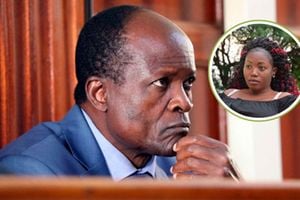
Former Migori Governor Okoth Obado and (inset) the late Sharon Otieno.
Photo credit: File | Nation Media Group
His testimony became one of the prosecution’s most critical links. After fleeing, he reported the abduction to police. Sharon’s body was discovered the following day by a farmer grazing cattle near Owade River.
Investigators later reconstructed Sharon’s final hours using mobile phone data, witness accounts and movements of the accused persons.
Call records presented in court allegedly showed communication between the accused before and after the murder. Prosecutors argued that the records demonstrated coordination and planning.
DNA evidence featured prominently in the proceedings. Government analysts linked Mr Obado to Sharon’s pregnancy, reinforcing the prosecution’s argument about motive.
Mr Obado’s lawyers argued that investigators never arrested the actual killers and failed to produce direct evidence connecting him to the murder scene.
“We submit that the prosecution has painted the first accused with the colours of suspicion,” the defence said.
Lawyers for the three accused also questioned the reliability of witness testimony and challenged the prosecution’s interpretation of call data evidence.
Mr Obado maintained that he was in Nairobi preparing for an official trip to Rwanda when the murder occurred.
His defence team argued that the phone records corroborated his alibi, proving that he could not have killed her.
The trial also raised difficult legal questions about the limits of circumstantial evidence in criminal prosecutions.
The court will now decide whether the chain of evidence presented by prosecutors was strong enough to establish guilt beyond reasonable doubt.
Earlier in the proceedings, the court narrowed the case by dismissing a second murder count relating to Sharon’s unborn child.
It ruled that under the law, the foetus did not meet the legal definition of a person capable of being murdered.
“It is clear that Baby Sharon was a foetus,” the judge ruled.
The case unfolded slowly through years of adjournments, intense public scrutiny and dramatic courtroom testimony.
When the trial opened, Mr Obado was still among the country’s most influential governors and a dominant political figure in Migori County. By the close of the proceedings, the murder case had eclipsed his political career and transformed him into the face of one of Kenya’s most sensational criminal prosecutions.
On Friday morning, the High Court will answer the question that has shadowed Kenyan politics and criminal justice since 2018: who killed Sharon Otieno?