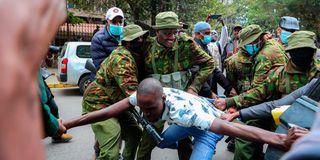
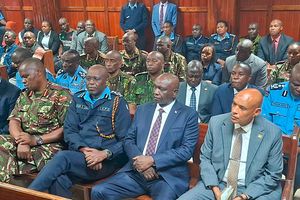
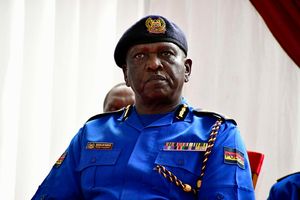
The government has formed an inter-agency team to fast-track implementation of a High Court order requiring new regulations for managing public demonstrations and police conduct.
The team comprises the Attorney-General, Interior Ministry, National Police Service, Kenya National Commission on Human Rights (KNCHR), National Police Service Commission (NPSC), Independent Policing Oversight Authority (IPOA) and other agencies.
This emerged as the court was being updated on enforcement of a March 25, 2026 judgment ordering the State to publish regulations on demonstrations, picketing and police use of force against protesters within 90 days. The order had been directed to the Inspector-General, National Police Service and Attorney-General.
The court heard that the inter-agency committee has prepared a roadmap and is supporting the Public Order Management Bill, 2025, before the National Assembly.
Pic 11
Photo credit: Lucy Wanjiru | Nation
“The committee had met on June 26, 2026 to set out a roadmap on the processing of the Bill now pending before the National Assembly,” the Attorney General told court, while seeking extension of time to allow all motions to be undertaken for the statute to be enacted.
The government says the Bill will replace the Public Order Act and operationalize Article 37 of the Constitution, which protects peaceful and unarmed assembly, demonstrations, picketing and petitions.
The development followed the court’s finding that the Inspector-General of Police, the National Police Service and Attorney-General were in contempt for missing the 90-day deadline.
Justice Alfred Mabeya discharged them after considering their apologies and steps taken towards compliance, but ordered them to file compliance reports every four months.
The report is due on January 25, 2027, with severe sentencing if the respondents fail to comply. The ruling is the latest step in a petition arising from police conduct during anti-government demonstrations in Kisumu, Migori and Ahero between March and July 2023.
The March judgment followed a petition by 29 people, including victims of shootings and assaults and relatives of people who died during the protests.
The judgment records that nine petitioners or their relatives died, while the others suffered injuries of varying severity. The court awarded them Sh36.6 million damages, cumulatively, payable by the Inspector-General of the National Police Service, the National Police Service and the Attorney-General jointly.
It awarded compensation ranging from Sh300,000 to Sh4.8 million, according to the judgment.
The petitioners said police attacked them while they were undertaking ordinary activities and argued that officers used excessive force.
The respondents disputed the claims, saying the petition did not specifically establish wrongdoing by the Inspector-General and National Police Service.
They also argued that injuries and deaths resulted from violent protests and that the petitioners should have first used statutory mechanisms through IPOA.
For its part, IPOA said it had opened investigations into allegations of excessive force but described the inquiries as complex because of difficulties identifying officers.
The court nevertheless found the petitioners had proved violations and ordered IPOA to conduct prompt, thorough and impartial investigations into the deaths and injuries.
photo 22
Photo credit: Billy Ogada | Nation
It ordered IPOA to give the petitioners investigation updates and recommendations within 90 days and directed the first three respondents –IG, NPS and AG- to publish the new regulations within the same period.
Justice Mabeya said nothing on record showed compliance. The court said the absence of rules left unclear how police officers should operate during picketing and summoned the three respondents to show cause.
“The first to third respondents had wilfully disobeyed the order or judgment of this court of March 25, 2026 by failing to report to court within 90 days what they had been required to do,” said the judge.
At the mitigation hearing, National Police Service Director of Legal Affairs Amos Amuga and Interior Ministry officer Kepha Onyiso represented the police and Interior Ministry.
They apologized and told the court that a legal regulatory framework had been initiated and that the Bill was before a National Assembly committee.
Attorney-General representatives sought more time, saying a government committee had prepared a roadmap after the March judgment.
The Attorney-General’s office said the government respects court orders and that there had been no wilful disobedience.
Justice Mabeya maintained the contempt finding, but considered their apologies, remorse, applications for more time and steps towards legislation and regulations.
“I have also considered that the contemnors are senior public officers who should strictly comply with Article 10 of the Constitution of Kenya,” the judge said.
“Accordingly, I discharge the contemnors on condition that they shall be filing reports in this court on the compliance of the structural edict every four months beginning January 25, 2027 until the order is fully complied with,” he ruled.
The ruling now requires the government to keep the court informed as the committee, legislation and regulations move through the compliance process.