When Justice Cecilia Githua found former Migori governor Zachary Okoth Obado and his two co-accused guilty of the September 2018 murder of Rongo University student Sharon Otieno, it marked the dramatic fall of a politician once regarded as one of the most influential figures in South Nyanza politics.
In her judgment on Thursday, Justice Githua found that the murder of the 26-year-old was the result of a carefully orchestrated plot involving Obado, his former personal assistant Michael Oyamo and his aide Caspal Obiero. The court held that each played a distinct role in executing the plan that culminated in Sharon’s killing.
For many who knew him, Obado was soft-spoken, humble, witty and politically astute — a self-made grassroots politician whose rise from representing sugarcane farmers in South Nyanza to becoming Migori’s inaugural governor reflected determination and ambition, though critics viewed him as a shrewd strategist who wielded power with calculated precision.
However, the murder trial that gripped the nation irreversibly altered that legacy, reducing a political career built over decades to one overshadowed by scandal and conviction.
Now 68, Obado began his working life as a sugarcane farmer before becoming a teacher at Rapogi High School, where he had studied.
He graduated from Kenyatta University with a Bachelor of Arts in Education before earning a Master’s degree in Strategic Management from the same institution.
From those modest beginnings, he built a formidable political career that propelled him to the top office in Migori County, only for it to unravel during one of Kenya’s most closely watched murder trials.
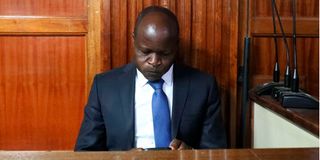
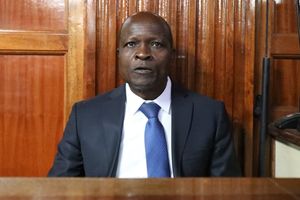
Former Migori Governor Okoth Obado at the Milimani Law Courts in Nairobi on July 23, 2026, during the delivery of judgment in the Sharon Otieno murder case. Lady Justice Cecilia Githua found Obado, and his former aides Michael Oyamo and Caspal Obiero, guilty of the 2018 murder.
Photo credit: Bonface Bogita | Nation Media Group
He entered public leadership as director of the former Kenya Sugar Board for the Awendo zone before rising to chairman, a position that helped him build influential political networks.
Throughout his political career, Obado was no stranger to controversy, both in politics and in the courts. In 2013, he defied the Orange Democratic Movement (ODM) wave to win the Migori governorship on a People’s Democratic Party (PDP) ticket. His victory was challenged in court by Prof Edward Oyugi, prompting a recount, but the results upheld his election.
Ahead of the 2017 General Election, he again fought fierce battles within ODM before securing the party’s gubernatorial ticket. He went on to defeat his main rival, Ochilo Ayacko, whose election petition was dismissed by both the High Court and the Court of Appeal. Even as his political fortunes flourished, legal challenges increasingly dogged his tenure.
In 2015, the Ethics and Anti-Corruption Commission named him in its controversial “List of Shame”, linking him to alleged irregular procurement involving more than Sh600 million.
In May this year, an anti-corruption court in Nairobi approved the withdrawal of Sh73.5 million graft charges against Obado, four of his children and 12 others following a plea bargain.
Under the agreement, the Director of Public Prosecutions recovered assets valued at about Sh235.6 million — more than three times the amount allegedly lost — including commercial buildings, apartments, maisonettes, parcels of land and two Toyota Land Cruiser vehicles.
Despite the controversies, Obado remained a dominant political force in Migori. He cultivated a fiercely loyal political base and was often surrounded by groups of youthful supporters prepared to defend him at all costs.
It was within this political environment that the term “Sangwenya” — now commonly used to describe violent political gangs or goons — gained prominence.
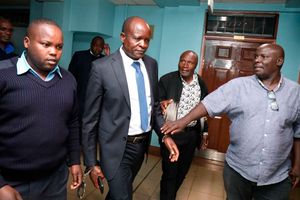
Former Migori Governor Zachary Okoth Obado is escorted out of the Milimani Law Courts in Nairobi on July 23, 2026, after being found guilty of the 2018 murder of Sharon Otieno. Lady Justice Cecilia Githua delivered the verdict at the Criminal Division of the High Court, where Obado and his former aides, Michael Oyamo and Caspal Obiero, were found guilty.
Photo credit: Bonface Bogita | Nation Media Group
His supporters frequently clashed with those of his longtime political rival, Mr Ayacko. One of the most notable incidents occurred during the 2017 election campaign when violence erupted at an ODM rally in Migori. Kisumu Governor Anyang’ Nyong’o was forced to take cover beneath a podium, while former Mombasa Governor Hassan Joho’s bodyguard was shot and injured.
The violence earned Obado a Sh2 million fine from the ODM Disciplinary Committee. Even after leaving office, Obado remained an influential figure in Migori politics.
Until his conviction, he was preparing a political comeback through a bid for the Migori Senate seat in the 2027 General Election, hoping to return to elective office as his successor sought a second term.
That ambition has now been cast into doubt following the conviction, which has brought one of Kenya’s most remarkable and controversial political careers to an abrupt and dramatic end.