When Kenya announced that it would construct a multi-million-shilling wall along its border with Somalia in 2015, the project sparked optimism in the wake of the Garissa University terror attack that claimed dozens of lives in Kenya. So ambitious was the plan for the wall that BBC News reported its budget was double what Kenya had set aside for its strategic food reserves.
The wall was designed to stretch over 700 kilometres, a barrier not only against Al-Shabaab militants but also meant to block illegal immigration. Yet four years later, only 10 kilometres had been built at a cost of Sh3.3 billion to taxpayers. The government then quietly suspended the project in 2018.
That changed in February 2026, when activity stirred along the contentious border after President Ruto announced plans to reopen the Kenya-Somalia border, but by May, those plans were once again put on ice. Internal conflict had erupted in Somalia, with the Somali National Army clashing with Jubaland forces right at the border, pushing Jubaland troops into Kenyan territory.
“You know, it is my wish. I really thought I would have opened these borders by now, but unfortunately, there is always a delicate balance between security and commerce, and we must protect both,” the president said during the North-Eastern media roundtable in Wajir on Madaraka Day.
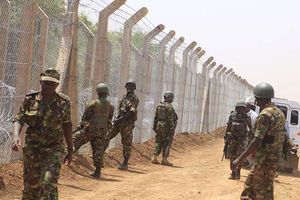
A section of the fenced Kenya-Somalia borderline.
Photo credit: File | Nation Media Group
Hopes were dashed for residents, businesspeople and traders who had been looking forward to the opportunities that cross-border trade and social integration would have created. However, the spectre of past terror attacks continues to haunt the fragile reopening, with the stalled 10-kilometre wall project serving as a reminder.
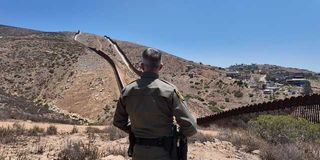
A starkly different reality plays out along the southwest border between the United States and Mexico. Here, the wall is imposing, measuring about nine metres in height and coated in the natural deep brown hues of its steel material. The colour is important because in August 2025, President Donald Trump announced that the entire wall should be painted black to make it hotter and harder to climb.
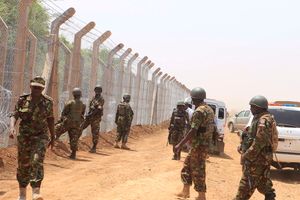
In this file picture KDF personnel inspect the fencing on the Kenya-Somalia border in Mandera County.
Photo credit: File | Nation Media Group
The wall also has formidable bolts and latches that reinforce its mighty build. The wall cuts through 33 miles, or 53 kilometres, of the dry desert area around Tucson in Arizona that borders Mexico, although the total distance of the border between the United States and Mexico is 1,954 miles, or 3,144 kilometres.
The purpose of the wall resonates with Kenya’s own security concerns and the threat of terrorism, particularly if history’s pages turn back to the United States in 2001, when the 9/11 terror attacks created devastating consequences for the country. This led the administration of then-President George W. Bush to tighten border security and abandon a plan that would have allowed Mexicans to work in the United States legally.
The present-day wall in the United States, while praised by supporters of the Trump administration, is still a work in progress. We observed a collaborative effort between the US Marines and Customs and Border Protection stringing barbed wire onto sections of the steel wall, which is reinforced with metal plates and concrete. The wall also features sensors, lights and CCTV cameras and is manned by border patrol agents on foot, horseback and in vehicles.
Officials here say that from apprehending more than 3,000 illegal immigrants, otherwise known as aliens, a day, the number has now dwindled to approximately 135 apprehensions daily.
“From my experience, it’s not just the infrastructure, it’s the technology and the manpower needed to create a secure border. You have the physical barriers, technology and the agent or officer on the ground to solve it,” John Hulag, a Supervisory Border Patrol Agent at Customs and Border Protection, says.
“I think a lot of people … Arizonans and Americans felt that the border was out of control and that order needed to be restored. People were being affected by a porous border that was affecting their security, their communities and their children,” C.J. Karamargin, senior adviser to Arizona’s 6th Congressional District Representative Juan Ciscomani, adds.
Migration sat at the heart of Donald Trump’s 2024 campaign, and its centrality only grew once he returned to the White House. So it came as little surprise when one of his first acts as president was declaring a national emergency along the southern border.
While many Americans who voted for Trump on this policy have welcomed the crackdown, sharp criticism has followed. Authorities have been accused, in some instances, of disregarding human rights and the dignity of migrants during enforcement.
At the centre of that criticism sits Immigration and Customs Enforcement (ICE), which operates under the Department of Homeland Security and has become the most recognisable symbol of the backlash against migration enforcement.
“Those ICE cases usually involve defendants who are away from the border, and ICE is pursuing them because they have a warrant either from us or they have significant criminal histories,” the US Attorney for the Southern District of California, Adam Gordon, states.
ICE has faced allegations of harassment and physical and sexual abuse of people held in custody. A report published by the Associated Press in February 2026 detailed multiple arrests of ICE agents for misconduct dating back to 2020.
But ICE is only one piece of a much larger picture. Border security in America is a multi-agency operation. Under the Department of Homeland Security, Customs and Border Protection, or CBP, is the department’s largest component and the world’s biggest law enforcement organisation.
This image taken on May 10, 2016 in Mandera shows the abandoned project to build a Kenya-Somalia border wall. PHOTO | FILE | NATION MEDIA GROUP
CBP operates through three branches: Border Patrol, the Office of Field Operations and Air and Marine Operations. This stretch of the southwest border has long been a flashpoint for criminal activity. In 2026 alone, 100 million doses of fentanyl were seized along the border. CBP records show enforcement encounters peaked in 2023, with 3,201,144 people recorded in its database. By April 2026, that figure had fallen sharply to 215,876.
The terrain along the southwest border between Arizona and Mexico betrays the harsh weather conditions that sometimes prove to be the Achilles heel of those looking to cross illegally into the United States. Battling the desert climate with little to no tree cover, these groups have sometimes had to abandon their journeys and use the rescue towers set up by a specialised CBP unit known as Border Patrol Search, Trauma and Rescue (BORSTAR).
Each rescue tower is fitted with a telephone, emergency lighting and a distress button that alerts authorities to the exact location. In an instant, the dynamic shifts from fleeing the law to calling on it simply to survive. Severe dehydration and other life-threatening complications are common. More often than not, the people in this situation were misled by the ringleaders of human-smuggling cartels, who downplayed or outright lied about the dangers of the crossing and the reality waiting on the other side.
To understand how contentious and symbolic the border wall is, history once again lends a hand. Democrats and Republicans, while divided politically, share an extensive history when it comes to decisive action at the border. The construction of the first fence can be traced back to 1933 during President Franklin D. Roosevelt’s administration. It was devised to keep animals out before later events, such as World War II, saw an influx of people crossing into the United States. This led to attempts by various administrations to both facilitate cross-border movement and tighten entry into the United States.
Fast forward to 2017, when President Donald Trump won the election. At the time, 654 miles, or more than 1,000 kilometres, of fencing were in place across California, Arizona, New Mexico and Texas. The Trump administration says it has completed more than 400 miles of a border wall since then, although analysts say the vast majority of the 452 miles replaced existing structures and that only about 80 miles of new barriers were built where none had existed before.
Back in Kenya, border matters remain unsettled. The complexity of border security is not confined to moments of open conflict; it persists even in quieter seasons. However, police spokesperson Michael Nyagah says that “the Kenya-Somalia border is generally well policed by our specialised units all the way from Border Point One in Mandera to Border Point 27 in Lamu. This includes the application of intelligence apparatus throughout. The government remains fully aware of threats posed by Al-Shabaab and other criminal elements operating across the border.”
With the border reopening once again on hold and the mega wall project still incomplete, communities along the Kenya-Somalia border will continue watching for the policies and changes that could finally deliver the stability they have sought for decades.