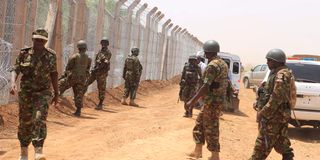
President William Ruto’s pledge to reopen the Kenya-Somalia border was welcomed with optimism by residents of North-Eastern Kenya, traders, transporters and families whose social and economic ties have been disrupted by more than a decade of restrictions.
However, months after the President announced plans to reopen key border points, the promise remains unfulfilled as fresh security concerns, including reports of suspicious cross-border movements involving motorcycles and individuals suspected of having links to criminal and extremist networks, continue to complicate the process.
The delay underscores the difficult balancing act facing the government: how to facilitate trade and regional integration while preventing Kenya's porous eastern frontier from becoming a gateway for insecurity.
Ruto's visit to Mandera revives debate on Kenya-Somalia border closure
Speaking during the North-Eastern Media Roundtable in Wajir on June 1, President Ruto admitted that security realities had forced the government to proceed cautiously.
"You know; it is my wish. I really thought I would have opened those borders by now. But unfortunately, there is always a delicate balance between security and commerce, and we must protect both," the President said.
His remarks reflected growing concerns within Kenya's security establishment over developments unfolding across the border in Somalia, where political tensions, armed conflict and the continued presence of the Al-Shabaab militant group continue to pose significant risks.
National Police Service spokesperson Muchiri Nyaga said specialised security units continue to monitor the entire Kenya-Somalia frontier from Mandera to Lamu.
"The Kenya-Somalia border is generally well policed by our specialised units all the way from Border Point One in Mandera to Border Point 27 in Lamu. This includes the application of intelligence apparatus all through," Mr Nyaga told Sunday Nation on Saturday.
National Police Service Spokesperson Michael Nyaga Muchiri during an interview at his office at Jogoo House in Nairobi on July 2, 2025.
Photo credit: Wilfred Nyangaresi | Nation Media Group
According to him, the government remains fully aware of threats posed by Al-Shabaab and other criminal elements operating across the border.
"The robust application on Kenya's eastern borderline has ensured we remain relatively safe and secure as a country. Any intrusion or attempted intrusion into Kenya is addressed," he added.
Mr Nyaga noted that the relatively limited number of successful intrusions demonstrates the effectiveness of ongoing security operations.
The Kenya-Somalia border has remained largely closed since 2011 following a wave of terrorist attacks linked to Al-Shabaab, which prompted Kenya to deploy troops into Somalia under Operation Linda Nchi.
The closure affected formal movement through border points such as Mandera, cutting off trade routes that had historically connected communities on both sides.
When President Ruto visited Mandera earlier this year, he revived hopes of normalcy by promising to reopen the border and restore cross-border trade.
For residents of Mandera, Wajir and Garissa counties, reopening the border represented more than an administrative decision. Families separated by international boundaries expected easier movement, while traders anticipated expanded business opportunities following Somalia's admission into the East African Community.
Diplomacy experts argued that reopening the border would strengthen bilateral relations between Nairobi and Mogadishu while boosting economic activity in a region long marginalised by insecurity, yet some locals have insisted that opening the border would spur insecurity.
Dr ED Githua, an international relations analyst, argued that the whole idea of the border closure was because of the increased insecurity in the region following Al-Shabaab attacks.
“So, one of the ways the security agencies thought would be prudent was to stem the flow of people coming in from the Somali side,” Dr Githua said, adding that it is in good faith to reopen the border but it comes with security risks.
Security agencies have, on their part, remained cautious.
The latest security concerns stem from reports from locals regarding alleged cross-border movements of motorcycles and personnel between Somalia and Kenya amid heightened political tensions in Somalia.
While authorities have not publicly verified the reports, security analysts warn that such claims cannot be ignored given the region's history.
Security teams at the Kenya-Somalia border. File | Nation Media Group
Motorcycles, commonly known as boda bodas in East Africa, are indispensable for transportation and commerce. However, they have increasingly become a security concern because of their ability to move quickly across difficult terrain and evade conventional security checkpoints.
A resident, Mr Deko Hussein, insisted that the Kenya-Somalia border need not be reopened because of their safety concerns.
“I don’t wish to see the border opened because criminals will infiltrate our nation,” he told Nation.
For years, security experts have warned that extremist groups and criminal gangs often prefer motorcycles for transporting personnel, weapons, supplies and intelligence operatives.
The concern is particularly acute along the Kenya-Somalia frontier, where vast stretches of territory remain difficult to monitor despite increased deployment of security personnel.
If organised groups were able to exploit motorcycle transport networks across the border, security experts say the implications could be significant.
The fear among authorities is not necessarily the movement of ordinary traders or civilians but the possibility that criminal actors and extremist operatives could blend into legitimate cross-border traffic.
Complex political environment
The shadow hanging over discussions on reopening the border remains Al-Shabaab.
Al-Shabaab has repeatedly carried out attacks targeting civilians, security personnel and infrastructure in both Somalia and Kenya.
North-Eastern Kenya has experienced some of the deadliest attacks linked to the group, including assaults on police camps, communication infrastructure, public transport vehicles and educational institutions.
Security officials argue that while the threat has diminished compared to previous years, it has not disappeared.
The possibility of extremists exploiting newly reopened border crossings remains a major concern for intelligence agencies.
A senior security official familiar with border operations said authorities are particularly concerned about the potential use of boda bodas to facilitate infiltration.
Security officers stand guard at the Kenya-Somalia border on March 30, 2018.
Photo credit: Manase Otsialo | Nation Media Group
Unlike larger vehicles, motorcycles can access remote routes that bypass formal crossing points, making detection more difficult.
This challenge becomes even greater when criminal elements take advantage of family, clan and commercial networks that naturally span both sides of the border.
The country continues to navigate a complex political environment involving federal and regional actors, elections and disputes over governance structures.
Recent developments in South-West State, including the election of a Speaker and the expected selection of a new regional governor, have drawn regional attention.
While political competition is a normal feature of democratic systems, security analysts note that periods of political uncertainty can create opportunities for armed groups and criminal networks to expand their influence.
Reports alleging unusual motorcycle movements within conflict-affected areas have therefore attracted scrutiny from observers monitoring developments in the Horn of Africa.
Although no competent authority has publicly verified claims linking political actors to such movements, analysts argue that any allegations involving potential security risks deserve thorough investigation.
The principle of presumption of innocence remains fundamental, but so does the responsibility of authorities to establish facts where credible concerns arise.
While security dominates official discussions, the economic costs of continued closure remain substantial.
Livestock traders, transport operators, wholesalers and small-scale merchants have all been affected by restrictions on formal movement.
Many residents argue that prolonged closure has merely pushed commerce into informal channels rather than stopping it altogether.
Economic experts contend that reopening regulated border crossings could actually improve security by bringing trade under official oversight.
Formal customs procedures, immigration checks and digital monitoring systems could provide authorities with better visibility over movements than the current situation, where informal crossings continue to exist.
Supporters of reopening also point to Somalia's membership in the East African Community, arguing that regional integration requires freer movement of people and goods.
However, security officials maintain that economic gains cannot come at the expense of national safety.
President William Ruto delivers his speech during the Madaraka Day celebrations at Wajir Stadium on June 1, 2025.
Photo credit: Billy Ogada | Nation
President Ruto, therefore, finds himself confronting a dilemma that previous administrations also faced.
On one hand, reopening the border aligns with his administration's agenda of promoting trade, regional cooperation and economic growth.
On the other hand, any security incident linked to relaxed border controls would expose the government to criticism and potentially undermine public confidence.
Following Somalia's entry into the East African Community, discussions on reopening the border gained momentum. However, renewed attacks targeting security personnel forced authorities to postpone implementation.
Today, similar concerns continue to shape decision-making.
Even as communities anticipate the reopening of border posts, security agencies appear determined to ensure that adequate safeguards are in place before any final decision is made.
The debate over the Kenya-Somalia border highlights a broader challenge confronting governments across the Horn of Africa: balancing economic integration with security imperatives.
For Kenya and Somalia, the stakes are particularly high.
The two countries share deep historical, cultural and economic ties. Communities living along the border often view the frontier as a political boundary cutting across longstanding social networks.
Yet both nations also face a common threat from extremist groups seeking to exploit instability and weak governance.
As reports of suspicious cross-border movements continue to attract attention, authorities in Nairobi and Mogadishu are under pressure to strengthen intelligence cooperation, enhance surveillance and investigate any credible allegations.