The arrest of drug-trafficking brothers Baktash and Ibrahim Akasha in Mombasa in 2014, their expulsion from Kenya in 2017, and subsequent prison sentences in the US marked a major milestone in international efforts to dismantle narcotics trafficking networks operating through Kenya.
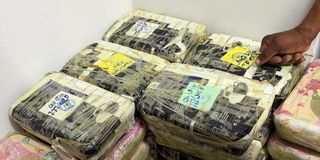
Police Recover 454kg of suspected narcotics worth Sh3.6 billion in Kwale.
Photo credit: Pool
Baktash was sentenced to 25 years in prison in 2019, while his younger brother Ibrahim received a 23-year sentence in 2020, after admitting to drug-trafficking, weapons and obstruction offences. The two were sons of Mombasa-based drug kingpin Ibrahim Abdalla Akasha, who was shot dead in Amsterdam, Netherlands, in 2000. In successfully prosecuting the drug lords, the US government did what Kenya had failed to do for decades.
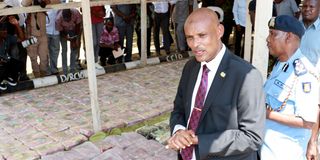
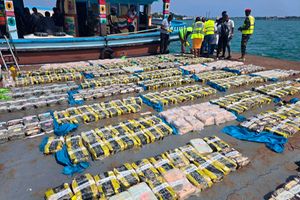
Some of the 1,024 kilogrammes of synthetic drugs seized from six Iranian crew members aboard a vessel. The haul, estimated to be worth Sh8.2 billion, was seized about 650 km off the shore of Mombasa.
Photo credit: Wachira Mwangi | Nation Media Group
The latest seizure, announced by police on Sunday, followed a cross-border investigation that began with the arrest of a suspect in Tanzania on November 5. Tanzanian authorities had intercepted the suspect with a separate consignment of 259 kilogrammes of narcotics believed to comprise methamphetamine and cocaine.
Following his handover to Kenyan authorities at the Lunga Lunga-Horohoro border crossing, investigators were led to two locations in Kwale's Msambweni Sub-County.
At Shirazi village in Kingwede Shirazi Location, officers traced the premises of a suspected accomplice. Further interrogation led them to Ganja La Simba village in Kinondo Location, where they recovered 454 kilogrammes of suspected narcotics.
Police Recover 454kg of suspected narcotics worth Sh3.6 billion in Kwale.
Photo credit: Pool
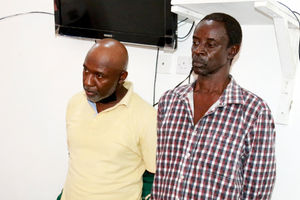
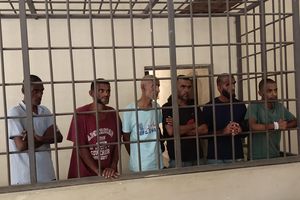
Three suspects— Basleman Saleh Khamis (Tanzanian), Hamad Seif Said (Tanzanian) and Nakabugo Zuraicah (Ugandan) — were arrested, and two vehicles and a motorcycle seized.
Suspects arrested after a drug bust in Kwale County.
Photo credit: Pool
The two incidents suggest that the region continues to face significant challenges in combating international narcotics trafficking. But neither seizure has publicly identified the ultimate owners of the drugs.
On Monday, Directorate of Criminal Investigations (DCI) boss Mohamed Amin said the National Anti-Narcotics Investigations Bureau (NANIB) is pursuing the financial networks behind the drug trade.
“Our focus is not only on apprehending couriers, but also on identifying and pursuing the financiers and organisers who sustain these criminal enterprises,” Mr Amin said during a press briefing in Mombasa.
US court proceedings in the Akasha brothers’ prosecution exposed the scale and sophistication of a criminal organisation that had operated for almost two decades. The US Department of Justice described Baktash as the leader of the Akasha organisation, with Ibrahim serving as his deputy.
The brothers were first arrested in Mombasa after supplying 99 kilogrammes of heroin and two kilogrammes of methamphetamine to confidential sources working under the direction of the US Drug Enforcement Administration. Investigators subsequently established that their organisation was involved in international narcotics trafficking, including the movement of multi-tonne quantities of drugs.
Court records showed that the brothers negotiated with heroin suppliers in the Afghanistan-Pakistan region, discussed methamphetamine production and arranged maritime transportation.
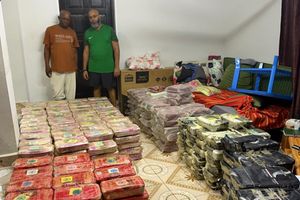
Some of the 454kg of suspected methamphetamine worth Sh3.6 billion recovered in Diani, Kwale County, on November 9, 2026. Kevin Odit | Nation
Photo credit: Kevin Odit | Nation Media Group
Their prosecution also exposed how criminal proceeds could be used to frustrate law enforcement. The brothers admitted participating in a bribery scheme targeting Kenyan officials, including judges, prosecutors and law-enforcement officers, in an attempt to obstruct their extradition to the US.
The removal of the Akasha brothers from the global narcotics supply chain was expected to disrupt the Kenyan-based leadership of an organisation whose operations extended across several countries.
However, emerging trends have proven that the suppliers, brokers, couriers, customers and financial facilitators have continued operating.
Detectives had initially identified Swaleh Yusuf Ahmed, alias Candy Rain or Kandereni , as the successor to the Akasha brothers' drug empire. He died under mysterious circumstances while the trial for trafficking narcotics worth Sh275 million was ongoing in 2024.
Swaleh Yusuf Ahmed in Mombasa Magistrate's Court on January 24, 2019.
Photo credit: File | Nation Media Group
His co-accused, Fatuma Ahmed Ali, was sentenced to 40 years in prison and fined Sh825.6 million. His other suspected accomplice, Masuo Bakari Tajir, was also found murdered under mysterious circumstances in a bush in Thika, Kiambu County, in 2022, a month after he was reported missing on December 3, 2021.
Swaleh was believed to be the leader of a drug cartel operating in Mombasa and Kilifi counties, remaining the only one most-wanted by the police. He was linked to a drug trafficking network that supplied psychotropic substances to the Coast and had run-ins with the law over drug trafficking since his teenage years.
A more recent US prosecution shows how East African nationals continue to be involved in international criminal operations extending far beyond the region.
The case involves Kenyan national Elisha Odhiambo Asumo, who was extradited from Morocco to the US in March 2026 to face charges arising from an alleged international cocaine and arms-trafficking conspiracy.
Elisha Asumo who has been linked to the Jalisco New Generation Cartel (CJNG).
Photo credit: Pool
The indictment filed in the US District Court for the Eastern District of Virginia named four foreign nationals: Bulgarian arms dealer Peter Dimitrov Mirchev, Asumo, Ugandan Michael Katungi Mpeirwe and Tanzanian Subiro Osmund Mwapinga.
US prosecutors alleged that the group conspired to supply military-grade weapons to Mexico's Cartel de Jalisco Nueva Generación (CJNG), one of the country's most powerful criminal organisations. The indictment described an operation involving machine guns, rocket launchers, grenades, sniper rifles, anti-personnel mines and anti-aircraft weapons.
The weapons were allegedly intended to support the cartel's cocaine trafficking operations, including shipments destined for the United States.
According to prosecutors, Mirchev recruited Asumo, who allegedly helped obtain fraudulent end-user certificates and delivery verification documents through bribery. Such certificates are intended to establish the authorised recipient of controlled weapons and prevent their diversion to unauthorised parties.
The indictment also noted a meeting in Cape Town, South Africa, in March 2023, during which prosecutors alleged that Asumo and Mwapinga discussed the possibility of using East Africa as a transshipment point for cocaine.
Asumo pleaded guilty in July 2026, to conspiracy to distribute and possess cocaine. He was scheduled to be sentenced on November 4, but the outcome of that hearing was not publicly available as at November 9.
Mr Amin stated that the recent substantial drug recoveries and successful prosecutions demonstrate the government’s determination to dismantle narcotics trafficking networks.
“Kenya will not be allowed to serve as a transit route, a destination market or a safe haven for drug traffickers. We remain resolute in pursuing the syndicates, their financiers and accomplices to ensure that all those involved in this illicit trade are brought to justice,” he said.
Kenya's struggle to identify and prosecute suspected powerful drug barons involved in international networks is not new.
In December 2010, then Internal Security Minister George Saitoti made a controversial statement in Parliament naming four MPs and a businessman who were allegedly under police investigation over narcotics trafficking.
The allegations triggered a political storm, with the individuals challenging the basis of the investigations and demanding that the government produce evidence.
In 2011, Saitoti tabled an interim report on drug-trafficking investigations alongside a letter from then US Ambassador Michael Ranneberger attaching additional information concerning alleged traffickers. The police investigation, however, did not produce evidence sufficient to sustain charges against the four MPs and the businessman named in the controversy.
The parliamentary proceedings also exposed concerns about the difficulties investigators faced in obtaining evidence.
The report raised allegations of collusion among civil servants at Mombasa port, inland container depots and container freight stations, as well as the reluctance of potential witnesses to record statements.
Kenya's geographical position makes it particularly vulnerable to international trafficking networks. The Indian Ocean connects East Africa to major maritime routes linking Asia, the Middle East and international markets, while the Port of Mombasa serves as a commercial gateway for several landlocked countries in the region.
In October, 2025, a mega methamphetamine seizure exposed this vulnerability. The Kenya Navy intercepted a dhow approximately 340 nautical miles east of Mombasa.
A subsequent search in Mombasa uncovered 769 packets containing 1,024 kilogrammes of methamphetamine, estimated to cost Sh8.2 billion. Six Iranian nationals aboard the vessel were arrested and charged with trafficking the drugs.
Drug-trafficking operations
During the September destruction of the methamphetamine seized from the Iranian vessel, the Director of Public Prosecutions, Renson Ingonga, called for investigations to go beyond the immediate suspects and target the financiers, coordinators and beneficiaries of drug-trafficking operations.
“We must move beyond arresting the courier at the end of the chain. The destruction we witness today is a milestone. But it is not the end of the fight,” Mr Ingonga said.
The government is now seeking to expand Joint Operations Centres (JOCs) from the current eight to all 35 Border Management Committees (BMCs) as part of efforts to strengthen coordination, intelligence sharing and accountability in border management.
Principal Secretary for Internal Security and National Administration Raymond Omollo said the centres were critical to strengthening surveillance, facilitating timely responses to emerging threats and promoting coordinated action among government agencies.
Beyond operational coordination, the PS emphasised the need to strengthen governance and accountability within the institutions responsible for border security.
“We cannot secure our borders effectively without strengthening the systems and personnel responsible for managing them,” he said, warning against collusion, corruption, information leakage and other practices that compromise security operations.
In recent years, detectives have announced dismantling several other drug-trafficking cartels, seizing thousands of kilogrammes of narcotics and property believed to be proceeds of crime.
Some of the arrests exposed how global drug trafficking networks also take advantage of loopholes at the Moi International Airport in Mombasa and Jomo Kenyatta International Airport (JKIA) in Nairobi.
In addition, the challenges posed by Kenya’s lengthy judicial process are reflected in several long-running cases. Among them is a case about the Sh1.3 billion heroin haul linked to six Pakistani nationals and an Iranian national arrested in Mombasa in 2014 after their vessel, AMIN DARYA, also known as AL NOOR, was found carrying narcotics.
The case took years to conclude, and the State’s victory proved short-lived. A magistrate’s court sentenced the accused to life imprisonment in 2023. However, in June 2025, the High Court overturned the sentences, citing bungled investigations, confusion within the Navy and the unlawful destruction of the vessel.