The government has allocated Sh1.65 billion for the maintenance of the deteriorating Thika Superhighway, highlighting the growing cost of maintaining the Sh27 billion infrastructure project that was once hailed as a masterpiece.
The Ministry of Transport and Infrastructure told Parliament that the maintenance allocation for the financial year 2025/26 was Sh1,400,632,612.41, while Sh1,649,541,319 has been allocated for the current financial year.
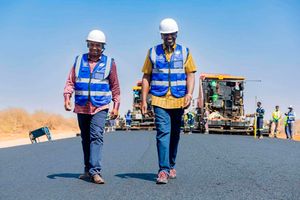
The ministry said maintenance contracts covering various sections of the highway are already under way.
The contract for the Nairobi-Ruiru section commenced on June 9, 2025 and will run for 24 months, with completion scheduled for June 8, 2027. The contract for the Ruiru-Thika section also commenced on June 9, 2025 and is scheduled to run until June 8, 2027, while that for the Thika-Kenol section commenced on November 24, 2025 and is due for completion on November 23, 2027.
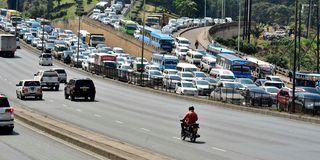
Traffic flowing on Thika Superhighway heading towards the city center on July 16, 2026.
Photo credit: Francis Nderitu | Nation Media Group
“The Ministry further submitted that comprehensive rehabilitation and reconstruction of the Thika-Kenol section will be undertaken subject to the availability of funding, completion of the requisite procurement processes, and fulfilment of statutory requirements,” the ministry said in submissions to the National Assembly.
The Kenya National Highways Authority (KeNHA), through the China Road and Bridge Corporation (CRBC), constructed the approximately 50-kilometre superhighway between 2009 and 2012. It was officially opened on November 9, 2012.
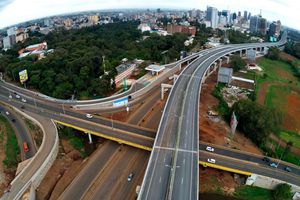
The project which cost approximately $360 million (Sh27 billion at the time), was designed to ease severe congestion and improve transport links between Nairobi, Thika and surrounding areas.
It introduced widened carriageways, interchanges, flyovers, underpasses, service roads, pedestrian facilities, drainage systems and street lighting.
The ministry provided the latest maintenance figures in response to a request by Mathioya MP Edwin Mugo, who sought to know what the government was doing to address the deteriorating state of the Thika Superhighway.
Mr Mugo sought details of the maintenance and rehabilitation plans for the highway, particularly the Ngara-Kenol stretch in Murang’a County; the reasons for delays in repairing potholes and other damaged sections; measures being taken to improve road safety; and timelines for completing repairs and rehabilitation to restore the road to a motorable condition.
Delivering the ministry’s response on behalf of the chairperson of the Transport and Infrastructure Committee, George Kariuki, Imenti North MP Rahim Dawood said the Ngara-Kenol corridor comprises the Nairobi-Thika Superhighway (S1) and the Thika-Kenol section of the A2 road.
“The maintenance interventions undertaken on the sections include surface dressing on the Nairobi-Thika main carriageway in 2019, localised repairs and pothole patching along the service lanes in 2025, and rehabilitation of selected sections of the non-motorised transport facilities (walkways) in 2025,” Mr Dawood said.
The works include construction of bus bays at Roysambu and Githurai to improve traffic flow and safety, pothole patching on failed sections, installation of road signs, road marking around the newly constructed bus bays, and performance-based maintenance of the carriageway, road reserve and structures.
On the Ruiru-Thika section, the ministry said the works include construction of a climbing lane along the Blue Post section in Thika, construction of bus bays along the Witeithie section, pothole patching, road marking and performance-based maintenance of the carriageway, road reserve and structures.
However, the ministry said budget constraints prevented the application of a surface dressing overlay under the same contract. As a result, the overlay experienced severe ravelling following the heavy rainfall recorded between October 2023 and May 2024.
“Due to budgetary constraints, sealing the overlay with surface dressing on the road section could not be executed within the same contract. The overlay hence experienced severe ravelling resulting from the effects of the excess rainfall experienced between October 2023 and May 2024 after the overlay,” Mr Dawood said.
Heavy traffic on Thika Superhighway on July 03, 2026.
Photo credit: Francis Nderitu | Nation Media Group
The ministry said the Thika-Kenol section is currently under a performance-based maintenance contract.
The scope includes drainage works, including provision of 900mm access culverts and drain excavation; localised base repairs using hand-packed stones; surface dressing using 6/10mm chippings and 80/100 penetration-grade bitumen on selected sections; road marking and other road furniture; and performance-based maintenance of the carriageway, road reserve and structures.
However, the committee noted that budgetary and contractual constraints had left the ministry with insufficient quantities to provide an asphalt-concrete overlay on all severely ravelled sections.
The ministry said it had therefore opted to forego surface dressing in some areas and use the funds allocated for it to address more of the affected sections through asphalt-concrete regulation.
Mr Dawood said the ministry had also identified weaknesses in the pavement structure as a major factor contributing to the rapid deterioration of the Thika-Kenol section.
“Also, the Ministry further submitted that while the traffic loading on the Thika Superhighway, Thika-Kenol and Kenol-Marua is considered uniform, faster deterioration is experienced along the Thika-Kenol section due to the inferior pavement structure,” he said.
“In view of this, the road section requires additional funding for pavement strengthening. In the long term, the Thika-Kenol section forms part of the government's planned upgrading of the Thika-Kenol-Marua Corridor.”
He said major rehabilitation and upgrading works would be undertaken subject to the availability of funds, completion of procurement processes and fulfilment of statutory requirements.
On the delay in repairing potholes and other damaged sections, the ministry said the major maintenance interventions undertaken since the superhighway was opened to traffic in 2012 included single-seal surface dressing in 2019.
Mr Dawood said the road had deteriorated over the years because of traffic loading and weather conditions.
“The Ministry further submitted that the deterioration is particularly pronounced on the service lanes and non-motorised transport facilities due to inherent limitations in the original pavement design. The non-motorised transport facilities were constructed with a 35mm asphalt-concrete wearing course, while many sections experience poor drainage that has accelerated pavement deterioration,” the ministry said in its report to the House.
“Similarly, the service roads were constructed with a less robust pavement structure than the main carriageway, making them more susceptible to premature failure under increasing traffic loads.”
Mr Dawood said KeNHA carries out regular road-condition assessments through the Annual Roads Inventory and Conditions Survey (ARICS), the Dynamic Response Intelligence Monitoring System (DRIMS) and routine inspections to identify and prioritise critical interventions.
However, he said the interventions undertaken over the years had largely been aimed at preserving the road in its existing condition rather than comprehensively rehabilitating it.
Mr Dawood said the ministry had committed to undertaking comprehensive rehabilitation and reconstruction of the affected sections once funding became available.