The planned establishment of a US Ebola quarantine facility in Laikipia, Kenya, which the US government has already committed Sh1.7 billion, can be traced back to the 2016 agreement that the government ratified to make it part of our laws.
But the growing public outrage over the planned US isolation facility and the High Court orders temporarily halting the facility’s construction, stand in the way of a project the US government says is a priority to prevent Ebola from getting to the US soil.
The facility, once completed, will serve as the quarantine centre to screen US nationals suspected of having the deadly disease that has no cure at the moment and whose outbreak since it was reported on May 15, 2026 in Democratic Republic of Congo has claimed 241 lives out of 906 suspected cases.
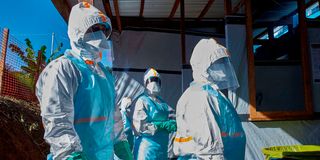
Doctors at an Ebola isolation centre. The current Ebola outbreak in DR Congo is caused by the Bundibugyo virus, a rare Ebola strain.
Photo credit: File | AFP
In Uganda, which neighbours DR Congo, one fatality has been reported out of the nine confirmed cases.
The agreement between Kenya and the US concerning cooperation in threat reduction biological engagement programs was signed by then Health CS James Macharia and then US Ambassador to Kenya Robert Godec on July 24, 2015 before it was ratified by Parliament.
“The purpose of the cooperative program is to facilitate efforts to reduce the threats from naturally occurring diseases, biological attacks, or unintentional release of biological pathogens and toxins, and the risks posed by non-state actors of bioterrorism,” the agreement states.
The ratification of the agreement, in line with the Treaty Making and Ratification Act of 2012, made it become part of the laws of Kenya as provided for in Article 2 (6) of the constitution.
Documents in parliament show that it is the same agreement that Kenya signed with the US that was used by the US government to construct the Corona quarantine centre for the US citizens at Nairobi hospital.
A brief from the Parliamentary Budget Office (PBO) shows that the purpose of the agreement is to establish a cooperative program to facilitate mutually beneficial efforts to reduce biological threats of common concern between the two countries.
Article II of the agreement outlines the scope of cooperation, covering a wide range of issues related to reducing threat from naturally occurring diseases, biological attacks or unintentional releases of biological pathogens and toxins, and the risks posed by non-state actors of bioterrorism.
The scope of the agreement covers a variety of subject matter ranging from human health, animal health, nationwide laboratory systems, biosafety and biosecurity and disease surveillance among others.
The areas of cooperation under the agreement “may include but are not limited to” supporting the implementation of an effective nationwide laboratory system within Kenya.
There is also the implementation of a functioning surveillance system within Kenya, “capable of identifying and responding to potential events of concern to health security from biological pathogens and toxins.”
The other areas of cooperation include a comprehensive, sustainable and legally embedded national programs for biosafety and biosecurity, implementation of policies and practices to minimize the spillover and spread of emerging diseases and supporting collaborative research programs in bio-surveillance, biosecurity, and biosafety.
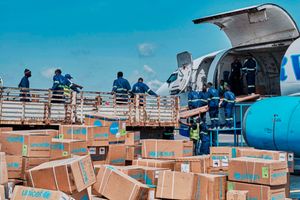
Unicef staff and airport workers receive a humanitarian aircraft carrying medical supplies, personal protective equipment for the Ebola response at the Bunia National Airport in Bunia, in the Democratic Republic of Congo, May 29, 2026.
Photo credit: Reuters
“The implementation of the activities under the scope of agreement will greatly enhance Kenya’s capability to identify and rapidly detect, diagnose and report biological terrorism and outbreaks of pathogens and diseases of security concern.”
The implementation of the agreement means no direct financial implication on Kenya since the US will provide “as appropriate and at no cost to Kenya,” assistance in support to the implementation.
However, the agreement provides that Kenya will be required to accord tax exemptions to the personnel of the US government in the country engaged in the implementation of the agreement and the goods and services used in the implementation of the agreement.
“It is the considered opinion of the Parliamentary Budget Office that tax exemptions and waivers will lead to a direct loss of revenue by the government hence a direct financial implication in the form of tax expenditures,” says PBO.
This is because under the Treaty Making and Ratification Act, Kenya ratified the agreement without amendments.
This means that the country enjoys the benefits but incurs the financial costs arising from the implementation of the agreement in terms of the tax exemptions and waivers.
PBO, a government agency within parliament, exists to provide professional and technical services to parliament and its committees on fiscal matters.
Had the government pushed for no tax exemptions and waivers at the negotiations stage, Kenya would have transferred the taxes and fees related expenditures to the US government.
Under the agreement, the US will provide Kenya the assistance in support of efforts to identify, detect, predict, monitor, control, safeguard against, reduce, eliminate, prevent the proliferation of, ensure safe storage and transport of, enhance reporting of, improve mechanisms for response to and strengthen research, training, and education related to biologic threats.
“The projects envisaged in the program shall consist of mutually agreed projects related to potential biological threats, including naturally occurring diseases, biological attacks, or unintentional releases of biological pathogens or toxins and biological weapons-related pathogens and toxins, materials, processes, and knowledge,” reads the agreement.
The agreement was designed to enhance Kenya’s capability to identify, consolidate and secure collections of pathogens and diseases of security concern in order to prevent the sale, theft, diversion, or accidental release of “such pathogens.”
It was also meant to enhance Kenya’s capability to rapidly and accurately survey, detect, diagnose and report biological terrorism and outbreaks of pathogens and diseases of security concern in accordance with international reporting requirements.