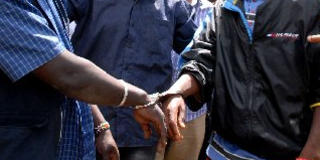
Two police officers accused of murdering a robbery suspect have suffered a major legal setback after the High Court cleared the way for them to stand trial over a fatal shooting during a police chase in Nairobi.
In a judgment delivered on July 9, 2026, the court dismissed police officers James Were and Christopher Thuita's bid to stop the criminal case, ruling that the Independent Policing Oversight Authority (Ipoa) acted within the law by investigating the shooting and recommending that they be prosecuted.
The judge also found that the Director of Public Prosecutions (DPP) made an independent decision to charge the officers with murder after reviewing Ipoa's findings.
The ruling lifts an earlier order that had temporarily halted the prosecution, allowing the murder trial to proceed.
Office of the Director of Public Prosecutions.
Photo credit: Photo | Pool
The case was filed by officers Were and Thuita, who challenged the decision to charge them with the murder of Dominic Mogere Machoni.
The officers argued that Ipoa unlawfully influenced the DPP to abandon an inquest into the shooting and instead prosecute them for murder.
According to court documents, the officers said the shooting occurred on June 17, 2022, after they responded to reports of an armed robbery along Kamukunji Road in Nairobi.
They claimed members of the public identified Machoni as one of the robbers, prompting a chase after he allegedly fled with three other suspects. The officers told the court that Machoni opened fire on them during the pursuit, forcing them to shoot in self-defence.
An inquest was opened at the Makadara Law Courts in 2023 to establish the circumstances surrounding the shooting.
However, Ipoa later conducted its own investigation and recommended that the officers be charged with murder. The DPP accepted the recommendation, halted the inquest and approved the prosecution.
The officers then moved to the High Court, arguing that Ipoa had exceeded its powers by effectively directing the DPP to prosecute them. They maintained that only the DPP has the constitutional authority to decide whether criminal charges should be filed.
Officers' claims dismissed
The judge, however, rejected that argument and ruled that Ipoa's role was limited to investigating the incident and making recommendations, as required under the Independent Policing Oversight Authority Act.
“The first respondent merely recommended prosecution to the second respondent as required under the Independent Policing Oversight Authority Act. Upon reviewing the material, the second respondent agreed with the recommendation and independently decided to prosecute the applicants,” the judge ruled.
The judge said the evidence before the court showed the DPP independently reviewed Ipoa's investigation file before deciding to press murder charges. He added that there was nothing to suggest the DPP had surrendered or delegated his constitutional powers to Ipoa.
“The mere fact that the first respondent and the second respondent reached the same conclusion does not mean Ipoa compelled, coerced or improperly influenced the DPP to prosecute," he said.
The judge also ruled that Ipoa was legally required to investigate the shooting because the law mandates it to examine every death or serious injury caused by police officers while on duty.
Justice Musyoka declined to determine whether the officers acted in self-defence, saying that question can only be answered during the murder trial after witnesses testify and all the evidence is examined.
“The truth can only emerge during the trial, where evidence from both sides will be tested,” he said, adding that courts can only interfere with a decision to prosecute if there is evidence that it was made illegally, irrationally or through an abuse of the legal process.
Finding no evidence that either Ipoa or the DPP acted outside the law, Justice Musyoka dismissed the application, lifted the orders that had suspended the prosecution and directed that the murder trial proceed.