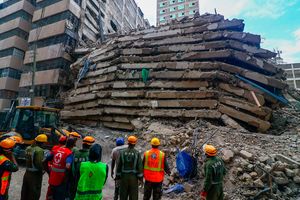
Rescuers at site of a collapsed building in Eastleigh, Nairobi, on October 23, 2026.

Kenya’s buildings are at risk of collapse because developers cut costs at the expense of structural safety, unqualified practitioners undertake or supervise projects, and contractors flout construction standards.
A government report tabled in Parliament also identifies fragmented approval processes, compromised regulatory agencies and weak county enforcement as systemic failures allowing unsafe structures to proceed largely unchecked.
The report, covering July 1, 2025, to April 2, 2026, identifies poor workmanship, a disjointed approval process among key agencies, compromised regulatory bodies and non-compliance with building standards as the major causes of building collapses in the country.
It also cites lenient fines that are not punitive enough to deter offenders, a lack of enforcement capacity within county governments and fake architects who sell drawings to developers as major contributors to the proliferation of substandard buildings.
The report details failures at every stage, from design and approvals to construction and the materials used. On structural design, the report noted that Kenya’s buildings start with structural designs that are poorly done by developers who are only interested in saving costs, with quality sacrificed to maximise profits.
Minimize construction costs
“Some developers in an effort to minimize construction costs on weak soil conditions, compromise on the quantity and quality of concrete and reinforcement thereby increasing the risk of structural failure and building collapse,” the report states.
The report reveals that most designers do not even undertake geotechnical investigations at construction sites to ascertain the bearing capacity of the soil substrata and ensure that it can safely sustain the imposed structural loads.
According to the report, there is also a worrying trend in which quacks posing as architects sell drawings to developers, who end up implementing them without questioning their validity.
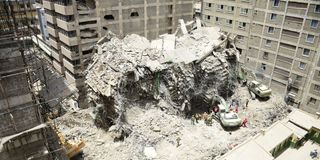
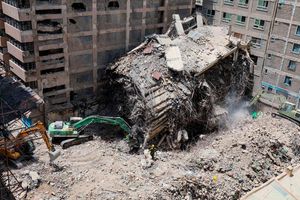
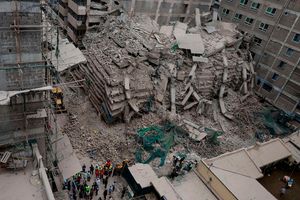
Aerial photo of building that collapsed in Eastleigh: Rescue operations have entered the fourth day.
“The involvement of unqualified persons was noted including instances where unlicensed individuals posing as engineers and architects prepare and sell engineering drawings to unsuspecting [developers],” the report notes.
“The use of incomplete and defective architectural and engineering drawings contributes significantly to structural deficiencies and potential building failure,” the report adds.
The report also raises concerns about professional integrity, noting that a few qualified practitioners, such as architects and structural engineers, supervise a high number of projects, compromising quality.
For instance, the report cites Mombasa County, where 73 per cent of construction developments are handled by only five architects and three structural engineers.
Due to the workload and an insatiable appetite to make more money, some practitioners resort to credential renting.
Credential renting refers to a situation in which registered professionals allow unqualified individuals to work under their names on a project without their actual involvement or supervision, a practice that erodes standards and exposes the public to risks.
According to the report, unscrupulous developers flout zoning regulations by increasing the number of floors, eventually resulting in heavier loads on the substructure.
The report noted that compromised regulatory agencies approve substandard structures and issue occupation certificates for buildings that do not meet the required standards.
There is also major concern over the disjointed approval process involving three key agencies — county governments, the National Environment Management Authority (NEMA) and the NCA — which leaves many developers resorting to shortcuts. The report cites poor workmanship, including rogue contractors who fail to follow approved plans, use unskilled workers and take shortcuts during construction.
“Contractors use improper construction building techniques such as mixing incorrect proportions of concrete, not observing correct compaction and curing method of concrete in terms of the period required and regular watering,” reads the report.
Weak scaffolding
It also identifies the erection of weak scaffolding to support wet and curing concrete, as well as failure to conform to the structural design or the specified spacing and sizing of reinforcement.
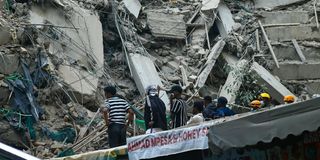
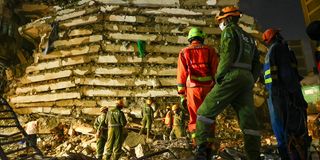
The site of a collapsed building in Eastleigh, Nairobi, on October 23, 2026.
“Construction must be carried out by registered contractors and supervised by competent professionals. Unqualified persons do not understand the process, procedures and standards of building construction,” the report states.
The report further identifies rampant use of substandard materials by developers due to a lack of quality control, noting that most building materials in the country are not subjected to any form of testing.
“Materials used for construction must be of a suitable nature and quality for the purpose used, adequately mixed and prepared, applied, used or appropriately fixed to sufficiently perform the designed functions,” reads the report.
The report proposes several reforms to tighten oversight of the construction process.
Among them, mandatory inspections at key stages of construction, such as excavation, structural framework, roofing and final inspection before occupancy, are needed to curb the rising number of building collapses.
“Inspections are necessary to verify that the construction aligns with approved plans and materials,” reads the report.
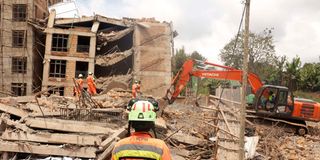
Emergency response workers at the scene where an 8-storey building that was under construction collapsed in Ole Nairi area of Oloolua, Kajiado County on May 10, 2026.
Members of the public are also encouraged to report any illegal construction, unsafe sites, environmental violations and other breaches.
There is also a need to improve building control processes across the country, from design and construction to completion.
“There is need for a one-stop center for all building control processes to ensure that not only the process is coordinated but also ensure efficiency and cost effectiveness on the part of the developers,” reads the report.
The report also recommends that automation of construction activities through the adoption of Building Information Modelling be entrenched in the construction process.
As in Malaysia, where professionals in the industry are given prominent roles in the construction process, the report says Kenya should adopt the same approach so that professionals are fully responsible for supervising buildings and providing feedback to the regulator.
Follow our WhatsApp channel for breaking news updates and more stories like this.